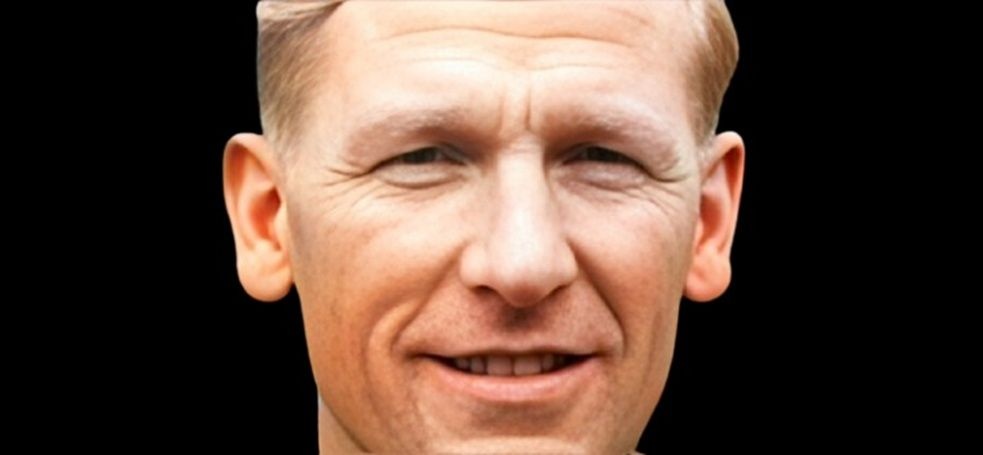
Bernhard Carl Trautmann, born 22 October, 1923, Bremen, Germany.
PART ONE
There is a moment in football that transcends the sport itself, a moment so extraordinary and so seeped in human drama that it belongs not merely to the record books but to something deeper, something that speaks to what people are capable of when the chips are down and the pain is almost too much to bear.
That moment happened on the afternoon of 5 May 1956, in front of 100,000 spectators at Wembley Stadium, when Manchester City goalkeeper Bert Trautman bravely dived at the feet of Birmingham City inside forward Peter Murphy and took a knee to the neck with such force that five vertebrae were dislocated and the second was cracked clean in two. And then he got up and played on.
Trautmann was brought up in Walle, a working-class district in west Bremen, the kind of place where men worked hard and got little in return and the smell of the docks followed you home every evening. His father grafted in a fertiliser factory down by the water, and the family lived modestly, as most families did in the bruised and broken Germany of the Weimar years, where economic catastrophe had hollowed out entire neighbourhoods and left a population angry, desperate and dangerously receptive to whoever promised them salvation.
By the early 1930s, the situation had become so dire that the Trautmanns were forced to sell their house and move to an apartment block in the nearby working-class area of Gröpelingen, where young Bernhard grew up alongside his brother Karl-Heinz, three years his junior, the two of them close in the way that brothers are when the world outside is uncertain and the family bond is all you have. Sport was Bernhard’s escape and his obsession, and he threw himself into football, handball and völkerball, a sort of dodgeball played with fierce enthusiasm, joining both the YMCA and a local football club called Blau und Weiss with a commitment that revealed even then the competitive fire burning inside him.
In August 1933, 10 years old and full of the restless energy of boyhood, he joined the Jungvolk, the junior section of the Hitler Youth, and nobody looking at that decision from the distance of history should be too quick to judge, because in the Germany of 1933, amid propaganda so total and so relentless that it had reshaped the air itself, a working-class boy joining a youth organisation that offered sport, comradeship and a sense of national purpose was doing what millions of other working-class boys were doing. The following year he won several local athletics events and was awarded a certificate for athletic excellence signed by Paul von Hindenburg himself, the President of Germany, and that small piece of paper must have meant the world to a boy from the docks.
When war came, Trautmann was 16 and working as an apprentice motor mechanic. In 1941 he joined the Luftwaffe as a radio operator, though his aptitude for radio work was, by all accounts, minimal, and he was soon transferred to Spandau to train as a Fallschirmjager, a paratrooper, which suited him considerably better. His first posting was to occupied Poland, where the war was at that stage largely a matter of enforced monotony for soldiers stationed far behind the front line, and Trautmann and his regiment passed the long empty days with sports and the sort of elaborate practical jokes that young men get up to when boredom becomes unbearable. One such joke, involving a car, went badly wrong and resulted in a staff sergeant suffering burns to his arms. The consequence for Trautmann was a court-martial and a three-month prison sentence, which he had barely started when acute appendicitis struck him down and sent him to a military hospital for the rest of his confinement.
By October 1941, he was back with the 35th Infantry Division at Dnepropetrovsk in Ukraine, where the German advance had ground to a halt in the face of the Russian winter and Soviet resistance. The work was dangerous and relentless: over-winter hit-and-run raids on Soviet supply routes, skirmishes in the frozen dark, the particular misery of the Eastern Front that broke so many men body and soul. Trautmann was promoted to Unteroffizier, the equivalent of corporal, and kept on fighting. By the time his unit was finally withdrawn from the Eastern Front, only 300 of the original 1,000 men who had gone out remained, and Trautmann had earned five medals for his conduct in those frozen fields, including an Iron Cross First Class, one of the most prestigious military decorations in the German armed forces.
Trautmann was promoted to Feldwebel, sergeant, and his shattered unit was amalgamated with the remnants of other decimated regiments and sent westward to France, to guard against the Allied invasion that everyone knew was coming. In 1945, he survived the Allied bombing of Kleve, one of only a handful to walk out of it, and decided then to head for Bremen, to home, to whatever was left.
But Germany was in its death throes by then, and soldiers without valid papers were being shot as deserters by their own side, so he moved carefully, trying to avoid everybody. A few days later he was captured in a barn by two Allied soldiers who quickly decided he had nothing useful to tell them and marched him out with his hands raised. Trautmann, convinced he was about to be shot in the back, ran for it, scrambled over a fence and landed directly at the feet of a British soldier. He had been captured twice before during the war, once by the Soviets and once by the French, and had escaped both times. This time, there was nowhere left to escape to.
After interrogation at a transit camp in Essex, Trautmann was classified a category “C” prisoner, meaning that the authorities regarded him as a convinced Nazi, which was perhaps understandable given the fact that he had been a decorated volunteer soldier. He was transferred first to Marbury Hall near Northwich in Cheshire, then, after being downgraded to the non-Nazi “B” status, to Fort Crosby near Liverpool, and finally to POW Camp 50 in Ashton-in-Makerfield in Lancashire, a small town sitting between St Helens and Wigan. He was one of only 90 men from his original regiment of 1,000 to have survived the entire war, a statistic that sits quietly in the back of the mind and refuses to leave.
It was at the camp in Ashton-in-Makerfield that football entered Trautmann´s life in its decisive form, though it did so almost by accident. Camp matches were a regular feature, and he generally played outfield, but in a game against the local amateur side Haydock Park he was injured while playing centre-half and swapped positions with the goalkeeper and from that unremarkable afternoon onward Trautmann was a goalie.
PART TWO
When the camp was about to close and repatriation was on offer, Trautmann turned it down. He had found something in Lancashire, a kind of peace or possibility that Germany in 1948 could not offer, and he chose to stay, working first on a farm in Milnthorpe and then on bomb disposal in Huyton, which given what the Luftwaffe had done to British cities was either a fine irony or a fitting act of atonement, depending on how you look at it.
In August 1948, he began playing amateur football for St Helens Town in the Liverpool County Combination, and it was through the club that he met Margaret Friar, the daughter of the club secretary, whom he would later marry. Over the course of that 1948-49 season, Trautmann’s reputation as a goalkeeper of genuine quality spread steadily through the local footballing world, and crowds began turning out specifically to watch him, including a record 9,000 for the final of the Mahon Cup, a local competition that drew a gate that would not have disgraced a Football League fixture. St Helens Town were promoted to Division Two of the Lancashire Combination League on the strength of that remarkable season, and Bert Trautmann was the reason why.
As the 1949-50 season began to take shape, Football League clubs were watching. Several made enquiries, but the first to move decisively was Manchester City, a First Division club of genuine stature and ambition, and on 7 October 1949 Trautmann signed for them as an amateur before turning professional shortly afterwards, becoming in doing so the first sportsman in Britain to wear Adidas boots, thanks to a friendship he had struck up with Adolf Dassler himself.
The reaction was immediate, furious and entirely predictable. The idea of a former German paratrooper, a man who had fought for Hitler’s regime, taking a place in an English football club tore open wounds that were barely four years old. Season ticket holders threatened a boycott. Protest letters poured into the club from Manchester and from around the country. 20,000 people attended a demonstration. The depth of feeling was real and entirely understandable: the war had ended only recently, the dead were still being mourned, and the sight of a German in an English football shirt was for many people an affront to everything that had been sacrificed.
The difficulty was compounded further by the particular history of the position Trautmann was taking. He was replacing Frank Swift, one of the greatest goalkeepers in Manchester City’s history and a man of enormous popularity, and the comparison would be brutal if Trautmann failed to deliver. The club captain Eric Westwood, a Normandy veteran who had more reason than most to resent a former enemy soldier walking into his dressing room, made the decision to go public with his acceptance, announcing simply: “There’s no war in this dressing room.” It was a gesture of remarkable grace, and it set a tone.
Before Trautmann’s first home match, Alexander Altmann, the community rabbi of Manchester, wrote an open letter to the Manchester Evening Chronicle asking City fans and Manchester’s Jewish community to give the young German a fair hearing, to judge him on what he did between the goalposts and not on what his country had done to theirs. It was an act of moral courage that said something profound about the capacity for decency even in the shadow of catastrophe.
Trautmann made his first-team debut on 19 November 1949 against Bolton Wanderers, and his performances gradually began to do the work that no words could do. The abuse at away grounds continued, and sometimes it cut deep enough to affect his concentration: in December 1949 at Derby County, he conceded seven goals in a performance that gave his critics ammunition. But the general trajectory was upward, and nowhere was this clearer than in January 1950 when City travelled to London to face Fulham.
That match was Trautmann’s first experience of London, and London was not ready to be kind. The damage wrought by Luftwaffe bombing was still visible all around the city, and the Craven Cottage crowd let the former paratrooper know exactly what they thought of him with the full force of their contempt. City were struggling in the league and expected to be hammered. Instead, Trautmann produced a display of such quality that the final score was a 1-0 defeat, flattering Fulham considerably, and at the final whistle both sets of players applauded him off the pitch. The crowd that had been booing him gave him a standing ovation. Something had shifted.
The Citizens were relegated that season, going down to Division Two, but they bounced straight back and in the years that followed Trautmann established himself as not merely the best goalkeeper at the club but one of the finest in England. Playing in all but five of his club’s next 250 league games, he was as reliable as the tide.
By 1952, his reputation had grown large enough that Schalke 04 in Germany came in with an offer of £1,000 for his services. City rejected it on the spot, saying they considered him worth twenty times that amount, and the exchange told you everything about how completely the picture had changed in three short years.
PART THREE
In the mid-1950s, Manchester City manager Les McDowall introduced a tactical innovation that would define the club’s approach for several seasons. Centred on Don Revie playing as a deep-lying centre-forward, the system became known as the Revie Plan and it required the entire team to adapt their roles and responsibilities.
For Trautmann, the key change was in how he distributed the ball after making a save. Where most goalkeepers of that era simply launched the ball as far downfield as they could and left it to chance, Trautmann, influenced by the Hungarian goalkeeper Gyula Grosics and what he had witnessed in Hungary’s astonishing 6-3 demolition of England in 1953, began throwing the ball accurately to the wing-halves, typically Ken Barnes or John McTavish, to initiate attacks with precision and purpose. It was a genuinely modern approach, ahead of its time and well-suited to the particular gifts that Trautmann brought to the position.
The Revie Plan carried Manchester City all the way to the FA Cup final of 1955, and with it came a piece of history: Trautmann became the first German ever to play in an FA Cup final. The opponents were Newcastle United, winners of the trophy in 1951 and 1952 and thoroughly experienced in the business of winning at Wembley. Nerves were evident in the City side from the first whistle, and within 45 seconds of the start, Jackie Milburn had put Newcastle ahead, a goal so quick it seemed to knock the stuffing out of City before they had drawn a proper breath. Things became worse still after 18 minutes when Jimmy Meadows was injured and had to leave the field, reducing City to ten men in an era when substitutes were not permitted.
Bobby Johnstone pulled one back before half-time and offered brief hope, but the ten men could not sustain the challenge, and after 57 minutes Bobby Mitchell found a way past Trautmann to make it 2-1 to the Magpies. A third goal followed and the match ended with a 3-1 triumph for Newcastle, leaving Trautmann with a runners-up medal and a lesson about the unforgiving nature of Wembley. However, a more glorious afternoon awaited him there. He just had to wait 12 months.
The 1955-56 season was among the finest Manchester City had produced in years, the team finishing fourth in the First Division while sweeping through the FA Cup, and Trautmann at the heart of it all was playing the best football of his life. The Football Writers’ Association confirmed as much in the spring of 1956 when they named him their Footballer of the Year, the first goalkeeper in history to receive the award, an honour that recognised not merely his technical excellence but the completeness of his achievement in becoming, over the course of seven years, a genuinely beloved figure in English football.
Two days after collecting the award, Trautmann walked out onto the Wembley turf for the FA Cup final against Birmingham City, and this time there were no nerves, no early defensive collapses, no sense of a team holding its breath and hoping. Manchester City were ready. Under the influence of Don Revie, who was outstanding throughout, they went into the lead through a Joe Hayes left-footed strike, and although Birmingham City equalised on 14 minutes the match remained a contest between equals until midway through the second half, when Jack Dyson and Bobby Johnstone scored two goals in rapid succession to give the Maine Road side a 3-1 lead with a quarter of an hour to play. But the Brummies came back hard and the Manchester City defence, under pressure now and conceding ground, needed their goalkeeper.
In the 75th minute, with the match still fifteen minutes from its conclusion and the outcome not yet certain, Peter Murphy ran onto a ball and Trautmann went down to collect it, diving forward with the total commitment of a man who knows no other way to play. Murphy’s knee connected with Trautmann’s neck. The collision was severe enough to knock Trautmann unconscious briefly, and when he rose to his feet the world around him was, by his own later account, something like a fog, shapes moving where they should not move and sound coming from a strange distance. There were no substitutes allowed, so he played on.
He played on for 15 minutes with five dislocated vertebrae and the second snapped in two, with the only thing preventing the fracture from killing him being that the third vertebra had wedged against the second and stopped it from moving far enough to sever the spinal cord. He played on and he made saves, including a crucial stop to deny Murphy a second time, and Manchester City held on for a 3-1 victory that sent their fans into raptures.
As Trautmann collected his winner’s medal, Prince Philip noticed that his neck was visibly crooked and commented on it. He attended the post-match banquet that evening unable to move his head, slept expecting the pain to ease, and when it did not, visited St George’s Hospital the following day, where a doctor told him he had a crick in his neck that would resolve itself. Three days after the final, a doctor at Manchester Royal Infirmary looked at the X-rays and saw the truth of it, and the truth was extraordinary: the neck was broken. Five vertebrae dislocated. The second cracked in two. He had played the most important club match of his career, and made the saves that won it, with a broken neck.
The story, when it emerged, spread around the world. Here was something that cinema could not improve upon, something that needed no embellishment because the facts themselves were almost beyond belief.
PART FOUR
The months that followed were difficult ones. Bert Trautmann’s convalescence kept him out for a large portion of the 1956-57 campaign, and when he finally returned it was with a caution and a lack of confidence that his supporters had never seen in him before.
Jack Savage deputised in his absence, and by the time Trautmann came back, first in reserve matches in December and then in the first team against Wolverhampton Wanderers on 15 December, he was not the same player he had been. He conceded three against Wolves and he struggled throughout the remainder of the season. The newspapers and some sections of the fan base, with the particular cruelty of the sporting press in any era, began suggesting it was time for him to retire, and others took the opposing view and argued that the club had pushed him back too soon after an injury that ought to have ended any normal career.
The 1957-58 season brought fresh humiliations, of a sort that had nothing to do with Trautmann specifically but in which he was inevitably caught. Manchester City became the only team in English football history to both score and concede 100 goals in a single season, a record of almost comedic symmetry. Trautmann played 34 matches and kept only two clean sheets. He did not play in the 9-2 defeat to West Bromwich Albion at The Hawthorns, but he was in goal for the 8-4 loss against Leicester City at Filbert Street, which stood as the most goals he ever conceded in a single match across his entire time at the club. The defence in front of him was at times non-existent, and a goalkeeper, no matter how gifted, is only as good as the organisation behind him allows him to be. But Trautmann was made of durable material, and he found his way back.
Over the remaining years of his Manchester City career he re-established himself, reclaimed his form and his confidence, and continued adding to an appearance record that would ultimately stand at 545 matches across fifteen years, a figure that places him among the most loyal servants this or any club has known.
On 15 April 1964, Trautmann played his last game for Manchester City in a testimonial that drew an official crowd of 47,000, though estimates placed the real figure closer to 60,000, because people wanted to be there, wanted to bear witness to the end of something that had meant a great deal to a great many of them. He captained a combined Manchester City and Manchester United XI that included Bobby Charlton and Denis Law against an International XI featuring Tom Finney, Stanley Matthews and Jimmy Armfield, and the occasion had the character of a celebration and a farewell rolled into one, as such occasions always do when the man at the centre of them has earned genuine love rather than merely respect.
He signed for Wellington Town in September 1964, attracted by the offer of £50 per match and perhaps by the simple difficulty of stopping, because men who have played at the highest level for fifteen years do not easily walk away from the thing that has defined them. His debut at Hereford United showed he could still draw a crowd, but a sending-off at Tonbridge for violent conduct in his second match, and five losses in seven games overall, suggested that the time had come. He walked away from playing football with his dignity largely intact and his reputation entirely so.
The question of international football was one that had hung over him throughout his career, a peculiar absence at the heart of an otherwise complete story. Trautmann met the German national coach Sepp Herberger in 1953, and was told plainly that political and logistical realities made it impossible to select a player based in England, that the national team needed players who were accessible and available, and that unless Trautmann was prepared to return to Germany and play in the German league, a cap was simply not on the table. He stayed in England, and as a consequence he watched from a distance in 1954 as West Germany lifted the World Cup in the Miracle of Bern, knowing he might have been part of it.
His only experience of representative football came in 1960 when, in a remarkable late acknowledgement of his quality, the Football League selected him for their representative team, the first time non-English players had been included. He captained the League against the Irish League and played against the Italian League, two appearances that were wholly inadequate recognition of 15 years of excellence but better than nothing.
After retirement from playing, Trautmann spent two months considering what came next and then received a call from Stockport County chairman Victor Bernard, who offered him the role of general manager. Stockport were a struggling lower-league club with limited resources and even more limited ambitions, and Trautmann tried to bring some imagination to the problem, persuading Bernard to move matches to Friday evenings so they would not be competing directly with either of the two Manchester giants. Revenue improved, but results did not, particularly, and a disagreement with Bernard in 1966 ended the experiment. From 1967 to 1968 he managed Prussia Munster in Germany, guiding them to a 13th-place finish in the Regionalliga West before a rather brief spell at SC Opel Russelsheim.
Then came the work that may, in the long view of history, matter as much as anything he did on a football pitch. The German Football Association sent Trautmann to countries that had little or no football infrastructure, and over the years that followed he served as a development coach and national team manager in Burma, Tanzania, Liberia, Pakistan and North Yemen, training coaches, building structures, earning a UEFA coaching licence and qualifying Burma for the 1972 Olympics while winning the Southeast Asian President’s Cup in the same year. The work was unglamorous and far from the headlines, conducted in difficult conditions in parts of the world where football was still finding its feet, but it was consequential, and it carried the spirit of the man who had found his own second chance in Lancashire and wanted others to have their chances too.
He settled in Spain after retiring from coaching, living near Valencia with his third wife Marlis, and the honours began arriving. In 1997 he received the Order of Merit of the Federal Republic of Germany. In 2004 he was appointed an honorary Officer of the Order of the British Empire, collecting the award at the British Embassy in Berlin and then attending a concert by the Berlin Philharmonic the following evening, where he encountered the Queen. In 2005 he was inducted into the National Football Museum’s Hall of Fame. He continued to follow Manchester City and visited Manchester to watch them play, his last visit coming in April 2010.
Behind the public story of redemption and excellence, there was private grief of a kind that no FA Cup winner’s medal can address. Trautmann married Margaret Friar in 1950, the woman he had met through St Helens Town, and they had three children. A few months after the 1956 final, their firstborn son John, five years old, was killed in a car accident, and the weight of that loss fell on the family in ways that time proved unable to lift. Trautmann would say years later that it was his wife’s struggle to come to terms with the death of their child that ultimately tore the marriage apart. They divorced in 1972.
He also had a daughter from a previous relationship from whom he was estranged for many years, reconnecting with her only in 1990 and with her mother, Marion Greenhall, in 2001. A second marriage, to Ursula von der Heyde while he was working in Burma in the 1970s, ended in divorce in 1982. From 1990 until the end of his life he was with Marlis, his third wife, on the Spanish coast, and the bungalow near Valencia where they lived was far from the roaring Wembley crowds and the frozen Eastern Front and the POW camp in Lancashire, but the distance was not merely geographical. He had travelled a long way to get there, in every sense of the word.
He made 545 appearances for Manchester City. He won the FWA Footballer of the Year award. He played in two consecutive FA Cup finals and won one of them. He played 15 minutes of that final with a broken neck and made the saves that secured the trophy. He trained coaches in Burma and Tanzania and Pakistan and Yemen and left football behind him in every country he visited.
Trautmann was complex, imperfect, short-tempered and occasionally sent off, and he was also, by the overwhelming consensus of those who played against him and alongside him and watched him, one of the greatest goalkeepers the game has ever produced.