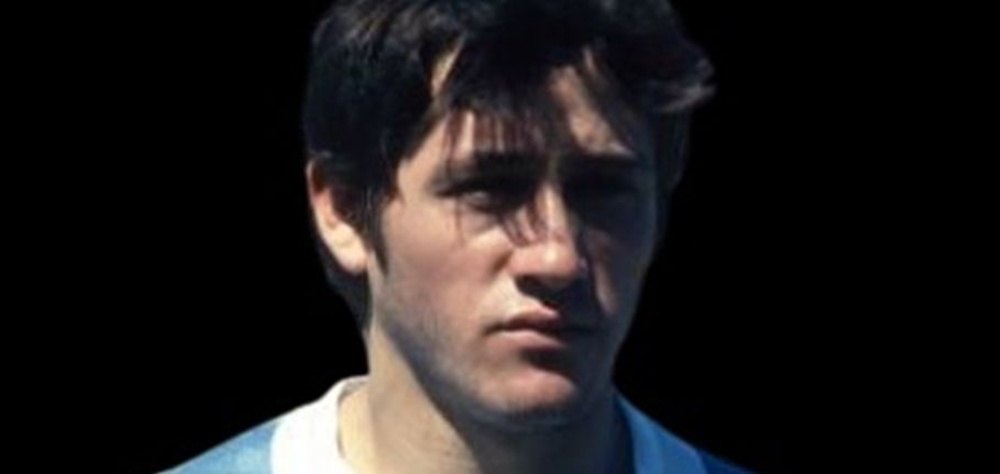
Juan Alberto Barbas, born 23 August 1959, San Martín, Argentina.
PART ONE
Juan Barbas debuted for Racing Club in 1977, and his initial deployment was at right back, then left back, positional assignments that might seem at odds with his natural instincts as an attacking player but that reflected the pragmatic approach of Argentine football management at the time, using versatile players wherever the team needed them most. It was under coach Omar Sívori — the legendary former Juventus and Argentina forward, a man who had himself been one of the most gifted players of his generation — that Barbas finally settled into the central midfield role that would define the rest of his professional life.
Sívori recognised in Barbas the qualities he valued most: technical precision with both feet, the ability to read the game a beat ahead of opponents, a defensive awareness that balanced out the creative instincts, and a temperament that remained steady under pressure. Over his four seasons with Racing Club, from 1977 to 1981, Barbas accumulated 132 appearances and scored 14 goals — numbers that speak of a consistent, reliable contributor rather than a flashy headline-grabber, which was precisely the kind of player Racing needed in that midfield engine room.
The 1981 Copa Libertadores represented the highest-profile stage of his time at Racing, and Barbas rose to it. He featured in all six of the club’s group stage matches in South America’s premier club competition, helping Racing advance in the continental tournament and demonstrating that his game translated to the elevated intensity of knockout football on a continental scale. These were matches played in front of passionate crowds, against opponents from across South America, with the unique pressures that come with representing your club on the biggest stage available, and Barbas handled them with the same measured authority that had made him indispensable in domestic competition.
The Avellaneda derby against Independiente provided another measure of his character, because those matches — fierce, intense, saturated with local pride — are the ones that reveal whether a player genuinely belongs at a big Argentine club or is merely passing through. In 1979, he was part of Racing sides that contested these derbies with real vigour, matches that drew the attention of the wider footballing public and placed individual performances under the sharpest scrutiny. Barbas passed those examinations, and by the time he departed Racing for Spain at the end of 1981, he left as a player with genuine international credentials, a Copa Libertadores pedigree, and a reputation that had crossed the Atlantic before he did.
Real Zaragoza in 1982 was a club of solid mid-table respectability in La Liga, not a glamour institution but a professionally run organisation that knew how to use intelligent transfer activity to punch above its weight. The signing of Juan Barbas from Racing Club fitted that model perfectly: a technically accomplished Argentine midfielder in his early twenties, tested in continental competition, available at a price that reflected the realities of the South American transfer market at the time rather than the player’s actual quality.
Adapting to European football is never straightforward, and Barbas encountered the usual range of adjustments that Argentine players of his era faced when crossing to Spain: the different tactical rhythms of La Liga, the physical demands of the European game, the cultural differences that extend beyond the football pitch and into daily life in a new country. Nevertheless, Barbas´ technical qualities proved genuinely suited to Spanish football, and within his first season at Real Zaragoza he was performing at a level that drew attention from beyond the club’s own fanbase.
The statistics from his three seasons in Zaragoza tell a straightforward story of steady, significant contribution. Barbas notched up 92 appearances in La Liga and scored 16 goals — a respectable return for a central midfielder, particularly in a team that finished sixth, seventh, and tenth across those three seasons, consistent without being spectacular. But it was the individual recognition that underlined just how well he had performed, because in both the 1982–83 and 1983–84 seasons, the prestigious Spanish magazine Don Balón voted Barbas the La Liga Foreign Player of the Year. Back-to-back awards in the top division of Spanish football, competing against some of the best international talent in Europe at the time, these were not consolation prizes or minor acknowledgements but genuine statements of quality from the people who watched the Spanish game most closely and critically.
In 1982–83, he scored four league goals as Zaragoza finished sixth with 40 points from 34 matches, a solid campaign in which Barbas provided both the creativity and the tactical balance that allowed the team to compete effectively at the top half of the table. The following season brought seven league goals — his best return at the club — as Zaragoza finished seventh with 35 points, and it was this campaign in particular that produced the performances which made neutrals and Spanish football observers take notice of him as one of the more accomplished foreign midfielders operating in the division. In 1984–85, the goals dried up somewhat and Zaragoza slipped to tenth, and Barbas, now 25 and at the peak of his career, made the decision that would define the next chapter of his professional life: he accepted an offer from Lecce and headed for Serie A.
PART TWO
There is something particular about Lecce as a football club, a modest institution from the heel of the Italian boot, a city more famous for its baroque architecture and warm Adriatic winters than for its footballing pedigree. Juan Barbas arrived at Lecce in the summer of 1985 alongside Pedro Pablo Pasculli, his fellow Argentine international and a forward of real quality, and the two South Americans formed the core of a side preparing for its inaugural season in Serie A with a mixture of ambition and realistic uncertainty about how they would cope with Italian football’s top division.
The 1985–86 season, Lecce’s first in Serie A, was brutal in the specific way that promotion-and-survival campaigns often are: flashes of quality, moments of genuine promise, and ultimately insufficient consistency to stay up. Barbas scored four goals in 24 appearances, including notable strikes against Udinese and Roma, but the team finished 16th and were relegated back to Serie B, the harsh arithmetic of Italian football having made its judgement. Another manager might have cleared out the squad and started again, but Barbas stayed, and that decision says something important about his character and his belief in what Lecce could become.
Through the Serie B campaign that followed, he remained a central figure, and his contributions to Lecce’s resurgence during that period were substantial and practical rather than decorative. By the 1987–88 season in Serie B, the Argentinian was integral to a side that finished second in the division with 49 points, earning promotion back to Serie A through a playoff victory over Brescia — a genuine achievement for a club of Lecce’s resources, and one that required an experienced and technically sound midfielder like Barbas.
The 1988–89 Serie A campaign produced what many consider the high point of Lecce’s history in that era. Under coach Carlo Mazzone, a man renowned for developing clubs beyond their natural ceiling, the team achieved a ninth-place finish — their best ever in the top flight — and Barbas contributed three goals in 33 appearances, the kind of season-long reliability that wins you respect in a dressing room even if it doesn’t generate headlines in the national press. He was the midfielder who kept things ticking, who provided the passing precision to link defence and attack, who took the set-pieces and generally held things together when the pressure was on.
The following season, 1989–90, brought four goals in 26 appearances, and one of those goals demands particular attention because it is the kind of strike that stays in the memory of everyone who saw it. On 7 January 1990, against Genoa, Barbas struck a free-kick from approximately 40 metres that bent, dipped, and flew into the net to give Lecce a 2–1 victory — a piece of technique that encapsulated everything that had made him such a distinctive presence in Italian football for five years. He was known as a free-kick specialist, renowned for bending shots with power and spin, but this particular effort transcended the category of set-piece expertise and entered the territory of genuine football artistry.
His five seasons at Lecce produced 149 league appearances and 27 goals across Serie A and Serie B, figures that understate the full extent of his contribution but at least provide a numerical framework for appreciating how much he gave the club. The 1989–90 season ended with Lecce finishing 14th and suffering relegation, and the arrival of Zbigniew Boniek as incoming coach signalled that the club was moving in a new direction. Barbas, now 30 years old, recognised the moment and departed for the next stage of his professional life with the knowledge that he had helped establish Lecce as a viable Serie A club during one of the most competitive periods in Italian football history.
The move to FC Locarno in Switzerland’s Nationalliga B for the 1990–91 season was not a glamorous one by conventional measures, but Barbas approached it with the same professionalism he had brought to every previous challenge, contributing five goals in 10 appearances in the promotion/relegation playoff round and demonstrating that his technical abilities remained intact even as he moved into his early thirties. Switzerland offered a different kind of football environment — less pressurised than Italy, more measured in its rhythms — and for a player of Barbas’s experience and quality, it provided a useful bridge between the intensity of Serie A and whatever came next.
In October 1991, he made the step up to FC Sion in the Nationalliga A, Switzerland’s top division, and despite making 18 appearances across the league campaign and the Swiss Cup without finding the net, his contribution was part of a Sion side that won the league title that season — a champions’ medal to add to a collection of experiences that already spanned three continents and several of Europe’s major leagues. It was a different kind of contribution to the ones he had made at his peak, but a contribution and a championship nonetheless.
He returned to Locarno for 1992–93, again featuring in the promotion/relegation playoffs with another five goals in 10 appearances, the consistency of his goal return suggesting that whatever physical diminishment naturally accompanies a footballer’s early thirties had not significantly affected his technical instincts or his ability to produce at important moments. By this stage, though, the horizon of his professional life was coming into view, and the decision to return to Argentina for the 1993 Apertura with Club Atlético Huracán — nine league matches, no goals, a midseason departure — reflected a player testing the waters of a homecoming rather than committing fully to one final chapter on Argentine soil.
A brief spell at Alvarado de Mar del Plata in the second division followed, and then, most significantly, the years at All Boys in the Primera B Nacional from 1994 to 1997, where he played out the final stages of a professional life that had begun nearly two decades earlier in Avellaneda. He retired in July 1997 at the age of 37, having played professional football in Argentina, Spain, Italy, and Switzerland across a span of twenty years, and having accumulated enough experiences, achievements, and memories to fill several careers rather than one.
PART THREE
Before any of the European years, before La Liga and Serie A and the Swiss Nationalliga, there was Japan in 1979 and one of the most remarkable tournaments in the history of Argentine youth football. The FIFA World Youth Championship — now known as the Under-20 World Cup — was held in Japan that year, and César Luis Menotti, who had already led the senior Argentina squad to World Cup glory in Buenos Aires the previous year, assembled a squad of extraordinary young talent to contest it. Diego Maradona, Ramón Díaz, Osvaldo Rinaldi, and Gabriel Calderón were all in that squad — these were players of genuine world-class quality, several of them on the verge of or already touching senior international football, and they swept through that tournament with a devastating combination of technical excellence and collective organisation.
Barbas was part of it, accumulating six caps at under-20 level and contributing to a campaign in which Argentina averaged over three goals per match while conceding barely half a goal per game — statistics that speak of total dominance of a tournament at the highest youth level. The final, against the Soviet Union, finished 3–1 in the favour of Argentina, a comprehensive victory that earned the country its first world title at that age group and sent the young players involved into their senior careers with a confidence born of genuine achievement rather than mere potential.
For Barbas specifically, the tournament served a dual purpose: it confirmed his quality at international level and it raised his profile in the eyes of senior national team management, which would lead directly to his debut for the full Argentina side in April of that same year. The connection between that youth triumph and his subsequent senior international opportunities was direct and logical, and it is worth noting that he achieved it in the company of Maradona — football’s most celebrated name of the era — without being overshadowed to the point of invisibility, which is itself something of an achievement.
The Argentina senior national team of the late 1970s and early 1980s was not short of midfield talent, which makes Barbas’s accumulation of 32 caps between 1979 and 1985 a genuine indicator of quality rather than an accident of selection. He debuted on 25 April 1979 in a 2–1 friendly triumph over Bulgaria, and from that first appearance under César Luis Menotti, he established himself as a reliable option in the engine room — not the most spectacular name on the team-sheet, but one whose technical and tactical qualities gave the manager genuine confidence in his ability to perform.
The 1979 Copa América provided his first experience of competitive international football at senior level, and he made two appearances in the group stage, playing 135 minutes across matches against Brazil and Bolivia as Argentina advanced from Group B before exiting in the semifinals. These were not peripheral cameos but real participation in one of South America’s most demanding competitions, against opponents of genuine quality, and Barbas acquitted himself well enough to remain in contention for further selection under Menotti.
The 1982 FIFA World Cup in Spain was the peak of his international involvement, a tournament that placed Argentina — reigning world champions, led by the increasingly dominant Maradona — in the global spotlight as one of the favourites for the title. Barbas appeared in two group stage games: a substitute role against Hungary in which he played 39 minutes, and a full 90 minutes in the second round against Brazil, the most important match of Argentina’s campaign and one that ultimately ended in a bitter and frustrating 3–1 defeat that sent Argentina home earlier than anyone expected. He played that Brazil match in its entirety, which tells you something about how Menotti viewed his reliability in high-stakes situations, and the fact that Argentina’s exit came despite having Maradona, Barbas, Kempes, and several other genuinely excellent players only underlines the brutal unpredictability of tournament football.
Under Carlos Bilardo, who took over from Menotti in 1983 and began the process of reshaping Argentina into the more pragmatic, defensively organised side that would win the 1986 World Cup, Barbas continued to receive call-ups and featured in four 1985 World Cup qualifiers against Colombia and Peru. His final two caps came in November friendlies against Mexico, and after 1985, his availability for the national team became increasingly constrained by the demands of his club commitments with Lecce in Italy — a practical reality rather than a falling out of favour, the kind of logistical difficulty that affected many South American players based in Europe during a period when international travel was considerably more demanding than it became in later decades.
32 caps for Argentina represents a genuine international career, not a token one. He played in a World Cup, a Copa América, and a youth World Cup that he won. Barbas represented his country alongside Maradona and under two of Argentina’s most important coaches of the twentieth century. And he did it while simultaneously building a club career that took him from Avellaneda to Zaragoza to Lecce to Switzerland and back again, the full breadth of a professional life lived with purpose and consistent quality.