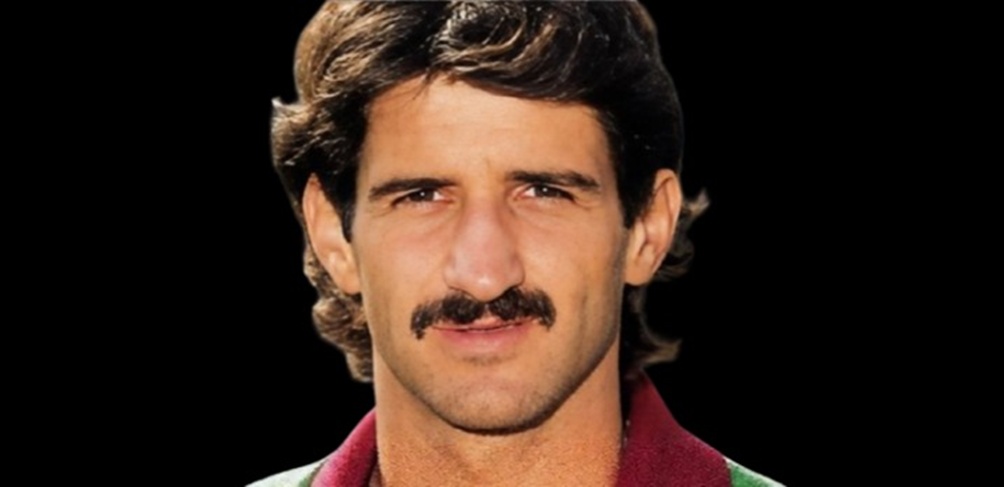
Giuliano Terraneo, born 16 October, 1953, Briosco, Italy.
PART ONE
Giuliano Terraneo took his first professional steps at Seregno, a small club from the town of the same name near Monza, in the 1972–73 season, before the bigger local club — AC Monza, with their distinctive white-and-red stripes — came calling and brought him into their youth system. By the 1973–74 season he was part of Monza’s senior setup, learning his trade in Serie C, the third tier of Italian football, where the pitches could be unforgiving, the crowds partisan and noisy, and the margin for error brutally thin.
Those early seasons at Monza shaped everything that came afterwards. He did not arrive as a finished product, polished and ready for the big stage, but rather as a young man with raw talent and an enormous capacity to absorb lessons, and Monza gave him plenty of lessons to absorb. In the 1974–75 campaign he helped the club win the Serie C Coppa Italia, which was a genuine achievement for a side of their stature and gave Terraneo his first taste of silverware, however modest the competition may have seemed to the rest of the football world. It mattered at Monza. It mattered to Terraneo.
The following season, 1975–76, was the one that announced him properly. He played in 21 league matches as Monza powered through their Serie C group and clinched promotion to Serie B five rounds before the end of the campaign, which suggested not merely competence but something approaching dominance. And on 19 June 1976, to round off what had already been a remarkable season, Monza won the Anglo-Italian Cup, beating the English non-league side Wimbledon 1–0 in the final — a result that few people outside Monza and Wimbledon now remember but which captured, in its small way, the upward trajectory of both the club and their goalkeeper. Wimbledon, of course, would go on to their own extraordinary story, but in the summer of 1976 they were simply the side Terraneo and his teammates had beaten, and Terraneo was simply a young goalkeeper on the rise.
The 1976–77 campaign in Serie B was Terraneo’s true audition for the higher stages. He made his Serie B debut on 26 September 1976 in a 2–0 home win against Novara and established himself as the club’s first-choice keeper across the campaign, standing behind a defence that conceded just six goals at home all season and remained unbeaten at their own ground, winning 15 and drawing 4. Over those four seasons with Monza, across Serie C and Serie B, he accumulated 61 appearances, kept 33 clean sheets and conceded just 37 goals — numbers that tell a story of a goalkeeper who was not merely keeping his team in games but actively winning them. Inevitably, the bigger clubs began to take notice.
In the summer of 1977, Torino came for Terraneo, and his life changed completely. Torino — the granata, the dark-red shirts of the working-class half of Turin — were a club with enormous history and even more enormous pride, the club of the legendary Grande Torino side that had perished in the Superga air disaster of 1949 and whose ghost still haunted the city like a beautiful, melancholy song. They had recently won the Serie A title in the 1975–76 season under the meticulous Luigi Radice, and while that championship now belonged to the record books rather than the present, they remained an ambitious, well-organised club who expected their goalkeeper to be unflappable under pressure. Terraneo, it would turn out, was exactly what they needed.
He did not walk straight into the first team. The man he was replacing, or rather succeeding, was Luciano Castellini — nicknamed Il Giaguaro, the Jaguar — one of the finest Italian goalkeepers of his generation, who had been the last line of that championship-winning defence and whose boots were not so much large as monumental. Terraneo sat patiently as Castellini’s deputy through the early months of the 1977–78 season, watching and waiting, until 11 December 1977 arrived with a fixture that could not have been more daunting for a young goalkeeper making his Serie A debut: the Derby della Mole against Juventus, the bitter, ferocious, cross-city rivalry that divided Turin more thoroughly than any river or road ever could. The match ended 0–0, and Terraneo kept a clean sheet. You could not have written a better start had you tried.
That blank scoresheet told its own story: here was a goalkeeper who could handle the biggest occasion without flinching, who could look across the penalty area at the white shirts of Juventus — Roberto Bettega, Marco Tardelli, the lot of them — and feel not terror but concentration. The result was not only a point for Torino in a fiercely competitive title race but a statement of intent from their new number one. Torino that season finished third in Serie A, just behind Juventus and Vicenza, and Terraneo had played a significant part in that achievement. By the following campaign, 1978–79, he was the undisputed first-choice goalkeeper, appearing in 29 of the 30 league matches and conceding just 23 goals as Torino finished fifth.
PART TWO
Building upon those performances, the early 1980s brought the most dramatic chapter of Terraneo’s time in Turin. Three consecutive Coppa Italia finals, each one a wrenching near-miss, came to define his Torino years with a painful kind of distinction. In May 1980, Torino faced Roma in the final at the Stadio Olimpico, and the match finished goalless after extra time before Roma won 3–2 on penalties — Terraneo had done enough to take his team to penalties but not quite enough, on the night, to bring them over the line. The following year, in June 1981, Roma were again the opponents, and again the final was decided by a shoot-out, Roma prevailing 4–2 after the two legs had ended 2–2 on aggregate. Then, in May 1982, Internazionale beat Torino 2–1 on aggregate in the final, winning the first leg 1–0 at San Siro before Torino salvaged a 1–1 draw in the second leg at home — but it was not enough, and the cup went to the Black and Blues.
Three finals. Three defeats. Any goalkeeper might have been broken by such a sequence, but Terraneo was not built that way. He kept playing, kept organising, kept reading the game with that patient, almost literary attention to detail that had given him his nickname, and kept conceding an average of under one goal per league match across his entire Torino tenure. Over seven seasons and 193 Serie A appearances, he conceded 164 goals and kept 83 clean sheets — remarkable figures for a side that, for all its quality, was perpetually living in the shadow of a Juventus team that won the scudetto year after year with what seemed like effortless authority.
Among the matches that stood out in his Torino years was a Derby della Mole from the early 1980s in which the young Michel Platini — by then established as Juventus’s creative genius and one of the best players in Europe — made his debut in the fixture. Platini’s Juventus created chances and pressed relentlessly, but Terraneo made a crucial save from Marco Tardelli that kept Torino in the game, only for the ball to rebound and fall to Platini, who converted with the composure of a man born to score in derbies. Even in defeat, Terraneo’s contribution had been immense and was noted by everyone who watched. The granata fans, passionate and demanding as they were, loved him for it.
During the summer of 1984, Terraneo moved on to AC Milan and found himself in the middle of one of the most dramatic transformations in European football history, even if he could not have known it at the time. Milan had just been promoted back to Serie A after a season in Serie B and president Giuseppe Farina was rebuilding with considerable ambition, bringing back the tactically astute Nils Liedholm as manager and assembling a squad that included the elegant English midfielder Ray Wilkins, the thunderously powerful striker Mark Hateley and the cultured Roman schemer Agostino Di Bartolomei, alongside homegrown talents like the young Franco Baresi, who was still developing into the defensive colossus he would eventually become.
Terraneo was signed to provide experience and solidity, and he delivered precisely that. In the 1984–85 season he made 30 Serie A appearances, conceded 25 goals and kept 12 clean sheets as Milan finished sixth — a respectable return for a side in their first season back in the top flight. And on 28 October 1984, in the Derby della Madonnina against Inter at San Siro, Terraneo’s goalkeeping helped secure a 2–1 win for Milan, which gave the whole club a lift and established a sense that the Rossoneri were back as a serious force. There was also, in that period, the 1985 Coppa Italia final against Sampdoria — a two-legged affair that Terraneo experienced as part of a Milan squad that fell short of the trophy but demonstrated, at least, that they could compete at the highest level of domestic cup football.
During his second season in Milan, however, the club changed ownership, and everything shifted. Silvio Berlusconi arrived in the spring of 1986 with vast wealth, vast ambition and a very clear idea of what kind of football club he wanted Milan to be: the greatest club in the world. He began the process of assembling what would become, under Arrigo Sacchi, one of the most dominant sides in European football history, but in the short term the arrival of Berlusconi meant that experienced players from the previous era — men whose time had been and gone, however gracefully — were moved on. Terraneo was one of them. In January 1986, he was transferred to SS Lazio and entered the most turbulent and emotionally charged phase of his career.
PART THREE
If Terraneo’s Milan years were defined by steady professionalism in a club in transition, his time at Lazio was something altogether more raw and visceral. He arrived in January 1986 to find the club battling a nine-point penalty imposed by the football authorities for financial irregularities — a sanction so severe that relegation to Serie C1 was not merely possible but genuinely likely. Lazio were in Serie B, and they were in real danger of dropping out of it, which would have been a catastrophe for a club of their size and tradition.
Terraneo was 32 years old, and he brought with him the kind of calm authority that a club teetering on the edge of an abyss desperately needed. Over a season and a half he made 45 outings for the club, organising the defence, commanding the penalty box and imposing a kind of structural solidity on a group of players who might otherwise have been overwhelmed by the pressure of the situation. The tension built all season and reached its peak on the final day of the regular campaign, when Lazio faced Vicenza needing a win to avoid dropping straight into the relegation playoffs. The match was won 1–0, and Terraneo wept on the pitch as the final whistle went and the crowd poured onto the turf — because this was not just a footballer keeping a clean sheet, it was a man who had invested his whole professional self in a club’s survival and felt every ounce of that weight lift at once. Lazio ultimately survived the playoffs as well, though Terraneo did not stay to fight for promotion. In January 1987, he moved south to join Lecce in Serie B, and the final chapter of his playing days began.
There is something fitting about a footballer of Terraneo’s character spending his final years in Lecce, a baroque city of golden stone at the heel of the Italian boot, warm and unhurried and fiercely proud of its own traditions. Lecce were a club punching above their weight in the Italian football pyramid, a tight-knit southern outfit with limited resources but tremendous spirit, and they were in Series B when Terraneo arrived, pushing hard for promotion to the top flight.
He helped them get there. In the 1987–88 season, Lecce won promotion to Serie A, and Terraneo was in goal for the decisive matches, bringing the experience and leadership of a man who had played over 300 top-flight games and seen virtually everything that Italian football could throw at a goalkeeper. Then, over the next two seasons in Serie A, he helped Lecce survive — firstly in a dramatic last-day escape in 1988–89, and then in the 1989–90 campaign in which the Salentini finished a respectable 12th place and were never seriously threatened by relegation. By now Terraneo was deep into his mid-30s and had evolved from first-choice keeper into something equally valuable: a veteran mentor, a man who shared goalkeeping duties with younger colleagues and guided them with a word here, a repositioning there, the kind of wisdom that cannot be coached but only earned.
His final professional match was played on 29 April 1990 at the Stadio Via del Mare in Lecce, in a 2–3 home defeat to Juventus in the last round of the season. He was 36 years old. He had started his career trying to keep the ball out of his net against provincial sides in Serie C, and he ended it with Juventus — Schillaci, De Agostini, Zavarese — putting three past him in his last ever game. There is a kind of completeness to that, a pleasing circularity, as if the game itself wanted to remind him that it was still bigger than any individual even at the very end. And then on 1 July 1990 he retired, and sixteen years of professional football were over.
PART FOUR
To understand what made Terraneo special, you have to understand what he was not. He was not Dino Zoff — authoritative, commanding, a player who seemed to turn the goalmouth into his personal domain and who won World Cups with the quiet confidence of a man who has never seriously doubted himself. He was not Ivano Bordon, explosive and athletic, a goalkeeper whose reflexes seemed almost supernatural. Terraneo was something different: a thinker, a reader of the game, a man who positioned himself so intelligently that he often did not need to make the dramatic save because he had already worked out where the ball was going before the striker had decided where to put it.
His shot-stopping was reliable rather than flashy, and his distribution was precise — long throws that turned defence into attack in an instant, goal kicks that found teammates rather than merely clearing the danger. He was, at 1.82 metres, not the tallest goalkeeper of his era, but he compensated for any aerial limitations with excellent positioning and an ability to command his penalty area through organisation and communication rather than pure physical dominance. The defenders in front of him — men like Eraldo Peja and Roberto Salvadori at Torino, the young Franco Baresi at Milan — trusted him completely, because he gave them reason to.
He had his quirks, naturally enough. The most famous was his habit of removing his goalkeeping gloves before facing a penalty, preferring the direct feel of his bare hands on the ball when the moment of maximum pressure arrived. Whether this actually helped his saving percentage is a matter of some debate, but as a psychological signal it was a masterstroke, the kind of small theatrical gesture that a poet would devise and a goalkeeper would carry out. It was, in its small way, entirely characteristic of the man.
Terraneo retired in 1990 and did not rest for long. Armed with a degree of intelligence about the game that few purely instinctive players ever acquire, he immediately began constructing a second career in football administration, returning first to Monza — the club that had given him his start — as general director in the early 1990s. There he oversaw two promotions to Serie B and, more significantly, began launching the careers of players who would go on to become some of the most celebrated in Italian football: Roberto Baggio, Antonio Asia, Aldo Serena, Christian Abbiati. Finding and developing talent was, it turned out, something he was extraordinarily good at, and his reputation grew accordingly.
He gained formal qualifications to match his practical experience, completing a Masters as General and Sporting Director at the Italian Football Federation’s legendary academy at Coverciano, and moved on to Como before being appointed sporting director of SS Lazio in August 1998 — the same club he had helped save from Serie C twelve years earlier and which was now, under the ownership of Sergio Cragnotti, one of the most ambitious sides in Europe. His tenure, from August 1998 to June 1999, contributed to the foundations of the club’s squad building that would deliver the Serie A title in 1999–2000, along with European silverware in the form of the Cup Winners’ Cup and the Super Cup.
In 1999, Inter Milan came calling. Terraneo joined as sporting director and served in that role until 2003, during which time he was responsible for some of the most eye-catching transfer business in European football. The acquisition of Clarence Seedorf from Real Madrid in 1999 brought one of the most technically gifted midfielders of his generation to the San Siro, and the signing of Fabio Cannavaro from Parma in 2002 added a defensive colossus who would go on to captain Italy to World Cup glory in 2006. These were not lucky signings or accidental discoveries — they were the result of careful, systematic talent identification by a man who had spent his entire career studying the game from the inside out.
Later still, in May 2015, Giuliano Terraneo was appointed sporting director at Fenerbahçe in Turkey, where he oversaw the arrivals of Nani from Manchester United and Robin van Persie, also from Old Trafford, as the club sought to strengthen for domestic and European competition. He held the role until March 2016 before moving on, and in April 2018 took on a brief consultancy role at West Bromwich Albion in the English Premier League, assisting with recruitment planning and squad review. Through all of this, he continued to operate his own consultancy company, GT Sport Consulting SA, founded in 2013, through which he advised clubs on player acquisition and strategic development.