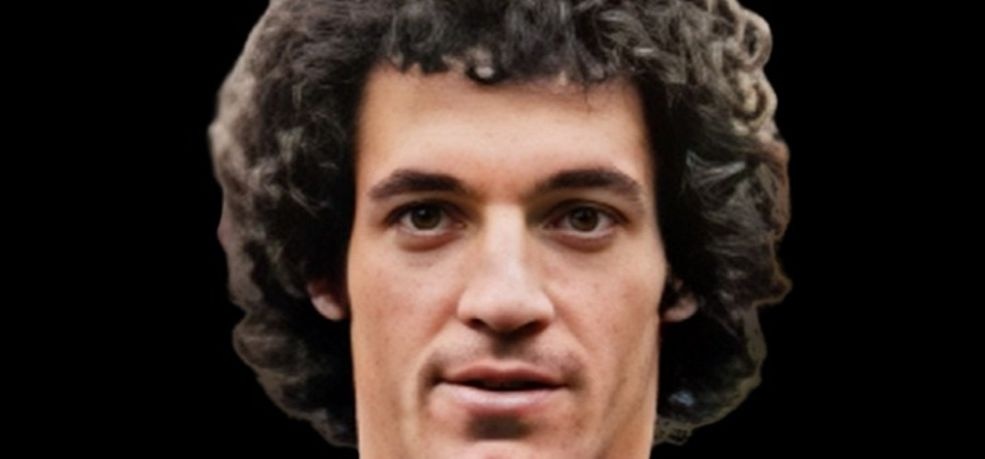
Abel Carlos da Silva Braga, born 1 September 1952, Rio de Janeiro, Brazil.
PART ONE
Abel began at Fluminense, Rio de Janeiro’s grand old club of the Laranjeiras neighbourhood, where he joined the youth ranks in 1968 as a gangly sixteen-year-old defender with good positional sense and a competitive streak that his coaches quickly noticed. Those early years were quietly formative, the kind that form a player’s backbone, and by 1971 Abel had made his way into the first-team squad, a young man learning what it means to compete among adults for a starting spot in one of Brazil’s most decorated clubs.
Now, making the first team and keeping your place there are two very different propositions, and in 1973 Fluminense sent Abel on loan to Figueirense, a club based in the southern city of Florianópolis in Santa Catarina state, where he could play regularly and develop away from the fierce competition at Laranjeiras. It was a common enough arrangement for ambitious young defenders in that era, and Abel embraced it, using his time at Figueirense to sharpen the qualities that would eventually make him a reliable, technically sound operator at the back rather than a flashy one — the sort of defender whose value is only really understood by managers who need dependability week in, week out.
Back at Fluminense in 1974, Abel initially enjoyed a spell as a first-choice defender, and you could sense the young man beginning to believe that his moment had truly arrived. But football in Brazil was already intensely competitive, and successive head coaches Carlos Alberto Parreira — who would go on to manage Brazil at two World Cups — and Paulo Emilio both eventually preferred other options at the back, nudging Abel down the pecking order until his backup status became a source of genuine frustration. He pushed for moves to two of the biggest clubs in Rio de Janeiro, first Flamengo and then América, but Fluminense president Francisco Horta blocked both transfers, holding on to an asset he valued even if he was not deploying him regularly, which must have been an infuriating paradox for a player of Abel’s ambitions.
The resolution, when it finally came in early 1976, was perhaps better than anything a transfer to Flamengo might have produced, because Abel was sent to Vasco da Gama in what amounted to a bulk transaction of the sort that would raise eyebrows today — and promptly discovered a club and an environment in which he could truly flourish. He played 90 matches in his first season at Vasco, which is an extraordinary number even allowing for Brazil’s overlapping state and national championships, and it tells you everything you need to know about how completely the change of scenery transformed him from a frustrated reserve into one of the most reliable defenders in Rio. Vasco, with their famous history of representing the working class and the mixed-race community of the city, gave him a stage on which his qualities were finally recognised and rewarded.
Those years at Vasco built the platform for the most exotic chapter of his playing life, because in 1979 Abel did something that very few Brazilian football players of his generation attempted — he moved abroad, signing for Paris Saint-Germain, the club then in only its eighth year of existence and still a considerable distance from the Qatari-owned super-club it would eventually become. For a Brazilian defender in the late 1970s, French football represented a genuine frontier, and Abel’s willingness to cross it speaks to a curiosity and an adaptability that would define him throughout a long life in the game. He spent two years in Paris, and while Paris Saint-Germain were not yet a major force in European football, the experience of playing in a different culture, learning to communicate across language barriers and adapting to a different tactical environment, gave Abel a breadth of football knowledge that would prove invaluable when he eventually turned to coaching.
He returned to Brazil in 1981, signing for Cruzeiro in Belo Horizonte, but the second chapter of his Brazilian career proved far more difficult than the first. A knee injury arrived almost immediately after he joined the Mineiros, shutting him out for two months at precisely the moment he needed to be making an impression, and when he recovered he found that the team had moved on without him, the starting berth filled by someone else and the manager disinclined to disrupt a settled unit. It is one of football’s crueller patterns — the injury that does not end a player’s fitness so much as it disrupts his timing, his momentum, his relationship with a manager who has learned to win without him — and Abel experienced it in its fullest form at Cruzeiro, finding himself marginalised at a club he had been unable to truly make his own.
He moved to Botafogo in 1982, another of Rio’s big four, but injuries continued to dog him there too, and the sense was of a player whose body was beginning to register the accumulated demands of more than a decade of professional football. He eventually found his way to Goytacaz, a smaller club from the interior of Rio state, and it was there that he brought his playing days to a close at the end of the 1984 season, aged thirty-two — not an unreasonably young age to retire in that era, particularly for a defender who had been asking a good deal of his knees for a very long time. He had played across two continents, in three of Rio’s great clubs, at the Olympics, and in a World Cup squad, which is a set of credentials that most professionals defenders would consider a thoroughly honourable account of a footballing life.
Before all of that, though, there had been the matter of representing his country, and here too Abel’s story has the kind of texture that rewards close examination. He played for the Brazil under-23 side, the Seleção Brasileira de Novos, in the 1971 CONMEBOL Pre-Olympic Tournament, which was the regional qualifying competition for the 1972 Munich Olympics, and he then appeared in two matches at the Games themselves — a tournament that Brazil entered as genuine contenders given the depth of talent flooding out of South American football at that point in the early 1970s. Playing at an Olympic Games at the age of 19, representing a nation that takes football with a seriousness that borders on the theological, is not a minor achievement, and it gave Abel the international grounding that he carried into the next phase of his representative career.
Abel´s full international debut for the Brazil senior team came on 19 April 1978, in a match that could hardly have been more glamorous in its setting — Wembley, against England, in a friendly which finished 1-1 and drew a capacity crowd who came to watch two of the world’s great football nations take each other on at a stadium then widely regarded as the home of the sport itself. That draw with the Three Lions meant Abel had played at both the Olympics and Wembley before his 26th birthday, which put him in remarkably select company.
As a result, Cláudio Coutinho, Brazil’s head coach at the time, included him in his squad for the 1978 FIFA World Cup held in Argentina that summer — a tournament Brazil contested in the shadow of political tension and disputed refereeing decisions, eventually finishing third after a controversial group stage in which the result between Argentina and Peru raised questions that have never fully been resolved. Abel did not make an appearance in the tournament itself, which must have been a source of real personal frustration, but to be part of a World Cup squad in any capacity is to have touched the highest point that football can offer, and it remained a proud chapter in the full account of his playing days.
PART TWO
In 1985, Abel made the transition into coaching at Goytacaz, the club where he had finished playing, and the ease with which he moved into management suggested that this had been his direction for a long time — that the years spent watching coaches like Parreira operate at close quarters had been a form of education he had never quite articulated but had always been absorbing. He returned quickly to Botafogo to take charge of the club in the 1985 Campeonato Carioca, and then, in November of that year, made his first move into European coaching, crossing the Atlantic to take over Rio Ave in Portugal. It was an adventurous choice for a first-year coach, but Abel had never been afraid of a new environment, and Portugal’s football culture, while different in scale and resources from Brazil’s, offered him valuable experience of working in a different tactical tradition.
Back in his native Brazil at the end of the 1985–86 campaign, the massive stopper moved through several clubs in quick succession — Vitória in Salvador, then Galícia, then Santa Cruz in Recife, where he won the 1987 Campeonato Pernambucano — and in doing so built the kind of broad domestic CV that gave him the credibility to take on a larger challenge. That challenge arrived in October 1988, when he was appointed head coach of Internacional in Porto Alegre, replacing Chiquinho and taking charge of one of the biggest clubs in southern Brazil. The timing was significant: the 1988 Série A was still in progress, and Abel led Internacional all the way to the final, where they lost to Bahia — a defeat that stung, but one that demonstrated his capacity to drive a club through a high-pressure competition at short notice.
The following year brought more of the same nerve-shredding drama, as Abel guided Inter to the semi-finals of the 1989 Copa Libertadores — South America’s equivalent of the Champions League and a competition that defines greatness in this part of the world — before losing on penalties to Olimpia of Paraguay, one of those heart-breaking exits that leave a permanent scar on a coach’s memory however long he lives. He was sacked in June 1989, which in Brazilian football is not necessarily a reflection of failure so much as the impatience of a board that had expected the Libertadores trophy and received instead a semi-final defeat, and Abel headed back to Portugal, where Famalicão awaited him in the lower reaches of Portuguese football.
What followed over the next several years was a period of intense activity across two countries, a spell in Abel’s professional life that resembles nothing so much as a man trying to catch his breath between sprints. He took Famalicão up to the Primeira Liga — Portugal’s top division — by June 1991, a real achievement for a club of modest means, and his reward was an immediate return to Internacional, where he replaced Ênio Andrade and was given a third crack at the Porto Alegre club. It lasted three months before the board pulled the plug, and Abel was back in Portugal, this time at Belenenses in Lisbon, where he spent nearly two years and achieved another promotion to the top tier — a pattern emerging of a coach who could reliably bring clubs upward through the divisions even when the resources available to him were limited. He returned to Famalicão in November 1993, back to Rio Ave in August 1994 for six matches before being dismissed, and then to Vitória de Setúbal before making his move to Vasco da Gama in April 1995.
The Vasco da Gama appointment lasted barely five weeks — he was sackedby the board in May 1995 — but Abel simply dusted himself down and returned to Internacional for a third spell in July of the same year, remaining until the end of the campaign. On 25 March 1997, after more than a year without a club, he replaced Geninho as head coach of Guarani, only to be sacked five matches later on 21 April — one of those brutal short-tenure dismissals that football dishes out with depressing regularity and that must have tested even Abel’s considerable resilience. He was back in work by 28 June 1997, agreeing to take charge of Atlético Paranaense, and it was there that his fortunes began to stabilise once more, leading the club to the 1998 Campeonato Paranaense before departing in August of that year.
He then spent a period in charge of Bahia, returned to Paraná state in April 1999 to take over Coritiba, won another state championship — this time at the expense of his former club Atlético Paranaense — and was then sacked from Coritiba in September 1999, taking over Paraná the following month and staying in charge despite suffering relegation at the end of the campaign, which at least speaks to a board that valued his leadership even when the results were going against him.
In March 2000, Abel left Paraná after receiving an offer to return to Vasco, and in July of that same year came the most unexpected appointment of his managerial life — Olympique de Marseille, one of the most storied clubs in French football and, deliciously, the great rivals of Paris Saint-Germain, the club where he had played twenty years earlier. Marseille had only survived relegation on the final day of the previous season, which meant Abel was inheriting a fragile, fractured squad with enormous expectations sitting above it like a permanent storm cloud, and the pressure of managing in the French top flight was of a different order from anything he had encountered in Brazil or Portugal.
He invested heavily, bringing in the Brazilian pair Marcelinho Paraíba and Adriano Gabiru — both players of genuine quality — in an attempt to provide the quality the squad needed, but results were disappointing and the team slipped toward the relegation zone rather than climbing away from it. By November 2000, having won just five of sixteen matches, Abel was dismissed, the experiment concluded, and the return to Brazil that followed must have felt both like a defeat and a relief.
Despite that, he bounced back with the resilience that had by now become his defining characteristic, taking over Atlético Mineiro in January 2001 before being sacked in April, returning to Botafogo in October, resigning in March 2002, returning again in August and resigning again in September — a cycle of arrival and departure at one club within the space of a year that gives you a vivid sense of how volatile the relationship between a manager and a board in Brazilian football can be, the expectations enormous, the patience frequently minimal.
Back to Atlético Paranaense in October 2002, sacked in November, taking over Ponte Preta in December — by this point in his story, the sheer number of clubs and the speed with which he moved between them might suggest a coach whose ideas had run dry, but that reading would be wrong. Abel was, in fact, a highly regarded tactical thinker who understood the game’s rhythms with genuine sophistication, and the Brazilian football environment in which he operated was one of the most demanding and unforgiving in the world, where no coach, however talented, could expect the kind of job security that might allow for longer-term development.
After steering Ponte Preta to safety and leaving the club on 17 December 2003, Abel moved on to Flamengo — one of the most famous clubs around, with somewhere in the region of 40 million supporters across Brazil, a pressure cooker of a job that most coaches approach with a mixture of excitement and barely concealed terror. He went on to win the 2004 Taça Guanabara and the 2004 Campeonato Carioca with the side, two of the most keenly contested trophies in Rio football, and for a time the relationship between him and Flamengo was producing exactly the quality of football that the club’s enormous support demanded. But then came the Copa do Brasil, and with it one of those results that haunt a coaching tenure long after everything else has faded: Flamengo lost the final against Santo André, a small club from São Paulo with a fraction of Flamengo’s resources and none of their glamour. Abel resigned in July 2004 following a defeat against Juventude, but the Santo André loss had already changed the mood irrevocably.
On 21 December 2004, he was announced as head coach of Fluminense — now returning to his first club but as the man in the dugout — and again the trophies came: he won the 2005 Campeonato Carioca, a title that always carries enormous weight in Rio football given the quality of the competition, and again he reached the final of the Copa do Brasil. And again, with the kind of timing that begins to feel almost cosmically arranged, he lost it — this time to Paulista, another lesser club from São Paulo, another result that defied the logic of resources and reputation and left him with the bittersweet distinction of being a man who could build a team good enough to reach a Cup final but somehow unable to win the thing when it mattered most. He left Fluminense on 6 December 2005, after missing out on a Copa Libertadores place by the narrowest of margins.
PART THREE
On 13 December 2005, came the appointment that would transform Abel’s reputation from that of a capable, experienced journeyman into something approaching a historical figure in South American football. He was named head coach of Internacional, replacing Muricy Ramalho in Porto Alegre, and what followed over the next 12 months would exceed anything he or anyone else connected with the club had dared to hope for. He lost the 2006 Campeonato Gaúcho to rivals Grêmio, which was painful enough in the context of local bragging rights, but the real prize was coming, and Abel drove his squad toward it with the conviction of a man who had waited a very long time to hold the biggest trophy in the room.
Internacional won the 2006 Copa Libertadores, beating the best clubs on the continent over the course of a gruelling campaign and confirming themselves as champions of South America — the kind of achievement that places a club in the continent’s permanent football conversation, and that placed Abel among the elite coaches of his generation. His IFFHS ranking of sixth best club coach in the world for 2006 was a recognition of what he had achieved that year, and he had barely finished processing it before an even larger prize materialised.
On 20 December 2006, Abel agreed a new one-year contract with Inter, and five days later the club won the FIFA Club World Cup — defeating clubs from all over the world to be crowned the best club team on the planet — the single greatest achievement in Internacional’s history and, in any fair reckoning, the pinnacle of Abel’s managerial life. To have taken a club from a continent-wide competition to the summit of world club football inside a single year is an extraordinary thing, and it belongs to Abel as surely as it belongs to the players who won it.
The months after a triumph of that scale are always complicated for any manager, because the expectations rise to a level that is almost impossible to sustain, and in April 2007 Abel was sacked after Inter were eliminated from the Copa Libertadores in the group stage — a fall from world champions to group-stage exit within a few months that illustrated the unforgiving mathematics of elite football. He returned to the club in August 2007 after his successor Alexandre Gallo was also dismissed, won the 2008 Campeonato Gaúcho, and then departed in June of that year to take up a contract with Al Jazira in the United Arab Emirates, stepping away from Brazilian football for the first time since the Marseille adventure of 2000.
On 8 June 2011, Abel was presented at Fluminense for a third time, and even by his own standards of perpetual return, what he produced over the following eighteen months was remarkable. In 2012, he won both the Campeonato Carioca and — far more significantly — the Série A, Brazil’s national championship, the most prestigious prize in Brazilian club football, and he was duly recognised as the best coach in the league. It was a late flourish of the very highest quality, evidence that the man who had lifted the FIFA Club World Cup in 2006 had not been a one-tournament wonder but was still capable, in his late fifties, of extracting the maximum from a squad and timing a championship campaign to perfection. He was dismissed in July 2013 after five consecutive defeats left Fluminense in the relegation zone, but even that could not undo the 2012 title.
Further spells followed: back to Internacional in December 2013 for a sixth time, winning the 2014 Campeonato Gaúcho; a second stint at Al Jazira from June 2015; a third spell at Fluminense from December 2016, during which he won the 2017 Taça Guanabara before resigning in June 2018. He arrived at Flamengo for a second time in January 2019, guided them to the 2019 Campeonato Carioca but resigned in May after fan pressure mounted, one of those departures driven as much by the emotional temperature of the terraces as by any failure of tactics or management. Cruzeiro came next, from September to November 2019, then Vasco da Gama again in December 2019, and a resignation in March 2020 that finally seemed to carry the weight of genuine finality.
It did not, of course, because nothing involving Abel and football ever quite arrives at finality when you expect it to. In November 2020, he returned to Internacional for a seventh spell as head coach, replacing Eduardo Coudet with the club chasing the Série A title, and came agonisingly close to winning it — losing the championship on the final round of matches in circumstances that will rank among the most painful of his long association with that club. A short stint at Swiss Super League FC Lugano in 2021 followed, though it ended after just four league games when results did not go as hoped, and on the fifteenth of December 2021 he was back at Fluminense for a fourth time — winning yet another Campeonato Carioca in 2022 before resigning in April, and on 29 June 2022, at the age of 69, announcing his retirement from coaching. This time, many assumed, it would stick.
On 29 November 2025, it did not stick, because Internacional were in danger of relegation from the Série A and they called the one man they trusted above all others to save them. Abel returned to the Estádio Beira-Rio for an eighth spell — agreeing to work with no wages across the two remaining matches of the season, a gesture of loyalty and love for the club that no amount of money could have purchased — and he kept Internacional in the top division. He then became a technical director at the club, finding the role in football that finally allowed him to stay without the relentless pressure of the dugout. 57 years after first walking through the doors of a football club as a 16-year-old in Fluminense’s youth ranks, he was still there, still inside the game, still indispensable.