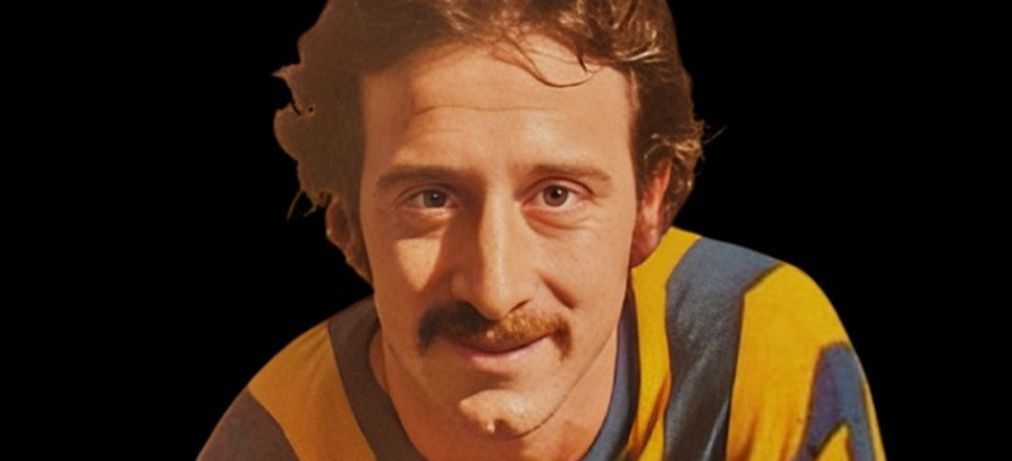
Aldo Pedro Poy, born 14 September 1945, Rosario, Santa Fe, Argentina.
PART ONE
Born and bred in the city of Rosario, Aldo Poy joined his local side Club Atlético Rosario Central in 1962. Rosario Central had been established on 24 December 1889, by a group of British workers tied to the Central Argentine Railway. At the very beginning, the club was tightly knit and exclusive, and only employees of the railway were allowed through its doors, which in truth were little more than a gathering point beside the tracks, but even then the spirit was unmistakable and the intent quietly fierce. Additionally, the first field was carved out on railway land, rough and uneven, while a disused wagon stood as headquarters, and though it may have looked modest to outsiders, it was a cradle of ambition and camaraderie.
The earliest kick of a ball came in 1890, and while records were sparse, the significance was not, because Rosario Central stepped onto the field for the first time against the crew of a visiting British ship, and the match ended in a 1–1 draw, a result which hinted at balance but also at hunger. The return meeting told a different story, however, as Central found their rhythm and claimed a 2–1 victory, and so, in those opening exchanges, a pattern began to form—one of resilience, adjustment, and eventual triumph.
On 3 October 1965, Poy eventually broke into Rosario Central’s first team when he debuted in a convincing 3-0 Primera División win over Huracán at the Estadio Jorge Newbery in Buenos Aires. And by all accounts, the attacker had talent, but talent and form are different things, and form can be a ruthless judge of a youngster´s future. By 1969, with the Central Rosario faithful growing restless and his confidence taking a battering, another club came calling. Club Atlético Los Andes, who were playing in the Primera División at the time, decided that Poy was exactly what they needed. The only problem was that he had no intention of going.
The story that emerged from that period is part football legend, part folk tale, and entirely Rosario. Rather than face the transfer and the men who wanted to take him away, Poy fled to the islands near the Río Paraná and spent a week in hiding, waiting for the storm to pass. It is the kind of thing that happens in novels, and yet in Rosario, people tell it with the matter-of-fact certainty of men describing the weather. He came back, he rejected Los Andes, he stayed with Central, and the rest of the story is one long vindication.
In 1971, Central reached the Nacional championship, one of the two main competitions of Argentine football at the time. In the semi-finals, they faced the team from the other side of Rosario — Newell’s Old Boys, their greatest rivals in a city that splits itself down the middle whenever those two clubs play. The match, which was held at the Estadio Monumental in Buenos Aires, produced a single goal, and that single goal produced a single moment, and that single moment produced something that Argentine football has been trying to categorise ever since. The cross came in, and Poy — moving at full stretch, body parallel to the turf, feet off the grass — met it with his head and drove it into the back of the net without touching the ground. This was a thing of beauty, and a thing of consequence, because Central went on to defeat San Lorenzo 2-1 in the final the Estadio Marcelo Bielsa in Rosario, winning the first championship in the history of the club.
Those two facts — the beauty and the consequence — are what have kept the memory alive. Additionally, the way the Argentine football calendar worked in that era meant that there was no shortage of dramatic finishes or celebrated goals; but Poy’s goal cut through all of that noise and lodged itself somewhere permanent in the city’s consciousness. Two years later, in 1973, Central were champions again, this time winning the Torneo Nacional in a final round that included River Plate, San Lorenzo and Atlanta. Poy was part of that too, his role in the club’s identity by now beyond question. However, it was always the 1971 goal, the one that opened everything up, the one that came in a semi-final against the old enemy, that people returned to.
PART TWO
There comes a point in every footballer’s life when the body begins to whisper what the mind refuses to hear, and for Poy that moment did not arrive gently or gradually but struck in the heat of competition, on a December evening in 1974 when the stakes were high and the tension between Rosario Central and Newell’s Old Boys could be felt in every challenge. As the ball spilled loose during that Copa Libertadores qualifier at the Estadio Gigante de Arroyit in Rosario, he went in with the same conviction that had defined his years as a forward, yet this time the collision with former Unión de Santa Fe midfielder Mario Zanabria brought not just contact but consequence, and in that split second his left knee gave way, changing everything that followed.
Because of that moment, the rhythm of Poy´s active playing days shifted abruptly, and what had once been about movement, anticipation, and goals became instead a cycle of surgery, recovery, and uncertain hope, each stage demanding patience that football rarely teaches. But he was not someone who walked away easily, and so after the first operation he worked his way back, step by step, driven by the same stubborn edge that had carried him through bruising defences and fierce derbies. Yet the game has a way of testing resolve beyond reason, and although he returned to the pitch, the knee refused to fully cooperate, forcing a second operation that drained both body and spirit, leaving him to weigh desire against reality. Therefore, by the time that second spell of recovery had run its course, the message was unmistakable, and even though the will to continue still flickered, he knew that pushing further would risk more than it could ever repay.
And so the closing chapter of Poy´s time in professional football arrived with a twist that felt almost scripted, because his final match came against Newell’s Old Boys, the same opponents who had framed both his finest moments and his cruellest setback. By the time Central Rosario qualified for the Copa Libertadores, he was at the height of his powers and had accumulated a record that spoke for itself: 61 goals in 292 Primera División appearances and 25 Rosarino derbies played in the famous blue and yellow.
Poy also represented the country of his birth. The 1974 FIFA World Cup in West Germany brought him to the international stage, and while Argentina did not progress beyond the second group stage, the tournament itself was a confirmation of the quality of the players they were producing in that era. Poy was one of them, a striker sharp enough and celebrated enough to earn his place in the squad, and whatever the limitations of their campaign that summer, his presence there was a recognition of everything he had done at club level.
Argentina were placed in Group 4 alongside Poland, Italy, and Haiti. The opening game against Poland ended in a 3-2 defeat — a result that immediately placed Argentina under pressure and established the tone for what would be a difficult competition. They recovered partially with a well-earned 1–1 draw against Italy, a point that kept them alive, and then delivered their most convincing performance of the group stage with a 4–1 victory over Haiti, a result that secured their advancement to the next round. The second group stage placed Argentina alongside the Netherlands, Brazil, and East Germany in Group A, and the level of opposition stepped up sharply. Argentina were beaten 4-0 by the Netherlands — a Dutch side that Johan Cruyff was orchestrating into one of the most admired teams in the tournament’s history — and then succumbed to a 2-1 defeat against Brazil before drawing 1–1 with East Germany in the final match. The results left Argentina with two points from three matches and an exit from the tournament, but the experience was invaluable.
Besides the playing record, there is the matter of Aldo Poy´s headed goal against Newell´s Old Boys and what has been built around it in the years since. The annual re-enactment began as a gathering of Central Rosario fans and grew into something that Argentina’s football culture now treats as a fixed point in its calendar. The location has shifted over the decades as it has been performed in Cuba in 1997, in the United States in 2000 and 2013, in Chile in 2002 and in Uruguay in 2008. A group of supporters has even attempted to have it registered in the Guinness World Records as the most celebrated goal in the long history of football.