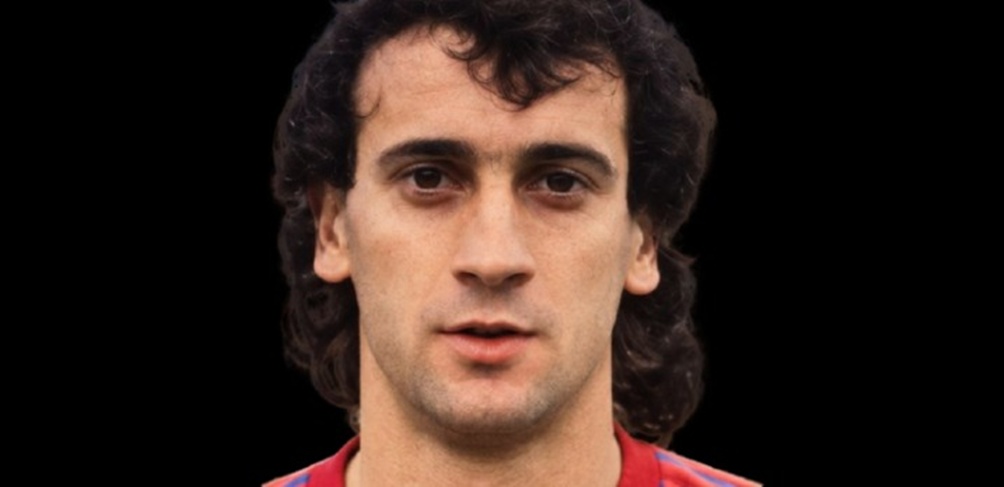
Walter Osvaldo Perazzo Otero, born 2 August 1962, Bogotá, Colombia.
PART ONE
Born in Colombia to Argentine parents, Walter Perazzo joined Buenos Aires side San Lorenzo in the late 1970s. He made his Primera División debut on 18 November 1979, aged just 17, on the eighth matchday of the Nacional, coming on in the second half in place of Miguel Gette against Cipolletti of Río Negro, one of the last matches ever staged at the mythical old Gasómetro. The coach who put him on was Carlos Salvador Bilardo, a detail that mattered more than anybody could have known at the time. Perazzo has since said that passing through Bilardo’s hands made him grow up as a professional far faster than he otherwise would have, and he treasures those few minutes on that pitch, because the last match San Lorenzo ever played at the old ground arrived on 2 December 1979, a goalless draw with Boca. Had he missed that window by a season, he would have been a supporter who never got to stand on the turf he grew up watching.
The following year gave him his shirt. In 1980 the Brazilian coach Delem handed him a starting place and the number nine, and Perazzo repaid the faith immediately by scoring in that very first match — his first goal in the top flight arriving on 24 February 1980, although the day itself ended badly with a 3–1 defeat against Ferro Carril Oeste. He added a couple more that season under Carmelo Faraone, who occasionally shunted him out to the right wing, and San Lorenzo scrambled clear of the drop in agonising fashion. Nevertheless, the reprieve was temporary. The club began 1981 by signing ten players, practically a whole team, which told the youngsters everything they needed to know; four of the new arrivals were forwards and Perazzo found himself buried, and when he did play he was often pushed out towards the touchline where his influence drained away. That was the terrible Metropolitano of 1981, the season San Lorenzo went down.
For a teenager, relegation is usually a sentence but for Perazzo it turned into an escape route. Juan Carlos Lorenzo did not want him for the Primera B campaign, so Bilardo took him to Estudiantes de La Plata in 1982. He was given his debut for the Pincha on 7 March 1982 in a 1–1 draw against Quilmes, and by the end of the year he was a champion of Argentina, part of the squad that won the 1982 Metropolitano under Bilardo’s brutal and brilliant management. The following year he went to the country of his birth to appear for Independiente Santa Fe, which closed a circle nobody had planned.
All the same, Boedo was where he belonged, and Boedo was where he went back. At the end of 1983 he returned to San Lorenzo, and it was there that he reached the best football of his life. From his return in 1984 onwards he was the symbol of San Lorenzo goalscoring, in hard years when the players put up with structural and financial misery, and by the time he left in August 1988 he had scored 77 goals in 240 matches in the blue and red. Those goals, struck for a club being battered from the boardroom down, made him the great figure of the so-called San Lorenzo of miracles and a member of the historic side nicknamed Los Camboyanos.
Furthermore, this was not merely local affection dressed up as greatness. Víctor Hugo Morales had a radio catchphrase for him, and the commentator’s verdict was no exaggeration: his background as an enganche gave him the range to be a complete attacker, a lethal finisher who was also refined, elegant and technically rich. The 1985/86 season showed the very best of him, and he finished second in the scoring charts behind Enzo Francescoli. Therefore the obvious next step was Mexico, but it never came.
Naturalised Argentine and dreaming of the World Cup, Walter Perazzo had both the hope and the merits; Bilardo was due to announce the squad at seven that evening, and at midday the broadcaster José María Muñoz rang his house to book him for that night’s programme on Rivadavia, because Muñoz had it on good authority that Perazzo was in. He turned on the radio in full confidence, waiting to hear his surname, and he was not among the 22. Bilardo finally called him up to the national team a year later, an Argentina Under-23 cap in 1987 that reads, with hindsight, like an apology delivered too late. In the years that followed he kept his level high, always near the top of the scoring lists, and offers arrived constantly, but the club would not sell him.
Eventually, though, the club had to, and the way it happened says a great deal about the man. Perazzo described his move to Boca Juniors at the end of the 1980s as an act of love towards San Lorenzo: his contract was expiring and he had a European offer that would have taken him away for nothing, but he chose to join the Xeneize so that money came into Boedo. San Lorenzo, as he puts it, came out of it better than he did. In August 1988 Boca paid US$200,000 for him and it caused a genuine sensation. His Boca debut came on 11 September 1988, a 1–0 home defeat by Deportivo Armenio, but a week later, on 18 September, he went to the Monumental and found the back of the net twice in the second half to beat River Plate 2–0. Few forwards have introduced themselves to a support quite so efficiently.
Nonetheless, the two years by the Riachuelo never quite took off. He never ratified with goals all the expectation that had been generated, and by June 1990 he had played 56 matches and scored on 12 occasions. Yet the medals came anyway, and they were not small ones. Boca reached the 1989 Supercopa Libertadores final against Independiente, drew 0–0 at La Bombonera on 22 November and 0–0 at La Doble Visera on 29 November, then won 5–3 on penalties, the shoot-out settled by Blas Giunta’s famous kick. Perazzo’s last goal in the blue and gold came on 15 October 1989, an equaliser away to Instituto in a 1–1 draw. Then, on 17 March 1990, Carlos Aimar’s Boca beat Atlético Nacional of Colombia 1–0 at the Orange Bowl in Miami, Diego Latorre scoring, to take the Recopa Sudamericana — a one-off on neutral ground because of security fears about staging a leg in Colombia and a congested calendar. Two continental trophies in five months is not a bad haul for a spell people remember as a disappointment.
After Boca, the wandering years began. Everything was agreed with Unión de Santa Fe, but he ended up signing for Argentinos Juniors instead, where he managed a single goal in eight appearances before the road went north. In 1991, at the request of Jorge Luis Pinto, he returned to his country of birth to play for Deportivo Cali, staying a year before Bolívar of La Paz signed him for 1992, and in the thin Bolivian air he collected another championship medal, the Liga Profesional title of 1992. In 1994 he moved on again, this time to the K League in South Korea with the Daewoo Royals, where he made just two appearances and failed to score — closing a professional record that, in Argentina alone, ran to 315 matches and 91 goals.
PART TWO
Coaching took a little while to arrive, but when it did he went straight to the hard end of the game rather than the comfortable one. In 1998 Walter Perazzo began managing El Porvenir and stayed until June 2000, then returned to the same club in January 2003 while it was competing in the B Nacional. Across his spells at Gerli he took charge of 106 matches, winning 35, drawing 34 and losing 37. Moreover, it was there that a door opened. At El Porvenir he got to know Enrique Merelas, the club’s president and also a figure in the youth national teams, and in 2008, when José Pekerman left and Sergio Batista took over with the champions of 1986, Perazzo was invited into the coaching staff, working with the Under-18s and serving as Batista’s assistant with the Under-20s. When Batista moved up to the senior side, Perazzo took the Under-20s himself across 2010 and 2011, handling the South American championship, the World Cup and the Pan American Games.
That patch of work turns out to have been rather important. In January 2011 Perazzo´s squad flew to Peru for the South American Under-20 tournament, acclimatising for altitude before opening against Uruguay in Arequipa on 16 January; Diego Polenta put the Uruguayans ahead in the first half, but Michael Hoyos and Juan Manuel Iturbe turned it around for a 2–1 victory. A later 1–0 defeat by Ecuador in the hexagonal stung, and Perazzo, publicly at least, refused to panic about it.
Argentina went to the 2011 Under-20 World Cup in Colombia and were knocked out in the quarter-finals, and even though that sounds like failure, the register of names he handled tells a different story. Over Perazzo´s time with the national youth setup he worked with Emiliano Martínez, Germán Pezzella, Nicolás Tagliafico and Paulo Dybala, plus Leandro Paredes, Manuel Lanzini and Erik Lamela at a younger age — Paredes already looked like a professional at 13 or 14, and Lanzini at 16 or 17 flew about the pitch with the intelligence of a finished player. His record with the Under-20s reads 19 matches, 12 won, four drawn and three lost, 27 goals scored and 12 conceded. Perazzo then took the Under-22s from 2011 into 2012.
Club management resumed in Bahía Blanca, and it produced the best domestic work of his life. He took over Olimpo in April 2012 with the team all but relegated, and the drop was confirmed five rounds before the end of the Clausura; in the 2012–13 B Nacional season he finished third overall and won direct promotion straight back to the Primera División. A year later Olimpo gathered 50 points in 2013–14, which not only kept them up but qualified them for the 2014 Copa Sudamericana — except that an AFA blunder, corrected only once the competition had finished, robbed the club of a first international campaign in its history. His time in Bahía Blanca ended on 12 April 2015. Perazzo also brought a 21-year-old Miguel Ángel Borja and Mauricio Cuero to Olimpo from Europe, where neither was playing, and both began making their names in Argentine football with him; Borja stayed grateful ever since, sending him a shirt from every club that he joined.
What followed was the grind of the Argentine second tier and its constant revolving door. He managed Ferro Carril Oeste in 2015–16, Aldosivi in 2017, Nueva Chicago from 2018 to 2019, Temperley from 2019 to 2021, Almagro from 2021 to 2022, Güemes from 2022 to 2023, Patronato in 2024, Temperley again later that same year and Nueva Chicago once more in 2025. Aldosivi went down to the Nacional B on his watch in 2017, and none of those posts let him repeat what he had built at Olimpo. Even so, there was always one job he wanted and never got offered, and he said as much out loud. Twenty years into management, he admitted he was surprised San Lorenzo had never once called to ask his opinion, never even sounded him out as an option.
Then, finally, they did. Perazzo arrived with the incoming board that won San Lorenzo’s elections on 30 May 2026, taking a place inside the professional football structure, his main brief being to sit on the Football Department and help build and monitor the senior area, though in practice he drifted increasingly towards the youth sides while Guillermo Franco and Martín Saric handled most of the first-team decisions. On 22 June 2026, when Gustavo Álvarez’s spell ended, Perazzo was handed the team on an interim basis while Marcelo Culotta’s board looked for a successor, and one of his first acts was to reintegrate the eleven players Álvarez had cast aside, so that the entire first-team squad, around fifty men in all, trained together again.
He was called upon a second time on 1 September 2026, after a 1–0 defeat at Instituto in Alta Córdoba left the Ciclón second from bottom of Zone A and finished Néstor Gorosito. Days later, in a poisonous atmosphere, Perazzo’s side beat Talleres 1–0 at the Nuevo Gasómetro, and the interim coach said afterwards that he had found a squad that had taken a battering and simply needed a bit of affection, praising the first half-hour for the football and the openings it created. Rubén Darío Insúa arrived immediately afterwards as the permanent appointment, and Perazzo stepped back into the youth structure, which is where he remains.