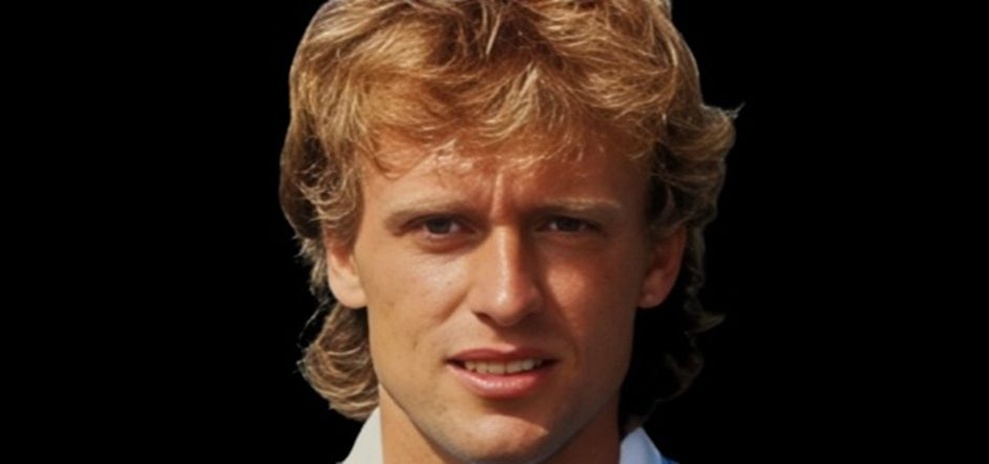
Thomas Jens Uwe Doll, born 9 April 1966, Malchin, Mecklenburg-Western Pomerania, Germany.
PART ONE
Thomas Doll’s earliest footballing steps were taken in modest surroundings, yet even then there was a sense hat he possessed something a little different, something that set him apart from the usual run of promising youngsters. And so, as he joined BSG Lokomotiv Malchin in his formative years, he began shaping a style that would later define him: direct yet intelligent, creative but disciplined, always looking to unlock defences rather than merely recycle possession.
The first real turning point came in 1979, when he was accepted into the youth academy of Hansa Rostock. By 1983, still only 17, Doll had progressed through the ranks and was ready—perhaps sooner than many expected—to take his chance in senior football, and his debut came on 27 August 1983 in the DDR-Oberliga against BSG Stahl Riesa. It was not a glamorous entrance, nor one filled with headlines, yet it marked the beginning of a journey that would soon gather pace, because Doll quickly showed he could handle the physical and tactical demands of top-flight football in East Germany.
Rostock’s fortunes were inconsistent during this period, and despite Doll’s growing influence, the club suffered relegation at the end of the 1985–86 season, a setback that forced him to consider his future carefully, because ambition and circumstance were beginning to pull in different directions. Then, in a move that would shape both his club and international career, Doll transferred to BFC Dynamo in 1986, a club synonymous with dominance in East German football, and a side that offered not just silverware, but visibility to national team selectors.
Besides, the decision was not purely professional; Doll chose Berlin partly to remain close to his family, and also because he already had strong connections within the squad, most notably with Andreas Thom, a fellow attacking talent who would soon form a formidable partnership with him.
From the moment he arrived, Doll slotted seamlessly into the side, and his impact was immediate. On 13 September 1986, in a derby against Union Berlin at the Stadion der Weltjugend, he scored his first league goal for the club, and not just in any victory, but in a crushing 8–1 triumph that underlined BFC Dynamo’s supremacy.
Undoubtedly, Doll’s time at BFC Dynamo represented the most successful phase of his playing career in terms of trophies, because he was central to a team that continued its relentless march at the top of the DDR-Oberliga. He won league titles in 1987 and 1988, and followed those up with FDGB-Pokal victories in 1988 and 1989, establishing himself not just as a contributor, but as a driving force in midfield, linking play with precision and delivering decisive moments in key matches.
Doll´s partnership with Andreas Thom became one of the most feared attacking combinations in East German football, because while the latter often provided the finishing touch, the former supplied the creativity, threading passes and dictating tempo with a calm authority.
And yet, one moment stood above the rest. On 5 August 1989, BFC Dynamo faced Dynamo Dresden in the DFV-Supercup—the first and only edition of that competition—and Doll rose to the occasion spectacularly, scoring twice in a 4–1 victory, ensuring his name was etched into a unique piece of football history.
PART TWO
At the time, history was moving faster than football could keep up, and with the fall of the Berlin Wall and the reunification of Germany, players like Doll suddenly found themselves in a new landscape, one filled with opportunity but also uncertainty. Because of this, he became one of the most sought-after talents emerging from the former East Germany, and in 1990 he made the move west, joining Hamburger SV alongside Frank Rohde.
This was a significant step, not just geographically but culturally, as Doll had to adapt to a different style of football, a different pace, and a different level of scrutiny, yet he embraced the challenge with the same composure he had shown throughout his career.
During the 1990–91 season, Doll quickly established himself in the Bundesliga, showcasing his technical ability and vision, and although he spent just one season at the club, it was enough to attract attention from abroad. So, after only a year, he made a high-profile move to Lazio in Italy for a then-record fee of DM15 million, a transfer that reflected both his talent and the growing interest in players from the newly unified Germany.
Moving to Serie A in the early 1990s was no small task, because Italian football at the time was arguably the most tactically sophisticated and defensively robust league in the world. Still, Doll adapted admirably, and over three seasons with Lazio, he demonstrated that his creativity could flourish even in such a demanding environment, combining flair with discipline and contributing to the team’s attacking play.
His time in Italy was not without its challenges, as injuries and the rigours of Serie A took their toll, and by 1994, he was ready to return to Germany. Eventually, Doll joined Eintracht Frankfurt, hoping to rediscover both form and fitness, but fate had other ideas, because injuries would become a recurring theme during his time at the club.
Despite his undeniable quality, he managed only 28 appearances over three seasons, and although there were glimpses of his former self, consistency eluded him, and his career began to lose some of its earlier momentum. But Doll was not ready to walk away from the game, and after a spell with Bari in Italy, he returned to Hamburger SV in 1998, bringing his career full circle.
Even so, the physical demands of the game were catching up with him, and while he contributed experience and intelligence to the squad, injuries continued to limit his involvement. And by the early 2000s, it was clear that his playing days were drawing to a close, yet his understanding of the game suggested that another chapter—perhaps even more impactful—was about to begin.
Parallel to his club career, Doll enjoyed a unique international career, representing both East Germany and the unified German team, a distinction that reflects the era in which he played. He earned 29 caps and scored seven goals for East Germany, and later added 18 caps and one goal for Germany, with his final international appearance coming in 1993. He also was part of the German squad at Euro 1992, where the team reached the final before losing to Denmark, a tournament that showcased his ability on the continental stage.
PART THREE
After retiring, Doll would go into coaching, beginning with the reserve team at Hamburger SV in 2002, and this role allowed him to develop his ideas and gain valuable experience behind the scenes.
In 2004, he was appointed first-team manager, stepping into a high-pressure role at a club that demanded results. Initially, he made a positive impact, guiding Hamburg away from relegation and stabilising the team, and then, in a remarkable turnaround, leading them to a third-place finish in the 2005–06 Bundesliga season, securing qualification for the Champions League.
The following season proved difficult, though, as Hamburg struggled in Europe and domestically, eventually slipping to the bottom of the table. Because of this downturn, Doll was dismissed on 1 February 2007, a reminder of the unforgiving nature of management. Later, Doll took charge of Borussia Dortmund, one of Germany’s biggest clubs, but despite his efforts, the team finished 13th in the Bundesliga, and he resigned on 19 May 2008. Subsequently, he embarked on a more nomadic managerial career, taking charge of Genclerbirligi in Turkey, where he sought to rebuild his reputation in a different footballing culture.
His managerial path then took him to Al-Hilal in Saudi Arabia in 2011, although his tenure there was brief, ending in January 2012. Yet, Doll’s resilience was evident, and in December 2013, he took over at Ferencvaros in Hungary, a move that would prove to be one of the most successful periods of his coaching career. In Budapest, he found stability and success, and in 2015, he guided the club to a 4–0 victory over Videoton in the Magyar Kupa final, a performance that highlighted his tactical acumen. In the 2015–16 season, he led the Greens to the Nemzeti Bajnoksag I title, securing the club’s 29th league championship, and in doing so, achieved the rare feat of winning every major domestic honour in Hungary.
Because of this, he was named Coach of the Year in 2016, recognition of his outstanding work and his ability to build a winning team. But after mixed results in subsequent seasons, Doll moved on, taking charge of Hannover 96 in January 2019, although his time there was short-lived. Likewise, his stint at APOEL later that year ended by mutual consent, despite leading the team to the Europa League round of 32.
In April 2022, Thomas Doll accepted a new challenge with Persija Jakarta, embracing the opportunity to work in a different footballing environment once again. And in his first season, he guided the team to a second-place finish, demonstrating that his passion for the game remained undiminished.