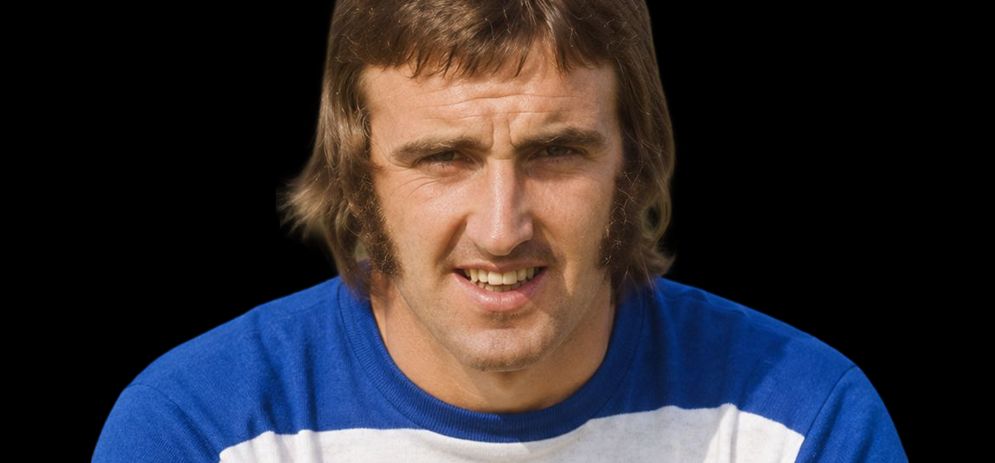
Martyn George Busby, born 24 March 1953, High Wycombe, England.
PART ONE
Hailing from Buckinghamshire, Martyn Busby signed professional forms with Queens Park Rangers in 1970. Rangers had built themselves a reputation for producing sharp young footballers out of their Loftus Road nursery, but even by those standards Busby was reckoned to be something special, one of the brightest prospects the club’s youth ranks had thrown up in years. Busby´s first taste of senior football came on 18 April 1970, thrown into a Division Two fixture away at Filbert Street against Leicester City, and although Rangers went down 2–1 on the night, nobody inside the away dressing room came away thinking any less of the teenager who had been handed his chance.
Debuts like that, in a losing side, on the road, against decent opposition, can either bury a young player’s confidence or toughen him up for what lies ahead, and in Busby’s case it plainly did the latter, because he did not sulk his way out of the picture. Instead he knuckled down, and by the back end of the 1971–72 season he had done enough in training and in the reserves to force his way into Jago’s plans on a regular basis, starting the last fourteen matches of the campaign as Rangers pushed for something better than mid-table respectability.
Building on that platform, Busby began the 1972–73 season as a fixture in the QPR side, starting every single game as the team roared into contention for promotion back to the First Division, and by the autumn he had become one of the names supporters looked for first on the team sheet. He was growing into himself, filling out physically, reading the game with a maturity beyond his years, and there was a growing feeling around Loftus Road that here, at last, was a midfielder who might go all the way to the very top.
But football has a habit of turning cruel just when it is at its kindest, and so it proved for Busby on 17 October 1972, when Queens Park Rangers travelled the short distance across west London to Craven Cottage to take on their neighbours Fulham. The Hoops won the match by 2–0 score, a routine enough result on paper, yet nobody who was there that day remembers the scoreline half so vividly as they remember what happened to the young Rangers wing-half in the middle of it. A tackle came in late and hard, described afterwards by those present as nothing short of thuggish, and Busby’s leg was left dangling in a manner that turned stomachs on both sides of the touchline. It was, without exaggeration, one of the most gruesome injuries witnessed at Craven Cottage in years, and the initial fear among the QPR medical staff was that the boy’s time in the game might be over before it had properly begun.
Rangers, however, carried on regardless, because football clubs must, and while their brightest young talent lay in hospital contemplating a future that suddenly looked very uncertain, his team-mates went on to finish the 1972–73 season in second place in the Second Division behind champions Burnley, thereby securing promotion back to the top flight. It was a bittersweet campaign in that sense, triumph for the collective, catastrophe for the individual, and Busby could only watch from the sidelines as Rangers celebrated a return to Division One that he himself had done so much to help engineer before that fateful afternoon at Craven Cottage.
Eighteen months is a long time for any professional footballer to be away from the only trade he knows, and Busby spent every one of those months working to get his shattered leg back into some kind of playing shape, refusing to accept that the injury had written the final chapter of his story before it had really started. Eventually, gradually, he did return to first-team action, and there was relief all round at Loftus Road that he had come through it at all. Yet those who remembered the fluent, powerful young player of 1972 could see, too, that something had been taken from him that no amount of hard work could fully restore; he was never again quite the player he had promised to become, and increasingly he found himself on the fringes of a Rangers side that, under new manager Dave Sexton, was building towards something remarkable.
PART TWO
By the 1975–76 season, Dave Sexton’s Queens Park Rangers Rangers were assembling one of the finest teams the club has ever fielded, stacked with internationals and playing football that would eventually take them within a single point of the First Division title, but there was precious little room in that side for a player who, however hard he battled, could no longer be certain of matching the pace he had once possessed. Busby found himself no more than a squad man as Rangers pushed Liverpool all the way, and in February 1976 the two clubs agreed a loan that would take him to Fratton Park and Ian St John’s Portsmouth, a team that occupied the opposite end of the table to Rangers and had precious little to smile about that winter.
Pompey had just recorded their first home win of the season, a modest enough achievement that nonetheless underlined how bleak things had become, and they sat rooted to the foot of the Second Division when Busby signed on. Three days after the loan was rubber-stamped he was straight into the Portsmouth side for his debut against a Bolton Wanderers team chasing promotion at Fratton Park, and although Busby gave what he could, Wanderers proved too strong on the day and left the south coast with both points, briefly climbing to the top of the table in the process.
Portsmouth’s form did not improve immediately, but there were flickers of encouragement in the games that followed Busby’s arrival. A 2–0 home victory over Plymouth Argyle saw Busby get his name on the scoresheet, a rare moment of personal satisfaction amid a difficult loan spell, and that was followed by a 3–0 win on the road against fellow relegation strugglers Blackburn Rovers, giving Pompey back-to-back victories for the first time all season and stirring faint talk of an unlikely escape from the bottom of the division.
Reality reasserted itself soon enough, though, with a midweek defeat at Stamford Bridge against Chelsea followed swiftly by a 3–1 loss at Notts County, results that dragged Portsmouth straight back down to earth and confirmed that their troubles were far from over. Busby’s sixth and, as it turned out, final appearance in a Portsmouth shirt brought him back to the very ground where his shattered leg had ended his best years as a footballer, and there was something almost poetic about the way Pompey collected both points that afternoon with a spirited 1–0 win over Fulham at Craven Cottage, the same corner of west London that had so nearly finished him off three and a half years earlier.
When the loan period expired, Busby returned to a Queens Park Rangers side that was now deep into its pursuit of the First Division championship, but as the campaign wound down towards its dramatic conclusion the midfield man again found himself surplus to Sexton’s requirements, watching from the margins as the Loftus Road outfit eventually finished runners-up to Bob Paisley´s Liverpool by the smallest of margins. Down at Fratton Park, meanwhile, there was no such glory to be found, and Portsmouth finished bottom of the Second Division that season, tumbling into the third tier alongside York City and Oxford United, both of whom shared the same miserable fate. Later that year Busby’s time at Loftus Road came to an end, at least temporarily, when he moved on loan and then permanently to Second Division team Notts County for a reported transfer fee in the region of £40,000, a sensible enough valuation for a player who, though never fully restored to his pre-injury best, still had plenty to offer at that level.
Regular first-team football at Meadow Lane appeared to do Busby a world of good, and as he settled into a role at the heart of the County midfield he began to rediscover something of the composure and range of passing that had once marked him out as a special talent, so much so that other clubs soon began casting an interested eye in his direction. In a neat twist of fate, it was Queens Park Rangers themselves who came calling again, and in September 1977, barely a year after letting him go, Rangers brought Busby back to Loftus Road for a fee reported at double what they had originally received for him from Notts County.
It was a show of faith that spoke to how highly his old club still rated him, even after everything that had happened, but sadly the reunion never quite recaptured the old magic on either side; neither Busby nor Queens Park Rangers were able to rediscover the form of those heady pre-injury days, and his second spell at the club drifted along as a solid, unspectacular contribution rather than the second coming supporters might once have dreamed of. There was one final adventure to come, a month-long loan spell at Division Two side Burnley during the 1979-80 campaign that yielded little of note, and shortly afterwards, with his damaged leg finally forcing the issue, Busby brought the curtain down on his playing days.
Across his two spells at Loftus Road he made 146 league appearances for Queens Park Rangers and scored 17 league goals, figures that hint at a solid, useful contribution without ever quite reflecting the extraordinary promise he had shown as a teenager before that October afternoon in 1972 changed everything. He is remembered around west London, and indeed on the south coast, as the younger brother of Viv Busby, the former Fulham striker whose own exploits in front of goal gave the family name a certain currency in English football circles during the same era.
Retirement from playing was not the end of Busby’s involvement in the game, either, for in June 1996 he took up a role as joint manager of non-league Maidenhead United alongside former West Ham and England midfielder Alan Devonshire, a partnership that lasted until March 1997 before the pair moved on. It was a modest postscript to a story that had promised so very much in its opening chapters, but those who watched Martyn Busby in his brief pomp, before the tackle at Craven Cottage changed the course of everything, still speak of him as a player who might, in kinder circumstances, have gone every bit as far as anyone Loftus Road ever produced.