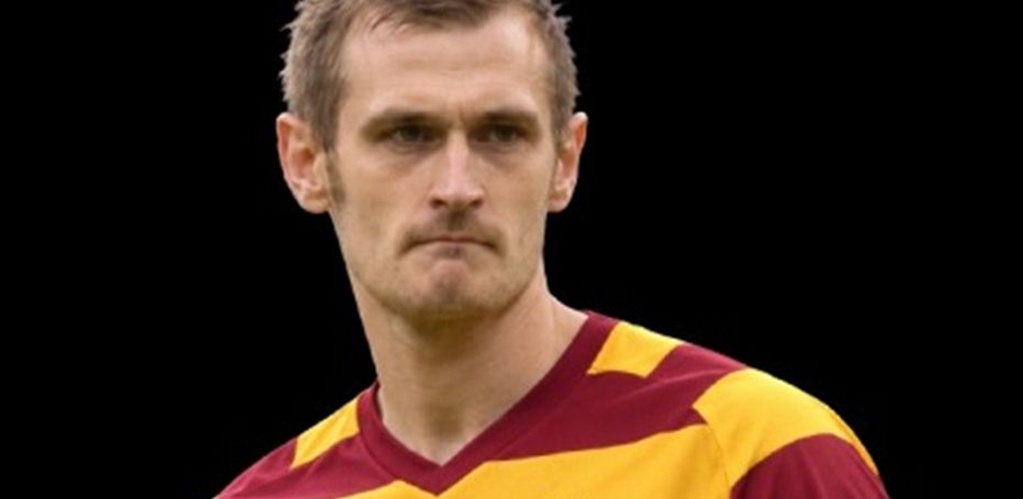
James Robert Hanson, 9 November 1987, Bradford, England.
PART ONE
James Hanson played youth football for Huddersfield Town and Bradford City before the youngster dropped into semi-professional non-league football with Eccleshill United and then Guiseley. In the summer of 2009, however, Bradford City decided that the striker they had let slip as a youngster was worth a second look. Hanson signed his first professional contract with the club in July 2009, and the fee was not settled between the clubs in a friendly handshake but by a tribunal hearing, which met six months later and put the figure close to £7,500, with a sell-on clause and the agreement of a friendly between the two sides thrown in. It was small money even by the standards of League Two, and it was just as small for the player himself, because in making the move Hanson took nearly a fifty per cent pay cut.
Hanson made his debut for Bradford on the opening day of the 2009–10 season, on 8 August 2009, in a 5–0 defeat against Notts County, which is the sort of introduction that would have sent a more fragile man back to the supermarket by teatime. He did not go anywhere. Two weeks later, on 22 August 2009, he scored his first goal for the club in a 5–4 victory away at Cheltenham Town, a game with enough goals in it to be remembered on its own, and which gave him the proof he had been looking for that he belonged. From that wild afternoon onwards the season went his way, and by the end of it Hanson had won the Player of the Year award in his very first season at Valley Parade, a remarkable thing for a man who had been behind a till a matter of months earlier. The club rewarded him with a new and improved contract for the next four years, which was as much a statement of belief as a pay rise, and it pointed to a player whose value was starting to be recognised.
Hanson was not content to coast on that award, and ahead of his second season with the club he decided to bulk up, a decision that reflected how seriously he took the physical side of being a lone target man in the lower divisions, where defenders are not shy about leaning on a big forward. The weeks and months that followed brought him the usual knocks, and in February 2012 he suffered a groin injury that was estimated to keep him out for six weeks. That setback did not undo the good work, because over the 2011–12 season he scored 14 goals, his highest tally to date in three years as a professional, and the figure marked him out as more than a willing runner, because he was now one of the men Bradford City looked to when they needed something done in the box. Phil Parkinson was the manager by then, and the pair of them would go on to share the best days either would know at the club.
Those best days arrived in the 2012–13 season, which began with a vote of confidence from within the dressing room. In October 2012 teammate Andrew Davies stated his belief that Hanson’s goals would help the club achieve promotion, and nobody inside Valley Parade was in any mood to argue, because the team had begun to play with a swagger that League Two had not seen from them for years. Then came the League Cup, and with it the nights that made the whole country look at Bradford City.
Hanson scored his side’s goal in the second leg of the semi-final tie against Aston Villa, and he was named Man of the Match for that second leg, helping Bradford to the League Cup final, which for a fourth-tier club was an achievement that the supporters would describe to their grandchildren. The detail that makes it better is that Hanson had a broken toe going into the match and received an injection for it fifteen minutes before kick-off, so that he played one of the biggest games of his life with a needle’s worth of numbness and a good deal of bloody-mindedness. His performance drew praise from former manager Steve Kittrick, which showed how widely the display had been noticed in the city.
The final itself, played in February 2013, took Hanson and his teammates to Wembley, where they came up against a Swansea side far above them in the football pyramid, and the afternoon ended in a heavy 5-0 defeat. Hanson played in the 2013 Football League Cup Final, and while the scoreline hurt, what stayed with him was a different feeling, because after the match he said he believed Bradford City would return to Wembley via the League Two play-offs. It is the sort of thing a footballer says to lift his own spirits and those of the fans around him, but in this case it turned out to be a prophecy and not just a hope.
The league form did its part, with Hanson scoring two goals in the next three League matches and reaching 10 goals for the season, and later that month he stated that the club had to win both forthcoming Easter games, a call to arms from a man who had stopped being the quiet one in the dressing room. In April 2013 he spoke of the buzz around the club as they mounted a play-off challenge, and the buzz was real, because the crowd that had been to Wembley once already now smelled a second trip.
The play-offs asked a great deal of everybody, and Hanson delivered. On 5 May he scored a vital goal in the second leg of the semi-final against Burton Albion, and the context makes it better still, because Bradford had come out of the home leg 3–2 down and needed to turn the tie around away from Valley Parade. They did it in style, winning the second leg 3–1 and the tie 5–4 on aggregate, and it was Hanson’s goal in that game that helped swing the balance. That earned the return to Wembley that he had promised, and in the Final he scored in a 3–0 victory against Northampton Town, so the big striker who had spent the League Cup final on the losing side now stood on the winning one, with a goal to his name.
PART TWO
Ahead of the 2013–14 season, Bradford City manager Phil Parkinson said that only a high-money bid would persuade the club to sell either James Hanson or his fellow striker Nahki Wells, which put a clear value on the pair and told the rest of the division to keep their cheque books shut unless they were serious. In July 2013 Hanson was praised by former Bradford City left-back Wayne Jacobs, and in August 2013 he spoke positively of his partnership with Wells, who returned the compliment by publicly praising their strike pairing as well. Then, on 29 November 2013, the club did what it had promised when it turned down the offers and signed him to a new contract taking him up to the end of the 2016–17 campaign, and Hanson became the first player at the club to sign a new contract that season.
Good partnerships rarely last as long as the supporters would like, however, and this one was ended by money. Wells was sold to Huddersfield Town in January 2014, and with that departure the strike pair that had so impressed the division was broken up, leaving Hanson to carry on without the man who had made so many of his goals and who had scored so many of his own. He did carry on, though, and in February 2014 Hanson scored his 10th goal of the season. Throughout March and April, however, he suffered a number of minor injuries which prevented him from playing and later that year he was diagnosed with arthritis, a hard thing to hear for a man whose living came from jumping and being jumped on, and one he would have to play through for the rest of his footballing days.
The following campaign brought change in how Bradford City wanted to play, and Hanson was one of the players who had to adapt. Ahead of the 2014–15 season the club implemented a new playing style and match tactics, and Hanson stated he was looking forward to showing that he was able to adapt to it, which was as good as an admission that the old, direct way might not be quite enough. Then, in September 2014, it was announced that Hanson was suffering from a thigh injury and could miss up to five matches. When he came back, he found the door less open than before, and in December, following his return from injury, he was kept out of the starting line-up by Jon Stead and Billy Clarke.
In April 2015 Hanson declared that he was aiming to score 20 goals a campaign for the club, a bold target from a performer who, at that point, was on 11 goals and had not scored for two months, but it showed that the ambition had not dimmed. Other clubs were watching, and in May 2015 Bradford City rejected an undisclosed transfer bid for him from Millwall. The Londoners made it clear they were still interested in signing Hanson, and Bradford City turned down a second bid a few weeks later, though the club also delayed any possible transfer while they searched for a replacement, which suggests they were not wholly closed to the idea.
In October 2015 Hanson was dropped from the starting eleven following a poor performance in a previous game, and someone who had played every match to that point had to sit and wait. He did not wait long. After an injury to his replacement Steve Davies, Hanson returned to the first team later that month, and he scored in his first game back in the starting eleven, a reply that said all it needed to. In November 2015 he suffered an ankle ligaments injury in an FA Cup game, which was another blow to a body that had already taken plenty. Yet there was better news round the corner, because on 13 February 2016 he made his 300th appearance for the club, and he marked it by scoring two goals in the process, which is the best way a striker can celebrate a milestone. Then, on 23 April, Hanson registered his first professional hat-trick as Bradford City demolished promotion rivals Walsall 4–0 at Valley Parade.
The final season at Valley Parade started badly, with Hanson playing in the first two games of the 2016–17 campaign and then missing over a month of play due to a calf problem. His first goal of the season did not come until 29 October, when he scored twice in a 3–2 victory against AFC Wimbledon, and it was an echo of the way he had always done things, late and with a flourish. By the time the winter came round, however, the end was in sight. Upon leaving Bradford City, he had scored 91 goals in 335 appearances, and was third on the club’s all-time scorer list, a staggering return for a player who had cost less than ten thousand pounds and whose contract had been settled by a tribunal.
On 21 January 2017 Sheffield United made an offer for Hanson, and the transfer was completed on 24 January 2017, which took a matter of three days and told you how keen the Blades were. He stated that he was looking forward to playing against his old club, and then he did what Bradford supporters had always expected, scoring on his debut in a 4–0 win over AFC Wimbledon on 4 February 2017. The goals did not keep coming at the same rate, though, and by the summer his name was already being linked with a way home. In August 2017 and again in November 2017 he was linked with a return to Bradford City, but the club’s manager Stuart McCall dismissed the rumours. Hanson made his debut in the Championship in November 2017, against Fulham, a step up he had waited a long time for, though the minutes were scarce. He moved on loan to Bury in January 2018, and at the end of the 2017–18 campaign he was transfer-listed by Sheffield United. On 26 June 2018, Hanson left Sheffield United by mutual consent, and joined AFC Wimbledon, the very side he had scored against on his Blades debut.
In June 2019 he was linked with a possible return to Valley Parade, but the link was denied by Bradford City boss Gary Bowyer, and so Hanson looked elsewhere. In the same month he signed for Grimsby Town on a two-year contract, and the move turned out well from the very beginning. He scored five goals and made three assists in August 2019, which saw him awarded the EFL League Two Player of the Month for the month. On 12 May 2021 it was announced that he would leave Grimsby at the end of the season, following the expiry of his contract. Refusing to hang up his boots, Hanson later played for a string of clubs, including Farsley Celtic, Boston United, Worksop Town and Bradford Park Avenue.