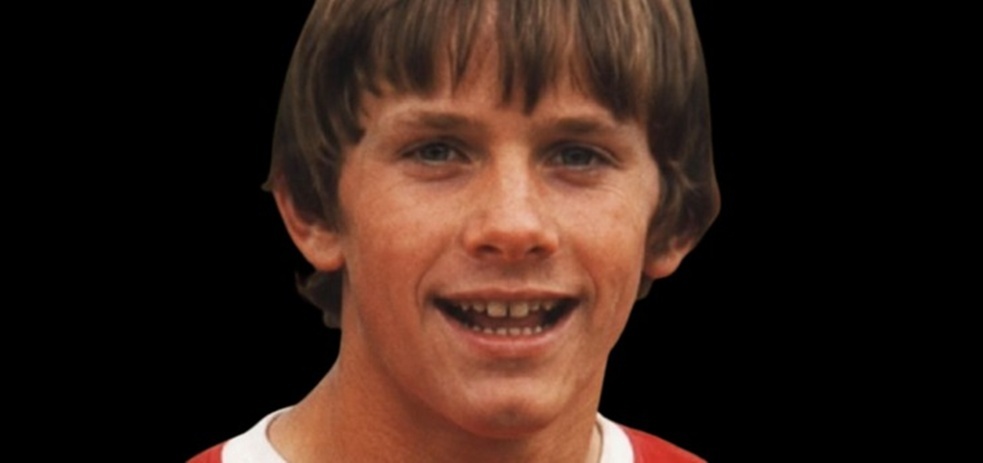
John Herbert Norton Fitzpatrick, born August 18 1946, Aberdeen, Scotland.
PART ONE
John Fitzpatrick first attracted attention while playing for Thistle Lads’ Club, where his strong running and willingness to compete marked him out from boys of the same age, and Manchester United’s scouts noticed him in September 1961, when he was only 15. An invitation to Old Trafford followed, but before leaving Aberdeen he asked permission to play once more for his local side, an understandable request from a boy preparing to move away from home, and during that farewell appearance he broke his leg.
The injury delayed his progress before it had properly started, and he could not sign apprentice forms until July 1962, although United kept faith with him and employed him on the ground staff while he recovered, giving him time to learn the rhythms of Old Trafford from the bottom upwards. He cleaned boots, helped with the everyday work and trained whenever his leg allowed, and that period must have strengthened an attitude already based on effort rather than entitlement, because nothing had been handed to him easily. Fitzpatrick signed professional forms in September 1963, two years after United first spotted him, and by then he had already learnt that talent might open a door but physical setbacks could close it without warning. It was a lesson he would encounter again, much more damagingly, before the decade was out.
The immediate target was a place in United’s outstanding youth side, and Fitzpatrick earned one alongside George Best, John Aston and David Sadler as the club pursued the 1963–64 FA Youth Cup. Manchester United met Swindon Town over two legs in the final, drawing 1–1 at the County Ground on April 27, 1964, when Don Rogers put Swindon ahead before Best equalised, and three days later more than 25,000 spectators were at Old Trafford as United won 4–1 and completed a 5–2 aggregate victory.
Sadler scored a hat-trick and Aston added the fourth, but Fitzpatrick’s contribution throughout the competition mattered just as much because this was a team in which every young player was being taught to accept responsibility, to move the ball quickly and to understand that promotion to the first team had to be earned. The greater significance for Fitzpatrick lay in the company he was keeping, for Best was already advancing at extraordinary speed while Sadler and Aston would also become senior regulars. Fitzpatrick did not possess Best’s natural brilliance, but he had pace, strength and a restless determination to remain involved, qualities that made him useful in several positions and gave Busby reason to retain him as the demands grew tougher.
His senior debut came on February 24, 1965, away to Sunderland at Roker Park, with Nobby Stiles injured and Fitzpatrick asked to fill the left-half position, yet there was no gentle introduction because the Rokerites won 1–0 and United were in the middle of a tight championship contest. Fitzpatrick was 18, still learning and stepping into the place of a man who had already become central to Busby’s side, so two league appearances in 1964–65 represented useful progress even though they were insufficient to earn him a championship medal when United finished level on points with Leeds United and took the title on goal average.
There was another piece of club history waiting the following autumn, although it came during an afternoon Manchester United preferred to forget, when the Football League’s new substitution rule brought Fitzpatrick into the match against Bill Nicholson´s Tottenham Hotspur side at White Hart Lane on October 16, 1965. Denis Law was injured during an embarrassing 5–1 defeat and Fitzpatrick replaced his fellow Aberdonian, becoming Manchester United’s first substitute in a league fixture, an unusual distinction which linked a young reserve with one of the greatest forwards in the game. The result was punishing, but the appearance demonstrated his value: if Busby needed energy in midfield, help in defence or even another body in attack, Fitzpatrick would go on and do the work. Opportunities nevertheless remained scarce, with only five senior appearances in the 1965–66 season and three outings in the 1966–67 campaign, because Stiles and Crerand were established at wing-half and United were chasing major prizes rather than experimenting freely.
That shortage of football could have persuaded a less stubborn player to move elsewhere, particularly when Manchester United won another league championship in 1966–67 while Fitzpatrick made just three appearances, but he remained at Old Trafford and began to feature more regularly during 1967–68. He played 21 times in all competitions, including 17 league matches and two European Cup appearances, and Busby used him in different roles as he tried to find the best outlet for the Scot’s running power.
Fitzpatrick appeared at wing-half and was also pushed into the forward line, where his directness could disturb defenders even though he was never likely to displace Law, Best or Brian Kidd for an important match, and this ability to cover several positions kept him around the senior side without yet giving him one secure place of his own. Manchester United became the first English club to win the European Cup when they defeated Benfica 4–1 after extra time at Wembley Stadium on May 29, 1968, but Fitzpatrick was not in the final team, and his experience of that successful season was therefore different from that of the men who stood on the pitch with the trophy. He had contributed during the competition and had played more often than ever before, yet he was still trying to establish precisely what kind of first-team footballer he would become, a difficult task in a squad crowded with famous and experienced internationals.
The answer emerged during 1968–69, the busiest and most productive season of his time at United, when he made 40 appearances and scored four goals in all competitions. He began the campaign still moving between roles, but in February 1969 an injury to Shay Brennan created an opening at right-back, and Fitzpatrick’s combination of speed, aggression and stamina suited the position far better than some had expected. Full-backs were increasingly required to do more than mark a winger and clear the ball, and Fitzpatrick could carry possession forward, support the players ahead of him and recover quickly when an attack broke down, while his experience in midfield meant he was comfortable stepping into crowded areas.
There were rough edges, particularly when his eagerness carried him into challenges too quickly, but for the first time he had found a role that offered continuity rather than another temporary assignment. His four goals included an FA Cup equaliser against Exeter City on January 4, 1969, in a tie United eventually won 3–1, and a league goal during a 2–1 defeat at Coventry City on April 8, yet scoring was a useful addition rather than his principal duty. More important was the growing evidence that he could succeed Brennan, whose years of reliable service had made right-back a difficult position for any younger player to inherit.
PART TWO
Fitzpatrick’s progress carried him into the European Cup semi-final against AC Milan, although the first leg at San Siro on April 23, 1969, produced the most controversial moment of his playing years. Milan went ahead through Angelo Sormani in the 33rd minute of the tussle and doubled their lead through Kurt Hamrin shortly after half-time, leaving the holders in serious trouble, and with ten minutes remaining Fitzpatrick was sent off after an off-the-ball incident involving Hamrin. He required a police escort as he made his way towards the dressing room, and the punishment did not finish with the dismissal because an eight-week suspension followed. Manchester United won the return leg at Old Trafford 1–0 through Bobby Charlton but went out 2–1 on aggregate.
It was a damaging end to what had otherwise been Fitzpatrick’s breakthrough season, and the incident underlined the danger within his competitive nature, for the force that had carried him into the team could also spill over when frustration took control. Even so, one bad night did not erase 40 appearances or the discovery of a position in which he looked capable of becoming a regular, and the expectation was that he would start the following season with an opportunity to make right-back his own.
Fitzpatrick did retain his place during the opening months of 1969–70, finding the back of the net three times in 26 appearances across all competitions, but injury returned on November 22, 1969, during a 3-1 Division One win against Tottenham Hotspur at Old Trafford and kept him out for four months. The interruption arrived just as he was settling into the side, and although he recovered in time to play the final seven fixtures of the season, United themselves were changing quickly, for Busby had stepped down as manager and Wilf McGuinness was trying to handle a squad whose greatest days were slipping away.
Brennan left in the summer of 1970 to become player-manager of Waterford United, removing the experienced man who had stood between Fitzpatrick and a settled place, and the Scot responded by producing his most consistent league season. He appeared in 35 of Manchester United’s 42 First Division matches during 1970–71, missing only seven, and his total of 43 games in all competitions was the highest of his senior years; additionally, he scored three times, twice in the league and once in the League Cup. United’s results were uneven and McGuinness was replaced by Busby midway through the season, but Fitzpatrick’s presence on the right side of defence had become one of the more dependable parts of the team, while his shoulder-length hair and forceful play made him an easily recognised figure in a side moving away from the neat appearance and settled authority of the earlier Busby years.
The physical cost, unfortunately, was increasing. Fitzpatrick suffered a serious knee injury following a challenge involving Leeds United’s Johnny Giles, but he never built a grievance around the incident or publicly accused Giles of deliberately ending his time as a player. Giles later accepted responsibility for making the challenge while rejecting the suggestion that he alone had brought Fitzpatrick’s playing days to an end, a reasonable distinction because the knee had already given trouble and the damage became a recurring cartilage problem rather than the consequence of one simple blow.
Still, the effect on Fitzpatrick was severe: after being one of United’s busiest players in 1970–71, he managed only a single first-team appearance throughout 1971–72. Four operations followed as surgeons attempted to correct the problem, and each recovery demanded another spell of training, another test of the joint and another attempt to convince both the club and himself that regular football remained possible. United were changing around him under Frank O’Farrell, with Martin Buchan arriving from Aberdeen and younger players pushing for places, but Fitzpatrick’s main opponent was no longer another footballer. It was his own knee, unreliable under strain and capable of undoing months of patient work in a moment, while the pace and contact of First Division football allowed no room for a defender who could not trust his movement completely.
There was enough improvement for him to return at the beginning of 1972–73, and after so many operations even that represented a considerable effort, but the comeback amounted to six first-team appearances and another two in the reserves before the knee gave its final answer. His last Football League match came at Molineux on September 16, 1972, when Bill McGarry´s Wolverhampton Wanderers defeated Manchester United 2–0, and Fitzpatrick was still only 26, an age at which a player of his experience would normally have expected several strong seasons ahead.
Medical advice left little room for argument, however, and he retired after nine years as a professional, his final record standing at 147 competitive appearances, of which 141 were starts, and ten goals. The figures break down into 117 league appearances and eight league goals, eleven FA Cup matches with one goal, twelve League Cup appearances with another goal, and seven outings in European or other recognised competitions. Manchester United’s obituary records his development from the youth team, his emergence at right-back and his 147 senior appearances, and those numbers describe a substantial contribution even though injury restricted its length. Fitzpatrick had not merely occupied a reserve shirt during United’s famous years; he had fought through the waiting, found a position and become a regular before his body stopped him.
Manchester United acknowledged his nine years of service with a £20,000 payment, a significant sum at the time, while a cabaret dinner held in his honour raised another £1,000. Fitzpatrick then returned to Aberdeen, the city he had left as a teenager, and remained involved in football through management in the Highland League, first with Buckie Thistle and later with Huntly. The level was different from Old Trafford, San Siro or the crowded First Division grounds where he had spent his senior playing years, but the work still demanded judgement, authority and an understanding of players, and John Fitzpatrick had accumulated plenty of practical knowledge during his time under Busby, McGuinness and O’Farrell. Away from the game, he established himself in business as an importer of fine wine, building a life that did not depend upon retelling old matches or complaining about the years that injury had removed.