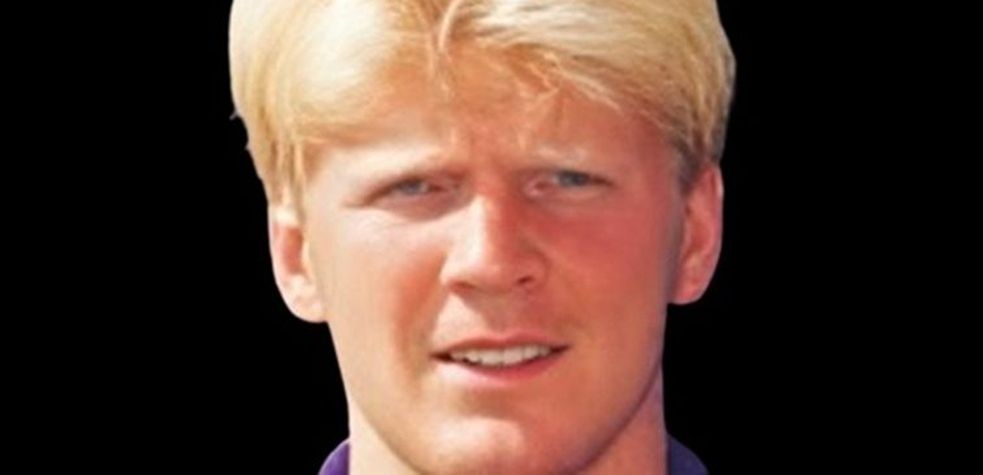
Stefan Effenberg, 2 August 1968, Niendorf, Hamburg, West Germany.
PART ONE
Stefan Effenberg grew up with a physical presence that belied his years, standing tall at 1.86m and carrying himself with a natural authority on the pitch, and by the time he broke into senior football he already had that blend of passing range, shooting power and relentless drive that made opponents sit up and take notice, though his temper often landed him in hot water too.
Effenberg kicked off his playing days with Borussia Monchengladbach, the club where he truly announced himself. He made his Bundesliga debut in the 1987/88 season and quickly settled into the side, turning out in 73 league games across his first spell and finding the net 10 times. By the age of 20 he had become an undisputed starter, patrolling the midfield with a mix of vision and bite that caught the eye of bigger clubs. Gladbach gave him the platform to develop his game, and he repaid them with performances full of energy and no little skill, though silverware remained out of reach during those early years.
In 1990 the call came from Bayern Munich, and Effenberg made the move south to join the Bundesliga giants. He slotted straight into the team and wasted little time making an impact, scoring 19 goals in his first two seasons combined while racking up 65 appearances. Yet success proved elusive for Bayern during that initial spell. The club finished as runners-up in his first campaign but then slumped to a lowly 10th place the following year, their worst league finish in over a decade, and the lack of trophies left a sour taste despite his personal contributions. Still, his ability to dictate play from midfield and his willingness to put his foot in when needed marked him as a player who could thrive at the highest level, even if the collective results did not match his individual promise.
When Lothar Matthaus returned to Bayern in 1992, space became tight in Munich and Effenberg headed to Italy with ACF Fiorentina. He arrived in Florence alongside stars like Brian Laudrup and the lethal Gabriel Batistuta, yet things did not go smoothly. Fiorentina suffered relegation from Serie A in his first season despite the talent on show, and Effenberg played 56 league matches across his two years there, scoring 12 goals. He could easily have jumped ship after going down, but he stuck around for the Serie B campaign and helped the Viola bounce straight back up at the first attempt, turning out in another batch of games and adding to his growing reputation as a midfielder who could handle pressure.
The summer of 1994 saw him move back to Borussia Monchengladbach, where he enjoyed one of the most consistent spells of his club career. Over four seasons he appeared in 118 Bundesliga matches and scored 23 goals, often captaining the side and driving them forward with his trademark leadership. His second stint at Gladbach brought more stability and highlighted his passing ability and physical strength, though the team still struggled to challenge for major honours. Effenberg’s time there reinforced his image as a no-nonsense operator who led from the front, picking up plenty of bookings along the way but also delivering performances that fans could rely on week after week.
By 1998 Bayern Munich came calling again, and this time the return would prove far more fruitful. Effenberg rejoined the Bavarians under coach Ottmar Hitzfeld and immediately became a central figure in a side packed with quality. His second spell in Munich spanned 95 league appearances and 16 goals, but the numbers only tell part of the story because he brought steel and direction to a team that was ready to dominate. Bayern claimed three Bundesliga titles in a row between 1999 and 2001, and Effenberg stood right at the heart of it, organising the midfield, spraying passes and occasionally thumping shots into the net when the moment called for it.
The European stage provided some of his most memorable nights. In the 1998/99 Champions League campaign Bayern marched all the way to the final only to suffer that heart-breaking late collapse against Manchester United in Barcelona, losing 2-1 after leading until injury time. Effenberg had been influential throughout the run, but the defeat stung deeply. Two years later, however, redemption arrived in spectacular fashion. Bayern reached the 2001 final against Valencia in Milan, and this time Effenberg wore the captain’s armband. The match ended 1-1 after extra time following Gaizka Mendieta’s early penalty for Valencia and Effenberg’s coolly taken equaliser from the spot in the 50th minute. In the shoot-out Oliver Kahn made the crucial saves, Bayern won 5-4 on penalties, and Effenberg lifted the trophy as skipper. He was later named the Most Valuable Player of the 2000-01 UEFA Champions League, a fitting reward for a player who had driven his team through every round.
Fans at Bayern still speak warmly of that night, and after he eventually left the club they voted him into their all-time eleven, placing him among the greatest to have pulled on the red shirt. His leadership on the pitch, combined with his ability to read the game and deliver in big moments, turned him into a figure who commanded respect even from those who found his personality abrasive.
PART TWO
Stefan Effenberg earned himself 35 caps for his native Germany between 1991 and 1998, registering five goals and showing the same combative qualities that defined his club career.
The midfield man was handed his debut on 5 June 1991 in a Euro 1992 qualifier against Wales, coming off the substitutes´ bench for the final 18 minutes of a 1-0 defeat. He quickly became a regular and featured prominently at the 1992 European Championship, even netting in the group stage during a 2-0 victory over Scotland. Germany reached the final that summer but fell to Denmark, yet Effenberg had done enough to establish himself as an important part of the national set-up.
His World Cup experience in 1994 proved far more controversial. Germany, as defending champions, travelled to the United States and started brightly enough, but tensions boiled over during the group match against South Korea in Dallas. On 27 June 1994, in searing heat at the Cotton Bowl, Germany led 3-0 but allowed the Koreans to fight back to 3-2. Effenberg had an off day and was substituted late on with the score still 3-2. As he left the field, some German fans voiced their displeasure and booed. In response, the midfielder raised his middle finger in a clear gesture of defiance directed at the supporters. Coach Berti Vogts was furious, immediately dropped him from the squad and declared that Effenberg’s international career was over. The incident made headlines around the world and overshadowed what had been a solid tournament up to that point for the player. Germany went on without him but exited in the quarter-finals to Bulgaria.
Effenberg did not pull on the white shirt again until 1998, when he was briefly recalled for a couple of friendlies in Malta under Vogts’ final games in charge. Those turned out to be his last two caps, bringing his total to 35 appearances and five goals. The finger incident at the 1994 World Cup remains one of the most infamous moments in German football history, yet it also encapsulated the fiery temperament that both propelled and hindered him throughout his playing days.
After leaving Bayern in 2002, Effenberg joined VfL Wolfsburg for one final Bundesliga campaign. He managed 19 league appearances and three goals, but the spell proved unsuccessful and the club finished in mid-table. Seeking one last adventure, he headed to Qatar and signed for Al-Arabi, where he linked up once more with his former Fiorentina teammate Gabriel Batistuta. Effenberg played 15 matches and scored four goals in the Qatar Stars League before hanging up his boots in the summer of 2004 at the age of 35. His club career had taken him across 441 league appearances and 87 goals, with additional cup and European games pushing his total output well over 500 matches and more than 100 goals in all competitions.
Off the pitch, Effenberg never shied away from the spotlight. He had picked up a staggering 109 yellow cards in the Bundesliga alone by the time he retired and his total bookings across German football topped 120. That disciplinary record reflected both his aggressive style and his short fuse, but it also spoke of a player who never gave an inch in the battle for every ball. Stories of his private life, including high-profile relationships and run-ins with the media, only added to the colourful image that followed him wherever he went.
Once his time as a player ended, Effenberg dipped his toe into media work as a colour commentator for German television, offering forthright opinions that matched the directness he had shown on the field. Management soon beckoned, and in October 2015 he took charge of SC Paderborn in the second division. His first coaching role lasted only until March 2016, when he was sacked after a poor run of results that included 12 league games without a win. He managed 15 matches in total, recording just two victories.
In October 2019, Eeffenberg moved into a sporting director role at KFC Uerdingen 05, but the stint proved equally turbulent. The club faced organisational issues, including a bizarre mid-season training camp in an Italian hotel that lacked a proper football pitch, and after a few difficult months he stepped down prematurely in May 2020. Those experiences showed that translating his playing leadership into coaching success was not exactly straightforward, yet they also underlined his willingness to throw himself into new challenges long after the final whistle had blown on his career.
In retirement he remained a vocal presence in German football circles, whether through television work or his short-lived coaching roles. The Paderborn and Uerdingen experiences may not have brought success, but they showed a man still eager to stay involved rather than simply fade into the background.