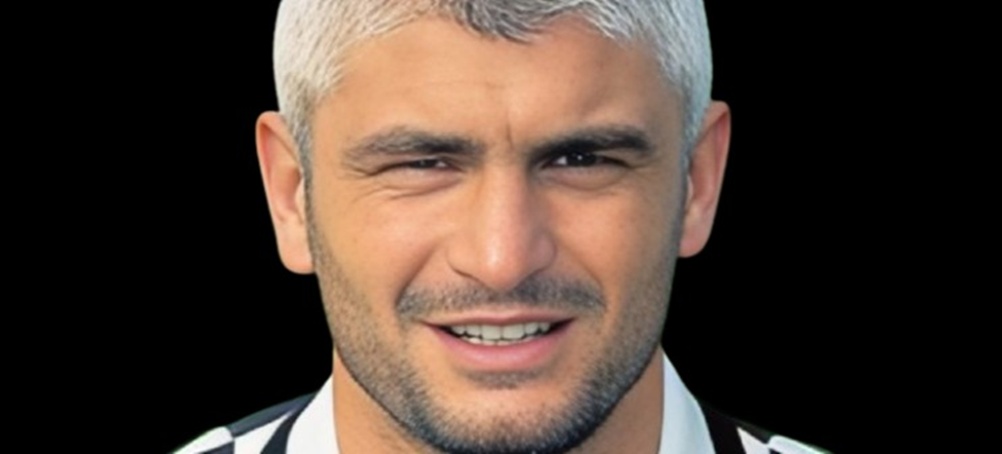
Fabrizio Ravanelli, born11 December 1968, Perugia, Italy.
PART ONE
When Fabrizio Ravanelli burst onto the footballing stage in the late 1980s with a head of prematurely silver hair and a left foot that seemed to possess a mind of its own, few could have predicted the rollercoaster ride that would follow.
Ravanelli was as local as they came. His love affair with football began not in the great cathedrals of calcio but in the dusty training grounds of his hometown club, AC Perugia, where he turned professional in 1986.
Here, in Italy’s third tier, he learned the game the hard way. The pitches were rough, the tackles even rougher, but the experience hardened him into a player who would eventually thrive on pressure. His time at Perugia was brief, but telling. Between 1986 and 1989, he scored 41 goals in 90 appearances, and his burgeoning reputation earned him a move to Avellino in 1989.
However, this transition was anything but smooth. At Avellino, he failed to find his rhythm, scoring just one goal in seven appearances. Consequently, he was quickly offloaded to Casertana, where he found a temporary reprieve, netting 12 goals in 34 appearances during the 1989–90 season.
Yet, for all his efforts, he was still far from the Italian elite. It would take a pivotal move to Reggiana in 1990 to truly set his career on an upward trajectory. If Perugia was where Ravanelli learned the game and Avellino where he faltered, it was at Reggiana where he caught fire.
Under manager Giuseppe Marchioro, Ravanelli became a central figure in Reggiana’s attack. Over two seasons, he scored 24 goals in 66 matches, helping the club mount a serious promotion challenge.
It was during this spell that he began to attract serious attention. His relentless pressing, intelligent movement, and a left foot that could slice through defences like a razor all made him the perfect blend of poacher and workhorse. And Juventus, ever the predator in search of new prey, came calling.
In 1992, Ravanelli signed for Juventus, and suddenly, the world took notice. At first glance, he seemed an unlikely star among the glamour and glitz of the Bianconeri. After all, this was a team boasting names like Roberto Baggio, Gianluca Vialli, Paolo Di Canio, and a fresh-faced prodigy called Alessandro Del Piero.
However, despite the galaxy of talent around him, Ravanelli quickly proved he was no mere supporting act. Though he initially struggled to secure a starting role under Giovanni Trapattoni, the appointment of Marcello Lippi in 1994 proved transformational. As a result, Ravanelli’s career trajectory shifted dramatically.
Lippi’s tactical nous gave Ravanelli licence to thrive in a front three, usually flanked by Vialli and either Del Piero or Baggio. This attacking trident, as fluid as it was ferocious, became the fulcrum of Juve’s assault on Italian and European football.
In the 1994–95 season, Ravanelli was electric, scoring 15 Serie A goals as Juve claimed a domestic double—winning both the Serie A title and Coppa Italia. Furthermore, he lit up Europe with his fearless displays, and in one particularly unforgettable night, bagged five goals against CSKA Sofia in a UEFA Cup tie.
Then came the crowning moment—the 1996 UEFA Champions League Final at Rome’s Stadio Olimpico. In the 29th minute against Ajax, Ravanelli capitalised on a defensive mix-up and rolled the ball in from the tightest of angles. It was not only a striker’s goal but a symbol of his knack for the spectacular and significant. Juventus eventually won via a penalty shootout, securing their second European Cup—and Ravanelli’s place in Juve folklore was sealed.
PART TWO
Following his Champions League triumph, Fabrizio Ravanelli stunned many by swapping Turin for Teesside, joining Middlesbrough in the summer of 1996 for £7 million.
The move was as bold as it was bizarre. Yet Ravanelli wasted no time making his mark in the Premier League, netting a hat-trick against Liverpool on his debut in a 3–3 draw at the Riverside Stadium.
Moreover, he scored 31 goals in all competitions during the 1996–97 season, including crucial strikes en route to the FA Cup Final and League Cup Final. However, despite his individual brilliance, Middlesbrough endured a season of heartbreak.
They lost 2–0 to Chelsea in the FA Cup Final, and were beaten in the League Cup Final replay by Leicester City after a 1–1 draw in the first match where Ravanelli had scored. Compounding the misery, the club was relegated after a three-point deduction for failing to fulfil a fixture—an off-field issue that perhaps symbolised the circus-like atmosphere that had enveloped the club.
Despite the goals and glamour, his relationship with Middlesbrough turned sour. He clashed with teammates and staff, often deriding the club’s training facilities and life in the town. Even though he lived in the picturesque village of Hutton Rudby, he seemed perennially unhappy. As a result, the love affair ended acrimoniously.
In 1997, Ravanelli swapped the cold of Teesside for the warmth of southern France, signing for Olympique de Marseille. During his two seasons at the Stade Vélodrome, he enjoyed a respectable spell, scoring 28 goals in 65 appearances and playing a key role in the club’s second-place finish in Ligue 1 in 1998–99, just a single point behind Bordeaux.
He also made his mark in the Champions League, netting in a 3–0 win over Sturm Graz. Yet, despite some success, his time at Marseille lacked the magic of his Juventus years.
Thus, in December 1999, he returned to Italy, joining a star-studded Lazio squad. Ravanelli would go on to collect his second Scudetto, as Lazio pipped Juventus to the title in 1999–2000. Moreover, he added the Coppa Italia and Supercoppa Italiana to his collection, although his role was more rotational than central. Even so, it was another triumphant chapter in his decorated career.
In a surprising move, Ravanelli returned to England in 2001, signing for Derby County on a free transfer. Despite being 32, he remained determined to perform at the top level, and though the Rams struggled, Ravanelli gave it his all.
He scored nine league goals in the 2001–02 season, but once again found himself part of a relegated side. Additionally, Derby’s dire finances meant they had to defer his wages, payments which continued for years after his departure.
From there, Ravanelli moved to Dundee in 2003, but the fairytale quickly crumbled. The club fell into administration and released its highest earners—including the Italian veteran. His only real highlight in Scotland was a hat-trick against Clyde in the League Cup, a brief flicker of form amid a fading career.
Finally, he returned to Perugia in 2004, closing the circle of his playing days. Though unable to save the club from relegation, it was a fitting end—returning to where it all began.
PART THREE
While Fabrizio Ravanelli’s club career was bursting at the seams with silverware and standout moments, his time with the Italian national team was comparatively fleeting—but by no means forgettable.
He made his debut for Italy in 1995, under Arrigo Sacchi, and scored in a 4–1 win over Lithuania. In total, Ravanelli earned 22 caps for the Azzurri, scoring eight goals. Though he was never the first name on the teamsheet in a golden generation boasting the likes of Roberto Baggio, Gianluca Vialli, Christian Vieri and Pippo Inzaghi, Ravanelli’s work rate and tactical intelligence made him a useful asset.
One of his most memorable appearances came in the Euro 1996 group stages. Italy, drawn into a tough group, ultimately failed to progress, and Ravanelli’s role was limited. It was a tournament tinged with frustration for both player and country.
The arrival of Cesare Maldini as manager in the build-up to France ’98 saw Ravanelli increasingly sidelined. By then, the emergence of younger forwards—and a tendency for Italy to favour more defensive systems—meant opportunities became scarcer. His final cap came in 1998, a somewhat abrupt end for a player whose international record was statistically solid but circumstantially stunted.
Yet, much like a fine wine left corked too soon, there remained a sense that Ravanelli had more to offer his country. Regardless, the White Feather’s impact—especially in key qualifiers and friendlies—left a mark. His goal in a fiery 2–1 win over Russia in Palermo, for instance, remains etched in the memory of those who saw it.
For most, retirement is a soft fade into media work or the business of endorsements. For Ravanelli, that was never going to suffice. Fire still burned within, not least the tactical flame sparked by years under the likes of Lippi, Trapattoni, and Sven-Göran Eriksson.
Post-retirement, Ravanelli dabbled in punditry—his passion often searing through television screens. But it was the dugout that beckoned.
He began his coaching education with Juventus’ youth teams, a fitting apprenticeship for a man who had lifted the Champions League in the black and white shirt. He absorbed, he instructed, he prowled the technical areas with a mix of calm calculation and combustible conviction.
Then came his big break—or so it seemed. In May 2013, Ravanelli was appointed manager of AC Ajaccio in France’s Ligue 1. However, the venture turned into a cautionary tale. Language barriers, a squad riddled with inconsistency, and a tumultuous dressing room saw Ravanelli last just five months. By November, he was sacked following a run of poor results, with the club languishing near the bottom.
If anything, though, it proved a baptism by fire. It taught Ravanelli that success as a player doesn’t guarantee smooth sailing as a manager. Still, his resolve remained undimmed.
In 2018, he returned to his roots once again—taking the helm at Arsenal Kyiv in Ukraine. The decision raised eyebrows. Why there? Why now? But Ravanelli saw it as a challenge, a chance to build something from the bottom up. Unfortunately, financial instability and political unrest made it an impossible mission. He resigned just a few months later.