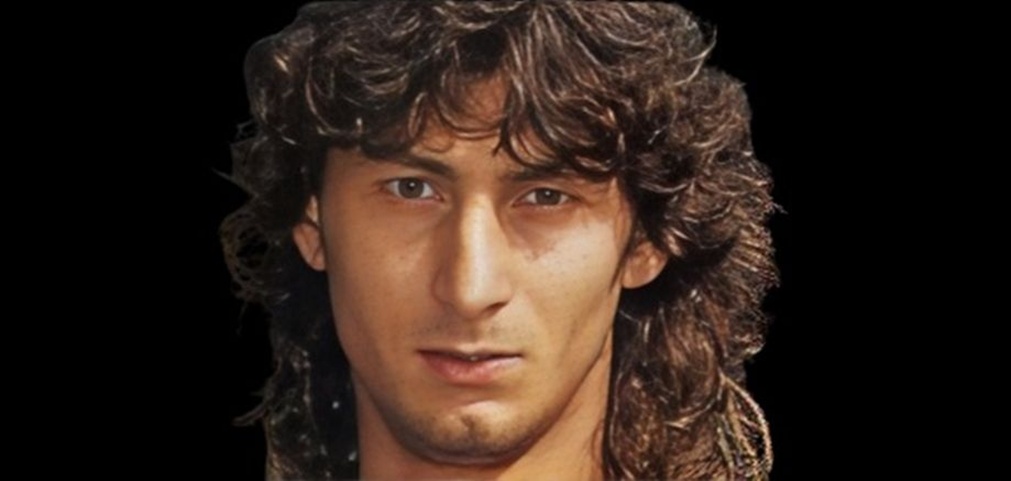
Andrea Silenzi, born 10 February, 1966, Rome, Italy.
PART ONE
Andrea Silenzi was a player who brought something different to the table, towering over many of his peers and earning the nickname “Big Brush,” due to his lanky frame and distinctive presence.
His early steps into the professional game came with A.S. Lodigiani, a modest club that has long served as a breeding ground for young Roman talent, and it was here that Silenzi began to shape his identity as a centre forward who thrived on physicality and aerial duels. Those early seasons were far from spectacular, as he struggled initially to impose himself and find the net with any regularity, and yet persistence slowly began to pay off as he entered his third campaign with the club.
Something clicked during that third season, and Silenzi suddenly discovered a scoring touch that had previously eluded him, finishing as the second top scorer in Serie C2 with 18 goals, a tally that hinted at untapped potential and drew attention from clubs higher up the pyramid.
The next step in his career came with a move to A.C. Arezzo in Serie B, a leap that should have signaled progress but instead became an early lesson in the harsh realities of professional football. Yet the move turned sour almost immediately, as Arezzo endured a dreadful campaign that culminated in relegation, and Silenzi himself failed to score in 19 games, a stark contrast to his previous exploits and a blow to his growing reputation.
Setbacks often forge resilience, and Silenzi’s response to this disappointment would define the next phase of his career, as he dropped back down a division to rebuild both confidence and credibility. Consequently, he joined A.C. Reggiana 1919 for the 1988–89 season, and it was here, in a more stable environment, that his fortunes began to turn decisively in his favour.
In contrast to his struggles at Arezzo, Silenzi flourished at Reggiana, scoring nine goals in 31 outings and playing a crucial role in the club’s promotion, as they finished first in Serie C1 and earned a place in the second tier. Promotion brought new challenges, but it also provided Silenzi with the stage he needed to showcase his abilities on a broader platform, and he seized the opportunity with remarkable determination.
The 1989–90 Serie B season became the defining campaign of his early career, as Silenzi exploded into life and delivered a stunning 23 goals in 38 appearances, accounting for a huge portion of his team’s total output. This meant that he would finish as the league’s top scorer and he earned recognition for having the best goal-per-game ratio in the division, a feat that elevated his status and made him one of the most sought-after strikers outside the Italian top flight.
Such prolific form could not go unnoticed, and it was only a matter of time before one of Italy’s elite clubs came calling, eager to harness his physical presence and newfound scoring touch. Accordingly, S.S.C. Napoli, fresh from winning the Scudetto and Coppa Italia, decided to invest heavily in Silenzi, paying a significant fee to bring him into a squad that already boasted the legendary Diego Maradona.
Naturally, joining a team of such stature brought immense pressure, and Silenzi found himself competing for minutes in a side where expectations were sky-high and patience was limited. Still, his Napoli career began with a flourish, as he played a key role in the 1990 Supercoppa Italiana, a match that saw Napoli thrash Juventus FC 5–1, with Silenzi scoring twice in a performance that suggested he could thrive at this level.
But despite that promising start, the remainder of the 1990–91 season proved frustrating for Silenzi, who managed just two league goals as Napoli slipped to an eighth-place finish. The following season offered only marginal improvement, as the team recovered to finish fourth, but Silenzi remained a peripheral figure, scoring four times in 20 appearances while others stepped into the spotlight.
Besides, the departure and absence of Maradona created a transitional period for Napoli and also exposed Silenzi’s inconsistency. And after two underwhelming seasons in Naples, a change of scenery became inevitable, and Silenzi moved on in search of a fresh start and greater responsibility.
PART TWO
In 1992, Andrea Silenzi joined Torino FC, a club looking to rebuild after the lucrative sale of Gianluigi Lentini, and one that offered him the chance to become a central figure in its attacking setup.
Alas, his first season in Turin followed a familiar pattern, as the central atacker struggled to find consistency in the league, scoring just three goals while the team finished in ninth position. Then again, football often offers redemption in unexpected ways, and for Silenzi, it came in the form of the Coppa Italia.
In the 1992–93 Coppa Italia final against A.S. Roma, Silenzi produced one of the defining performances of his career, scoring both goals in the second leg in Rome, even as Torino lost 5–2 on the night. But the aggregate score of 5–5 handed Torino the trophy on away goals, and Silenzi’s brace ensured his place in the club’s history, endearing him to supporters who valued decisive contributions in big moments.
Then, in the 1993–94 Serie A campaign, he reached his peak at the Stadio delle Alpi as he notched up 17 goals and finished among the league’s leading scorers, finally translating his physical gifts into consistent output. He also formed a dynamic attacking partnership with Enzo Francescoli and a young Benito Carbone, creating a forward line that combined strength, creativity, and movement.
His performances did not go unnoticed at international level, and Silenzi earned a call-up to the Italian national team in early 1994, a reward for his excellent club form. On 16 February 1994, he made his only appearance for Italy national football team in a friendly against France national football team, coming on as a second-half substitute in a match that ended in a 1–0 defeat.
Despite that milestone, Silenzi´s international career would go no further, as competition for places remained fierce and his inconsistency in front of goal once again counted against him. Meanwhile, back at Torino, the 1994–95 season brought changes that would alter his role within the team, as the arrival of Ruggiero Rizzitelli shifted the attacking hierarchy.
As it was, Silenzi’s goal tally dropped to just four, while Rizzitelli took center stage with 19, and the balance of power within the squad shifted accordingly. Silenzi’s reputation as a physically imposing striker remained intact, however, and it was this reputation that would lead to one of the most unusual moves of his life.
In the summer of 1995, he made history by signing for Nottingham Forest, becoming the first Italian to play in the Premier League, a league that was still in its early years and eager to attract international talent. The move, orchestrated by manager Frank Clark, was seen as a bold experiment, bringing a traditional Italian centre forward into the fast-paced, physical environment of English football.
Unfortunately, the transition proved difficult from the outset, as Silenzi struggled to adapt to the tempo and style of the Premier League, and he found himself on the fringes of the team. During the 1995–96 season, he made just ten league appearances, failing to score in the competition and unable to secure a regular place in the starting lineup. Besides, his contributions were limited to cup competitions, where he managed to score twice, once against Oxford United in the FA Cup and once against Bradford City in the League Cup.
Those moments were not enough to change perceptions, and his time in England quickly gained a reputation as a misfit spell, one where expectations and reality never aligned. So, after only two outings the following season, he returned to Italy on loan with S.S.C. Venezia, seeking to revive his career in more familiar surroundings.
His departure from Nottingham Forest was not without controversy, however, as it was reported that manager Dave Bassett terminated his contract after he allegedly refused to return from his loan spell. As a consequence, Silenzi left England with a tarnished reputation, often cited in the press as one of the least successful foreign signings of that era. Yet football careers rarely end in a single chapter, and he returned to his homeland determined to continue playing, even if the spotlight had dimmed considerably.
Back in Italy, he embarked on a journeyman phase, featuring for clubs such as Reggiana and Ravenna Calcio, where he contributed experience and occasional goals. He also returned to Torino FC for a final stint, but the sharpness of his earlier years had faded, and he managed to score just a mere two goals as the Maroons struggled and were ultimately relegated.
The final years as a player were marked by diminishing returns, and his last season with Ravenna in 2000–01 saw him fail to score, bringing his footballing days to a quiet conclusion. In 2001, at the age of 35, he decided to retire from professional football, leaving behind a career that had spanned the heights of the Italian Serie A and the challenges of the English Premier League.
Retirement did not mark a complete departure from the game, though, as he remained involved in football through administrative roles, including a position with Torino. He later took on a role in youth development with A.S. Cisco Calcio Roma, helping to nurture the next generation of players in his native city.