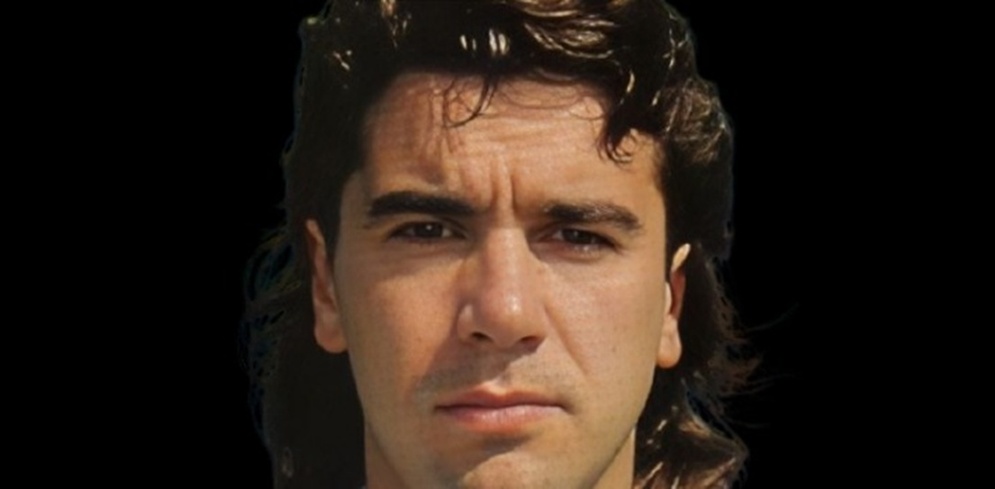
Full name: Stefano Borgonovo. Birthdate: 17 March, 1964. Birthplace: Giussano, Italy. Total league appearances: 272. Total international senior appearances: Three.
PART ONE
Stefano Borgonovo came through the youth ranks at Como Calcio and made his Italian Serie A debut at the age of 17, against Ascoli Calcio, three days before his 18th birthday. Serie A in the early 1980s was not a competition that indulged youth or forgave errors, and Borgonovo was a slender, quick, relatively small striker stepping into a world of hardened professionals who would sooner kick you into the advertising boards than give you space to breathe. But he adapted, and he survived, and in doing so he served notice that there was real substance behind the promise.
His early years at Como were spent learning his trade in the rough-and-tumble of both Serie A and Serie B, the Italian second division, and though he was never a prolific scorer in that period — managing just three goals in 33 appearances across two seasons in the lower division — it was clear to those watching closely that his value was never simply about the goals he scored, but about the way he moved, the angles he created, and the sheer cleverness of his positioning. He was not a battering ram. He was not a target man. He was something rarer and harder to coach: a footballer who understood space as though it were a language he had been born speaking.
A loan spell at Sambenedettese Calcio gave him further experience and sharpened his finishing instincts, and when he returned to Como he was a more complete player, more assured in front of goal, more capable of imposing himself on a match. So much so, in fact, that in 1986 Milan — one of the most powerful clubs in the world, midway through their transformation under manager Arrigo Sacchi into perhaps the most formidable club side Europe had ever seen — decided to buy him. That purchase was, in its own way, a remarkable statement of intent; and yet, with characteristic irony, Milan immediately loaned him back to Como, recognising that what Borgonovo needed more than the training ground of a great club was the weekly reality of first-team football.
He spent two further years at Como on that arrangement, growing steadily, developing the instincts that would shortly make him famous, and when the 1988–89 season arrived, Milan decided it was time to send him somewhere that would truly test him. They loaned him to ACF Fiorentina, the Florentine club in purple, and what happened next would become one of the most celebrated chapters in the history of that proudly emotional club.
Fiorentina in the autumn of 1988 had in their ranks a certain Roberto Baggio, who was already being spoken of in the kind of reverent terms that Italian football reserves for its most gifted sons. Baggio was 21-years old, extravagantly talented, capable of moments of invention that left defenders and spectators alike simply unable to respond, and he played with a withdrawn, creative intelligence that made him the ideal foil for a sharper, more direct partner. Borgonovo was that partner, and the two of them clicked from the first week as though they had been playing together for years, developing an understanding that went beyond football and became, by Stefano’s own account, a deep and lasting friendship.
Together under coach Sergio Santarini, Borgonovo and Baggio became the most feared attacking partnership in Italy that season. Borgonovo contributed 14 goals in 30 Serie A appearances — a remarkable return for a player still technically on loan — and the pair combined for 29 of Fiorentina’s 44 Serie A goals that season, a figure that tells you almost everything you need to know about how central they were to everything the club did. Moreover, their combined brilliance helped Fiorentina qualify for the UEFA Cup, which for a club of Fiorentina’s resources and recent history represented a genuine achievement.
But it was a single match in February 1989 that would define Borgonovo’s season, and perhaps encapsulate better than any statistic the particular kind of footballer he was. On 12 February, in the last match of the first round of the Serie A campaign, Fiorentina played host to Inter Milan, who at that point sat at the top of the table, unbeaten, and managed by Giovanni Trapattoni. Inter were the best team in Italy that season — they would go on to win the title and set a new points record in doing so — and they arrived in Florence as heavy favourites, a team of internationals at the peak of their powers, bristling with defensive organisation and attacking quality.
Fiorentina trailed 3–2 with the match running out, and Inter’s undefeated record seemed safe. Then Borgonovo stepped into the story. He equalised, pulling it back to 3–3, and the Artemio Franchi stadium erupted in the kind of noise that only relief and unexpected hope can generate. But there was more. Deep into the second half, in the 85th minute, Borgonovo produced what became his signature moment — a goal of such intelligence and precision that it still makes the eyes widen when described. He slipped behind Inter defender Riccardo Ferri, almost invisible to the Inter defence, and when midfielder Giuseppe Bergomi played a back-pass towards his goalkeeper Walter Zenga, Borgonovo exploded from his position and intercepted it. Bergomi later admitted he had no idea where Borgonovo was. Zenga came rushing from his line, and Borgonovo, reading the situation instantly, deftly took the ball past him and slotted it into an empty net. Fiorentina won 4–3.
Inter, on the other hand, were barely interrupted by the defeat; they went on to win their next eight consecutive matches and eventually claimed the title. But that afternoon in Florence, Borgonovo had done something extraordinary: he had beaten the best team in Italy with goals of intelligence rather than brute force, anticipating the intentions of experienced internationals in a manner that felt almost supernatural in its precision.
PART TWO
Borgonovo’s senior debut for Italy came on 22 February 1989 in a friendly against Denmark, which Italy won 1–0. He had also contributed to the Italian Under-21 side qualifying for the European Championships during the 1985–86 season, scoring a crucial goal against Sweden in that process, although injury ultimately prevented him from playing in the finals, where Italy finished as runners-up to Spain. It was a pattern that would, frustratingly, repeat itself throughout his time with the senior club he joined next.
Back on the club scene, his extraordinary season with Fiorentina earned him a permanent transfer to Milan for 1989–90, which meant he would now be operating within the most ruthlessly organised, most tactically sophisticated club environment in European football. Arrigo Sacchi’s Milan were defending European Cup champions, a team of titans that included Franco Baresi, Paolo Maldini, Carlo Ancelotti, and the incomparable Marco van Basten, who was at that point the best centre-forward on the planet. Borgonovo was, in effect, his deputy — and that was never going to be the easiest role for a man whose greatest quality was his love of playing, his need to be involved, his hunger for the weekly act of a football match.
He notched up 13 appearances that campaign, contributing two goals, and spent long stretches on the bench or in the treatment room, nursing the injuries that had begun to take a persistent toll. Yet his contribution to Milan’s European Cup triumph that season was not negligible. In the semi-finals against Bayern Munich, he first won a penalty that Van Basten converted, and then, in a moment of wonderful composure, scored a decisive goal of his own — a delicate lob over home goalkeeper Raimund Aumann at the Olympiastadion in Munich — that helped secure Milan’s passage to the final, where they edged out Benfica 1–0 to claim the trophy. He netted two goals in that European Cup campaign, and his name was engraved on the medal as surely as any of the stars who played more minutes than he did. Additionally, that same season he was part of the Milan side that won the European Supercup and the Intercontinental Cup, making it one of the most decorated single campaigns any Italian footballer could hope to experience.
Despite all of that, despite the glittering silverware and the European Cup winner’s medal, Borgonovo knew his own situation clearly and honestly. He wanted the pitch, the crowd, the immediacy of competition, and at Milan, behind Van Basten, that was not reliably available to him. Even though Arrigo Sacchi was reportedly keen to retain him, Borgonovo chose to return to Fiorentina for the 1990–91 season, determined to rediscover the form and freedom he had enjoyed during that magical loan spell. Unfortunately, as happens sometimes in football and in life, the magic proved impossible to recapture. He spent two seasons back in Florence without managing to approach the heights of 1988–89, and the statistics of those years reflect a player whose body was beginning to resist the demands he placed upon it.
He later moved on to Pescara Calcio, then to Udinese, and finally to Brescia Calcio, where he played out the remaining years of his professional career before retiring in 1996 at the age of 32. Across those later clubs there were good days and difficult days, glimpses of the old intelligence and sharpness alongside the mounting evidence that the physical toll of fifteen years of professional football was extracting its price. But in the estimation of those who watched Italian football throughout that era, Borgonovo’s reputation needed no late redemption; the 1988–89 season at Fiorentina had been enough to secure his place in the affections of the sport, and the goals he scored against Inter on that February afternoon remained, for many, the defining image of a player who did his best work in the moments that mattered most.
He had been a footballer of quicksilver intelligence. He was not the quickest man over 50 yards; he was not the most powerful or the most technically elaborate. What he possessed was something far rarer — a gift for reading the positions of opponents before they had taken them, for understanding where a defender’s attention was directed and then appearing precisely where that attention was not. His positional sense inside the penalty area was, by any measure, exceptional, and he combined it with good acceleration over short distances, fast reactions, and the kind of calm in front of goal that is impossible to teach and very difficult to acquire.
On top of that natural finishing ability, he was creative and mobile in the link play between midfield and attack, capable of dropping deep to receive the ball and setting team-mates into space, and though his most effective position was always as an out-and-out striker playing alongside a more creative, withdrawn forward — the dynamic he had with Baggio was the ideal expression of that partnership — he could also operate as a second striker when required.
After retiring from playing, Borgonovo moved into coaching at youth level, returning to Como — the club where everything had started — and for several years he shaped the next generation of players with the same intelligence he had brought to his own game.