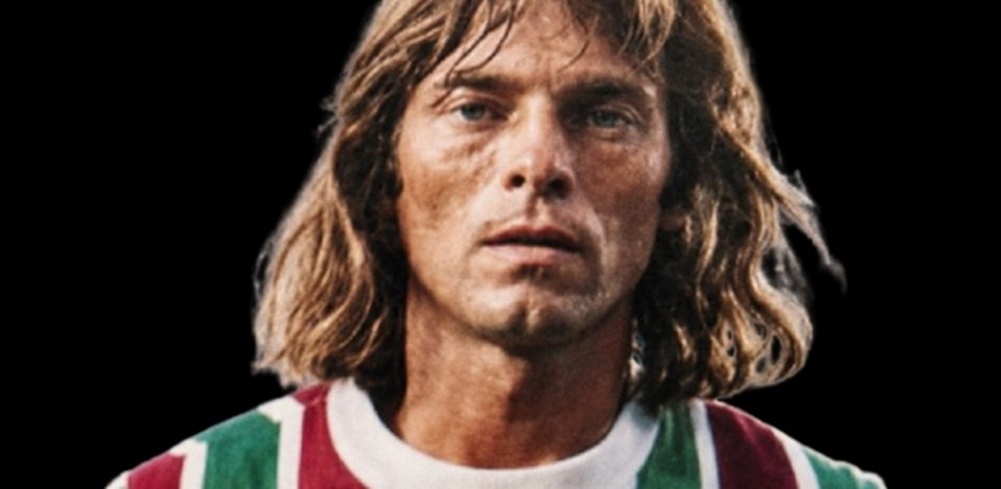
Narciso Horacio Doval, born 4 January 1944, Buenos Aires.
PART ONE
Narcisco Doval was signed by San Lorenzo de Almagro in 1953, and by November 1962, still only 18, he was in the first team and already causing a stir. He was quick, direct, and technically accomplished, capable of playing wide on the right or cutting inside to operate as a second striker, and he had the kind of low centre of gravity and explosive first step that made full-backs look slow even when they weren’t. Over six seasons in the senior side he made 90 appearances and scored 30 goals — a more than respectable return for a wide player — but the numbers only hint at the impression he was making. The Boedo crowd christened him El Loco Serenata, the mad serenade, which is perhaps the most charming nickname in the history of Argentine football, and they adored him with a ferocity that would become the recurring theme of his life.
But his time at San Lorenzo was not without complications and this too would become a recurring theme. He earned a single cap for Argentina in 1967, but the same year brought an incident involving a stewardess on a flight that led to his suspension by the Argentine football federation and effectively ended his international involvement before it had begun. He maintained his innocence throughout, but the damage was done, and his relationship with the football establishment cooled considerably. A brief loan spell to Elche in Spain in 1968 produced two outings and no goals, suggesting neither player nor club got much from the arrangement.
What rescued him, and launched the most extraordinary chapter of his story, was a Brazilian coach named Elba de Padua Lima, universally known as Tim. Tim had managed San Lorenzo’s championship-winning side and knew Doval’s qualities as well as his vices, and when he took charge of Flamengo in 1969, he went straight back to Buenos Aires and paid one hundred thousand dollars to bring his maverick attacker with him. Tim told Doval that if he went to Rio de Janeiro, he would never want to leave. He was right.
Doval arrived in Rio de Janeiro in 1969 and took to the place like a man who had been waiting his whole life for it. The beaches, the music, the warmth, and the enormous football culture of a city that takes the game more seriously than almost anywhere else on earth — all of it suited him perfectly. And the football suited the city right back. He was fast, he was fearless, he was technical, and he had the kind of personality that makes stadiums hum, which is why the Flamengo supporters, the most numerous and passionate fanbase in Brazilian football, took to him immediately and called him O Gringo with the kind of affection that only Brazilians can load into a word that might otherwise carry a hint of distance.
But the first spell was bumpy. A Flamengo coach named Yustrich, a hard-line disciplinarian of the old school, had little patience for the long-haired Argentine who liked staying out late and showing up to training looking like he had enjoyed the evening considerably. In 1971, Doval was loaned to Buenos Aires club Huracán, where he made 29 appearances and scored five goals, and it was not clear that his Brazilian adventure would survive. However, in 1972, under new manager Mario Zagallo — the same Zagallo who had won the World Cup as both player and manager — Doval was given a fresh start, and he grabbed it with both hands.
What followed was the best football of his life. In the 1972 Rio State Championship, Doval was the top scorer and scored the decisive goal in the final against Fluminense, heading the ball into the net in a 2-1 victory that sent the red-and-black half of Rio into ecstasy. Flamengo retained the Taca Guanabara in both 1972 and 1973, and won the Rio State Championship again in 1974, and through all of it Doval was a central figure — dangerous, creative, and addictively watchable. By the end of his time at Flamengo, across two separate spells from 1969 to 1975, he had made 263 appearances and scored 95 goals, making him the highest-scoring foreign player in the club’s history, a record that stood until only very recently.
PART TWO
In early 1976, the president of Fluminense, a lawyer and judge named Francisco Horta, engineered what was one of the more audacious transfers in Brazilian football history by persuading Rio’s biggest derby rival to sell him their most beloved player. By rights this should have made Doval a villain in one half of the city and a hero in the other, but such was the strange charisma of the man that he managed, against all odds, to remain beloved on both sides of the divide. At Fluminense he won the Rio State Championship in 1976 and was the leading scorer that year too — the only player to be top scorer in the Carioca for two different clubs, and bitter enemies at that — and in 1976 he was also voted the best centre-forward in Brazil. He played 142 matches for Fluminense, scoring 68 goals, and at the end of it the city of Rio de Janeiro, which had already awarded him honorary citizenship in 1973, naturalised him as a Brazilian in recognition of what he had contributed.
One of the most significant things anyone ever said about Doval came from none other than Zico, the Brazilian genius who is widely considered one of the greatest players who ever lived. Zico, who played alongside him at Flamengo in the early 1970s, said that Doval was one of the best attacking partners he ever had — not one of the best foreign players, not one of the best players at Flamengo, but one of the best he had played with, full stop. Coming from Zico, that is not a sentence you read past quickly. It is worth sitting with for a moment and considering what it says about a man who won a solitary international cap.
Zico’s reputation has only grown with time, but in the early part of the 1970s he was still finding his way, and the presence of Doval — experienced, fearless, intelligent in front of goal — gave the offensive oriented midfielder both a partner and a model. The two of them together were a problem that no Rio defence had a reliable solution to, and the fact that Doval was prepared to work hard off the ball as well as on it made the seasoned campaigner the kind of wide forward that creative players cherish.
There is also the matter of Garrincha. In 1973, Doval was selected to play in the farewell match for Garrincha at the Maracana Stadium — the great winger who was, along with Pele, the most celebrated Brazilian footballer of his generation. That Doval, an Argentine, was invited to participate in this ceremony of Brazilian football speaks to the regard in which he was held not just by supporters but by the game’s insiders. You do not get asked to be part of that kind of occasion unless you are considered family.
Following his second stint at San Lorenzo in 1979 — 22 appearances and 10 goals — Doval had one final chapter to write, and it was, in its way, endearingly eccentric. In 1980 he headed to the United States and the American Soccer League, playing first for the Cleveland Cobras, where he scored two goals in four outings before being traded mid-season for an attacker named Joey Fink, and then for the New York United, where he did rather better with 10 goals in 14 appearances. The North American Soccer League era had brought players such as Pele, Johan Cruyff and Franz Beckenbauer to the United States, and while Doval was not quite in that company of names, his late spell in America had a certain poetry to it — the restless Argentine, still scoring, still wandering, finding one more crowd to charm before the curtain came down.