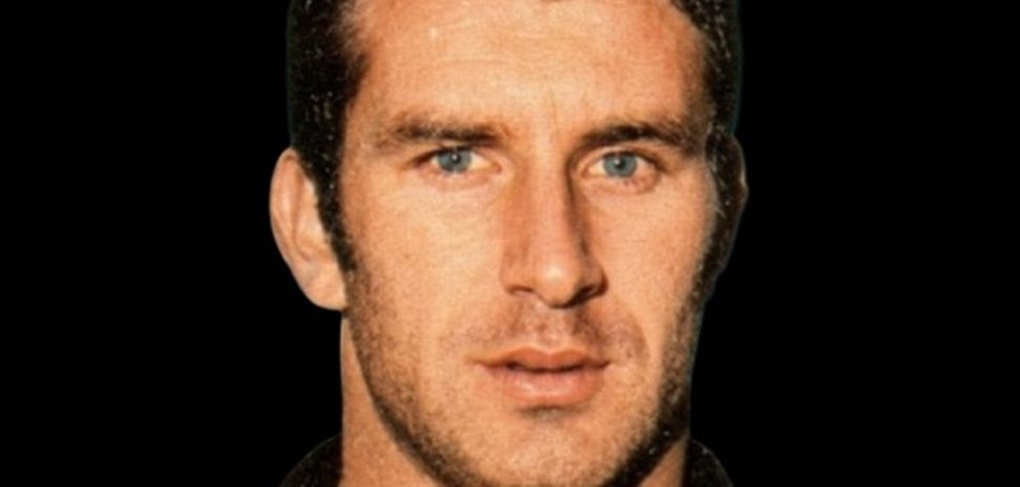
Silvino Bercellino, born 31 January 1946, Gattinara, Italy.
PART ONE
Silvino Bercellino came through the Juventus youth system, and from the beginning it was clear that he had something — the touch, the positioning, the unhurried authority in front of goal — that set him apart from the other prospects moving through the academy. In 1963, while still in Juventus’ youth setup, Bercellino earned two caps for Italy’s Under-21 side and scored four goals — a ratio that suggests he was playing with a freedom and abandon at youth level that he could rarely quite replicate in the pressured adult game. His most significant contribution in an Italy shirt came at the Mediterranean Games in Naples, where the Azzurrini won gold and Bercellino featured prominently in the knockout stages. It was the high-water mark of his international involvement, and it is slightly poignant that it came so early — that the peak of his life in blue happened at nineteen, before the complications of senior football had fully descended.
The young forward had his first taste of senior football at Juventus in the 1963–64 Serie A campaign, and it was the briefest of glimpses — two appearances, one goal, a whisper of what might be possible. But the context around him was formidable and almost comically daunting. The Juventus squad of that era contained Omar Sívori, the Argentine genius, all curls and insolence and devastating skill, and Giampaolo Menichelli, one of Italy’s most dangerous forwards, quick and direct and hungry. Breaking into that attacking line was not simply a matter of talent. It required a kind of organised, relentless self-promotion that Silvino simply did not possess.
The 1964–65 season brought a loan move south to Potenza in Serie B, and it is here that the real Silvino Bercellino begins to emerge. Away from the weight of expectation in Turin, away from the giants blocking his path, he flourished as a centre-forward with a freedom and a productivity that turned heads throughout the division. Eighteen goals in 35 appearances — a fine return in any league, in any era — and among them some moments that illustrated precisely why Juventus had signed him in the first place.
On 17 January 1965 he scored twice in a 2–2 draw against Parma, and three weeks later, on 7 February, he put two more past Hellas Verona in a 3–0 win that showed Potenza at their very best and Bercellino at his most efficient. His left foot was a weapon, his positioning in the box impeccable, and his capacity for the decisive action — the run timed to perfection, the finish taken with minimum fuss — became the signature of his play. Potenza finished mid-table, which was a reasonable enough outcome for a club of their resources, but Bercellino’s individual contribution was considerably above what mid-table suggests. He had announced himself.
Juventus recalled him for the 1965–66 Serie A campaign, and this time Silvino made more of a mark, earning ten appearances and six goals, all of which arrived from set pieces — a detail that speaks volumes about his technical refinement and his capacity for stillness under pressure. Free kicks and penalties are, in their different ways, moments when the chaos of the game momentarily pauses and a single player must impose his will on the situation, and Bercellino was exceptionally good at both.
On 13 February 1966 he converted two penalties in a 3–1 home win over Varese. A week later, on 20 February, he bent two free kicks past the Vicenza goalkeeper in a 2–2 draw at their ground, a performance that earned him plaudits across the Italian press. On 27 February he settled a tight contest against Catania with a free-kick winner, and then on 6 March he equalised against Roma with another dead-ball effort, deep into the second half, in a game Juventus had threatened to lose.
PART TWO
In the summer of 1966, Bercellino moved to Palermo, and something shifted. Not dramatically, not all at once, but gradually and unmistakably, he found a home. His debut season, 1966–67, produced 13 goals in 35 Serie B appearances, and with cup competitions included he finished with 15 goals from 37 games — a contribution that moved Palermo to a ninth-place finish and established him quickly as a significant figure in the dressing room and on the pitch. There is something telling in the numbers: this was a player who, at Juventus, was considered peripheral and slightly suspect, a man who needed watching, who couldn’t be relied upon to produce consistently. At Palermo, competing at a level commensurate with his talents and free of the political weight of a giant club, he simply scored goals, game after game, and kept scoring them.
The 1967–68 campaign brought a brief interruption — a loan to Mantova for the early months, five Serie A appearances and one goal — before he returned to Palermo in November and resumed where he’d left off, scoring nine goals in 26 league games as Palermo pushed for promotion. They won it. The Serie B title was theirs, and Bercellino’s goals had been central to it, and there was genuine satisfaction in that, the kind of collective achievement that gives a footballing life its texture and meaning.
Promotion to Serie A in 1968–69 brought a step up that tested him, as it tests all players accustomed to the second tier. Eighteen appearances and three goals in the top flight — modest by his own recent standards, but it was enough to keep Palermo up, and a 14th-place finish in their first season back in Serie A counted as a success. The 1969–70 season in Serie A brought three goals in fourteen games, and Palermo ultimately went down — the step between surviving and thriving in Italy’s top division was always narrow, and the squad’s limitations were real. But Bercellino had acquitted himself honestly, and through relegation and promotion and the grinding reality of Serie B he remained a constant, scoring seven goals in 21 games in 1970–71 as Palermo pushed for another promotion that narrowly eluded them, then four more in 20 appearances in 1971–72 as the club tried to find stability.
By the summer of 1972, his six years in Palermo were over. The club had changed ownership, restructured, and Bercellino was thirty-six. Actually, he was twenty-six, which sounds young, but Italian football could age a man quickly in those days when clubs were volatile institutions and footballers had very limited power over their own circumstances. His total across all six years at the club: 146 appearances, 42 goals. A record that deserves more than a footnote.
After Palermo, Bercellino joined forces with Monza for the 1972–73 season in Serie B — seventeen appearances, one goal, a modest final chapter in professional football’s upper tiers. Then came Livorno in Serie C for 1973–74, 26 appearances and four goals, a further step down the pyramid but one he navigated without drama. He was adapting, as footballers of his era had to, to the gradual narrowing of options that came with age and changing circumstances.
The final and perhaps most unexpected chapter came at Biellese, his regional club from 1974 to 1978, spanning Serie D, amateur football, and eventually promotion to Serie C. Here, away from the bright lights, playing for a club close to where he had grown up, Bercellino produced numbers that would have astonished anyone who’d watched him idling in the shade at the Comunale. One hundred and four appearances. Fifty-five goals. A man who had spent much of his peak years apparently in no great hurry suddenly becoming a proliferating, decisive force in regional football — as if the absence of pressure and politics and expectation had finally released him fully into the player he always had the potential to be.
He retired after a final season with Grignasco in 1978–79, at thirty-three years old, somewhere in the semi-professional lower reaches of Italian football where records are patchy and statistics thin. Across his entire time as a professional, he accumulated approximately 332 appearances and 123 goals. Not a spectacular total, but an honest one — the sum of a man who moved a great deal, scored consistently at every level he played, and brought something to every club he represented.