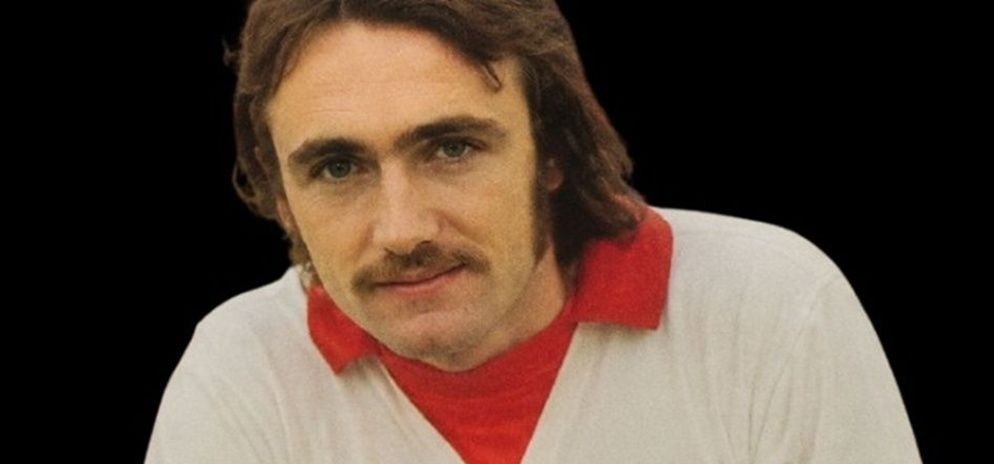
Michael Peter Kitchen, born 16 February 1952, Mexborough, England.
PART ONE
Growing up in Mexborough, a tough South Yorkshire mining town that sat in the shadow of the steelworks, Peter Kitchen attended Mexborough Grammar School, where his talent was obvious enough to earn him representative honours for Yorkshire Senior Schools and England B, and where a football scout named Lawrie McMenemy — a big, voluble man who would go on to manage Southampton to one of the great FA Cup upsets of the 20th century — spotted something in the boy that suggested he was worth a gamble. McMenemy brought him to Doncaster Rovers, and what followed was seven years of goals, partnerships, and the kind of loyalty to a struggling club that you simply don’t see anymore.
Kitchen made his debut at 18, and if anyone needed confirmation that they were watching something special, they got it inside the first two minutes. Doncaster beat Shrewsbury Town 3–0 that day, and Kitchen scored, announcing himself to Rovers fans with the kind of impudence that would become his trademark. He scored again in his very next game, even as Doncaster went down 2–1 to Swansea Town, and in those back-to-back appearances you could already see the outline of the player he would become: someone who found the net regardless of the scoreline, regardless of the occasion, and regardless of whether anyone else around him was pulling their weight.
Doncaster were a Division Four club, and there was nothing glamorous about their situation. They scraped and struggled through seasons the way most lower-league clubs do, short of money and short of quality, and yet Kitchen stayed, and Kitchen scored, and Kitchen built himself a reputation that transcended the division entirely. The striking partnership he formed with Brendan O’Callaghan was a productive one, and the one he developed with Mike Elwiss had a particular chemistry — two players who read each other well and who could pull defences apart even when the rest of the side was going through the motions. But of all the memories he accumulated during those seven years at Belle Vue, none would quite match what happened on a cold January afternoon in 1974, when Doncaster Rovers — a Fourth Division club with no earthly business being anywhere near such an occasion — travelled to Anfield to face Liverpool in the FA Cup third round.
Liverpool in January 1974 were not merely a good side; they were one of the dominant forces in English football, a Bill Shankly team playing with the kind of assurance and superiority that made them feel inevitable. And yet Doncaster, with Kitchen and Elwiss leading their line, refused to be brushed aside. The game ended 2–2, a result that seemed to stun the football world, and Kitchen scored one of those two goals — putting his name on a scoresheet at one of English football’s most storied grounds and proving, if proof were needed, that he was operating on a level his current club simply couldn’t contain him at forever. Doncaster lost the replay 2–0, as perhaps was always going to happen, but the damage to Kitchen’s reputation was done in the best possible sense: people had noticed.
Higher division clubs began to circle. He spent time on trial at Ipswich Town, where Bobby Robson was building a side that would eventually win the FA Cup and the UEFA Cup, but a permanent move didn’t materialise, and Kitchen continued to score for Doncaster while the football world considered what to do with him. The answer, when it finally came in the summer of 1977, was Leyton Orient, who paid £40,000 for a player who was 25 years old and had been proving himself in the fourth tier for the best part of a decade. It was, in retrospect, a bargain of almost insulting proportions.
PART TWO
What Kitchen did at Leyton Orient in his first season there belongs among the more extraordinary individual performances in the club’s history. He was ever-present across the campaign, missing nothing, and he finished as the club’s top scorer with 21 league goals — a number that would have been impressive on its own but which was only part of the story. Because Orient that season made a run in the FA Cup that had the whole club buzzing and the whole of east London daring to dream, and Kitchen was at the centre of it.
He scored seven times in the competition as Orient beat Chelsea and Middlesbrough on their way to the semi-finals, and if you want to understand what that meant to a club of Orient’s size and standing, you have to understand that reaching an FA Cup semi-final is, for a club like that, what winning the competition might be for someone else. It was the stuff of fairy tales, and Kitchen was writing the most important chapters. The goals against those bigger, better-resourced opponents — Chelsea and Middlesbrough were both considerably more powerful sides than Orient — carried a significance that went far beyond the mere arithmetic of football. They were statements, and Kitchen was making them.
However, success of that kind has a way of attracting attention, and the following year Fulham came in with £150,000 and persuaded Orient to sell. It was a big fee, and it represented the kind of move that Kitchen had perhaps been building towards since those early days in Mexborough, but it didn’t work out the way anyone had hoped. He struggled to find his form at Craven Cottage, which can happen even to the best of players when they move to a new environment, and in his second year things deteriorated further when a series of injuries took hold and cost him most of the season. Fulham were relegated, and Kitchen, diminished by those lost months and never quite having convinced at the club, departed for Cardiff City at a fee of £100,000, which itself tells you something about how quickly a footballer’s value can erode when circumstances conspire against him.
Cardiff gave him a fresh start, and Kitchen took it. He made his debut for the Welsh club in a 4–2 win against Leyton Orient — his old employers, which added a certain neat irony to proceedings — and though he didn’t score that day, he ended the season as Cardiff’s top scorer with 13 league goals and 19 in all competitions, the extra six coming largely from a remarkable performance in the Welsh Cup in which he scored five times in a 6–0 demolition of Cardiff Corinthians. It was the kind of form that kept Cardiff out of the relegation places that season, and though the club ultimately couldn’t escape their troubles — they fell to Division Three in his second season at Ninian Park — Kitchen had at least given them everything he had.
What followed was a period that reflected both the broadness of football’s geography in the early 1980s and the restlessness that sometimes settles on players once they pass their peak years without finding the big stage they deserved. He spent time with Happy Valley in Hong Kong, sampling football on a different continent and a different scale entirely, before returning to Leyton Orient for a second spell in 1982–83. He made another 49 league appearances for the club, adding to the considerable tally he had already built up there, and then crossed the Atlantic to play Major Indoor Soccer League football with the Las Vegas Americans — a move that would have seemed extraordinary in the context of where he had started, in the coal-and-steel landscape of South Yorkshire, and yet made a certain kind of sense for a man who had always been willing to go wherever football took him.
He played non-league football for Dagenham, then spent a short stint at Chester City in 1984–85, rounding off his Football League involvement before returning to Dagenham for the rest of that season. He retired at 33, which is not particularly early, though the game had taken its toll in the way it always does, and the years of scoring goals for clubs that never quite matched his ability had used up a great deal of him. But retirement, as it turned out, didn’t quite stick. He made a brief return for Margate in 1991, because some men simply can’t walk away from the game cleanly, and during the 1990s he appeared 228 times for Corinthian Casuals Veterans, scoring 280 goals — a number that is, when you think about it, completely extraordinary, and which speaks to a goalscoring instinct that simply never dimmed regardless of the level or the context.
After football, he moved into work on the youth development programme at Wimbledon, passing on what he knew to a younger generation, and then into leisure management in Sevenoaks before retiring fully around 2010. The tributes came eventually, as they always do when enough time has passed for perspective to settle in. In December 1999, supporters of both Doncaster Rovers and Leyton Orient — two clubs separated by geography, division, and culture — voted Kitchen among their greatest ever players, an achievement that is rarer than it sounds, because earning that kind of cross-club reverence requires not just talent but a particular quality of character that makes itself felt on supporters long after the player has gone. Then, in the summer of 2021, he was inducted into the Leyton Orient Hall of Fame, recognition of those extraordinary seasons in which he had dragged the club to places they had never been before and have rarely visited since.