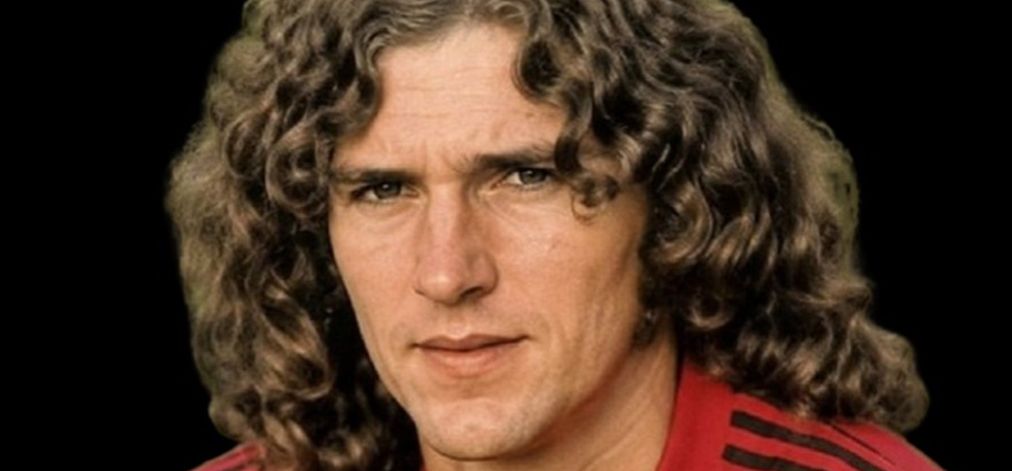
Edward Byrne, born 31 October 1951, Dublin, Ireland.
PART ONE
The Dublin football scene of the late 1960s was a world unto itself. The League of Ireland ran on part-time wages and full-time passion, the terraces at Glenmalure Park and Dalymount filled with men in overcoats who argued about Irish football with the same ferocity their counterparts in England reserved for the First Division. Into this world stepped a teenager from the city, Eddie Byrne, who joined Shamrock Rovers’ youth setup around 1969 and began the slow, grinding work of becoming a centre-forward.
Rovers were one of Dublin’s preeminent clubs — the Hoops, with their distinctive green-and-white stripes and their home at Glenmalure Park in Milltown, a compact, atmospheric ground that sat in the lee of the Dublin mountains. The club’s youth programme was structured enough to offer a young striker proper developmental football, and Byrne came through it with his instincts sharpened. By 1970, still barely eighteen, he stepped up to the senior side, signed as a professional in the League of Ireland and given a number to wear and a role to play. He was a centre-forward, which in the language of that era meant something specific: get in the box, win the ball in the air, make yourself a nuisance to defenders, and score goals when the moment comes.
His three seasons at Rovers, from 1970 to 1973, were formative rather than spectacular. He made forty league appearances and found the net once — figures that tell you something about the nature of his contribution, which was more about occupation of space and physical presence than about being the primary outlet for goals. Paddy Ambrose managed the side, and under him Byrne absorbed the tactical disciplines of League of Ireland football: the compact shape, the direct approach, the premium placed on work rate in a league where the pitches could be heavy and the margins thin. Specific details of individual matches from this period are hard to pin down now; it was an era before blanket coverage and digital records, when the only reliable accounts were buried in the sports pages of the Irish Independent or the Evening Herald. What we know is that Byrne was there, learning his trade, building the foundations of a professional life.
The summer of 1973 brought an abrupt lesson in the economics of football. Rovers placed Byrne on the transfer list, and the move that should have followed didn’t come. No League of Ireland club came in with a contract, and so he dropped down to non-league football with Bluebell United, a club from the south-west of the city, playing competitive football but without the professional structure he had known at Milltown. It was a humbling interlude, and not a brief one; the best part of six months passed before Bohemians came calling in December 1973, offering Byrne a return to the senior game.
Bohemians and Shamrock Rovers were Dublin’s great footballing rivals, and the journey from Milltown to Dalymount Park — Bohs’ own ground in Phibsborough, a crumbling, much-loved arena that seemed to belong to another century even when it was relatively new — was not merely a geographical one. It was a crossing of an invisible cultural divide, a move from one end of the Dublin football spectrum to the other. Manager Billy Young brought Byrne in as a forward option, and he integrated into the squad for the remainder of the 1973–74 season. However, the good fortune didn’t hold. After that first stint at Bohs, Byrne found himself back at Bluebell United for the 1974–75 and 1975–76 seasons, spending two years outside the top flight altogether, a period of real instability that tested whatever professional resolve he had.
In March 1976, Bohemians brought him back, and this time the arrangement would last. The second spell at the club ran until April 1978, and it is this period that contains the most vivid passages of Byrne’s story. Under Billy Young’s continued management, Bohs were building towards something — a coherent, competitive side with European ambitions — and Byrne was part of the attacking machinery that gave the club its shape. He was a reliable forward presence, a man who understood his role and executed it without demanding the limelight, and in the wider context of Irish football, that had its own kind of value.
The 1976–77 season brought something genuinely rare for a League of Ireland side: a serious run in continental competition. Bohemians had qualified for the European Cup Winners’ Cup by winning the previous year’s FAI Cup, and their first-round opponents were Esbjerg fB, one of the dominant Danish sides of the 1960s who had already won their second domestic cup and had previous experience against Irish sides, having knocked Linfield out of the European Cup in 1962–63. Danish football was on the cusp of professionalism — it would officially turn professional in 1978 — but Esbjerg remained a formidable proposition.
The first leg was played at Dalymount Park, and Bohemians won 2–1. Byrne featured in that match, starting as he would in all three European appearances across the two legs and a second-round fixture. The second leg, played in Esbjerg itself, produced a 1–0 win for Bohs, and with it came a historic moment for the club: Bohemian FC had knocked out Esbjerg fB to secure their first European tie victory, with Noel Mitten heading in a cross from Pat Byrne to clinch progression. The aggregate stood at 3–1 to Bohs, and they advanced to the second round, where Śląsk Wrocław of Poland awaited, winning 3–0 in Wrocław to end the run. Byrne didn’t score, but he was present for the moment when a Dublin club made European history, which is something not every footballer gets to say.
The following season, 1977–78, brought a different kind of European experience entirely. Bohemians had finished second in the League of Ireland and earned a place in the UEFA Cup, where they were drawn against Newcastle United — fifth in the English First Division the previous season and one of the most storied clubs in the country. The European dream turned into something of a nightmare as a riot marred the away match with Bohemians at Dalymount Park, where Newcastle supporters caused serious trouble. The UEFA Cup tie with Bohemians at Dalymount had to be stopped for ten minutes as fans fought with each other, with bottles, blocks of wood and cans used as missiles, the trouble eventually spilling onto the pitch, and Newcastle keeper Mahoney requiring treatment after being hit.
The football itself, beneath all the disorder, ended goalless: Newcastle drew 0–0 at Dalymount Park on 14 September 1977, and won 4–0 at St. James’ Park on 28 September to advance comfortably on aggregate. Byrne started both legs, playing the full ninety minutes in the cauldron of Dalymount as the trouble broke out around him and then at St. James’, where Newcastle’s greater quality told eventually and emphatically. He was twenty-five years old, competing at the highest club level available to him, and acquitting himself with the professionalism that defined his approach throughout.
PART TWO
The spring of 1978 brought an unexpected opportunity, one that placed Byrne in a very different context altogether. He moved along with Pat Byrne and Fran O’Brien to the Philadelphia Fury of the North American Soccer League. The NASL in 1978 was at the height of its gaudy, exhilarating, financially precarious prime: Pelé had just retired from the New York Cosmos, the crowds were there, the television coverage was there, and clubs across the country were signing players from Europe and South America in an effort to make the spectacle credible. Philadelphia had its own version of this, and the Fury — playing in a league defined by artificial grass, generous scoring systems and a clientele that had never grown up watching football — offered Byrne a summer’s work in the sun.
He wore the number four shirt and made eighteen appearances across the 1978 season, accumulating 678 minutes of playing time and contributing one goal to the Fury’s efforts. His teammates included defender John Dempsey, a former Chelsea and Republic of Ireland man who had won the FA Cup in 1970 and the European Cup Winners’ Cup in 1971, and midfielder Tony Glavin, a Scot who would go on to play for Celtic. It was, in its way, a properly cosmopolitan squad, a mixture of fading names and hungry professionals from various parts of the football world, all finding their feet on unfamiliar turf — sometimes literally, given the NASL’s fondness for artificial surfaces.
The cultural contrast with League of Ireland football was complete. Where Dalymount had been a terraced bowl, creaking and intimate, the Fury played at Veterans Stadium, a vast multi-sport arena designed for American football and baseball. Where Dublin crowds had argued over the finer points of the 4-4-2, Philadelphia audiences were still learning the offside rule. But Byrne was a professional, and professionals adapt. He played his eighteen games, scored his goal, and returned to Ireland in August 1978 when his time with the Fury concluded.
His return to Shamrock Rovers in August 1978 was notable for the company he kept. The club signed him alongside Bobby Tambling, the former Chelsea and England forward who had spent years in Ireland and whose presence at Rovers gave the club a certain cachet. Byrne slotted back into the Hoops’ setup, resuming domestic duties in the League of Ireland while also earning one further European appearance during the 1978–79 season.
The occasion was a Cup Winners’ Cup first-round tie against Baník Ostrava of Czechoslovakia, and Byrne played the full ninety minutes of the match in Ireland. The precise result of that fixture has become part of the long statistical record of Rovers’ continental endeavours; what matters in the context of Byrne’s story is that he remained, at twenty-seven, a figure whose coaches still trusted with European football. His second spell at the Hoops ran until the middle of 1981, during which time the club were a consistent force in the League of Ireland without quite reaching the heights they had sought.
The winter of 1980–81 brought another international excursion, briefer and colder than Philadelphia had been. Byrne joined VfB Lübeck in the German Regionalliga Nord, the third tier of the domestic pyramid, signing on a free transfer in January 1981 alongside his compatriot Eamonn Gregg. Lübeck was a Hanseatic city on the Baltic coast, elegant and historic and entirely unlike anything the League of Ireland had prepared him for, and the Regionalliga Nord was a competitive, physically demanding division where margins were tight and the football unforgiving. He stayed until the end of the season, making what contribution he could in a short stint, and then returned to Ireland.
The German episode is perhaps the most quietly remarkable detail in Byrne’s story. Many League of Ireland players of his generation never played abroad at all; some went to England’s lower leagues and found the adjustment too severe; almost none made it to continental European football under their own steam. Byrne did it twice — Philadelphia and Lübeck — and did so as a journeyman in his late twenties, motivated not by celebrity or money but simply by the desire to keep playing at a professional level for as long as he could.
PART THREE
The 1981–82 season saw Byrne sign for Shelbourne, another Dublin club, completing yet another chapter in his lengthy acquaintance with the League of Ireland. Shelbourne were based at Tolka Park in Drumcondra, a ground with its own character and history, and Byrne spent a season there before making the most consequential club move of the second half of his playing life.
Athlone was — and remains — a town at the very heart of Ireland, sitting on the Shannon with equidistance from Dublin and Galway, and its football club was something of an anomaly in the League of Ireland structure, which had historically been dominated by Dublin sides. But Athlone Town under Turlough O’Connor had already won the League of Ireland title in 1980–81, and the squad they assembled for the early 1980s was genuinely talented: the O’Connor brothers — Turlough, Padraig and Michael — ran the spine of the team, Larry Wyse was a reliable presence up front, and now Byrne arrived to add experience and aerial ability in attack.
The 1982–83 season was something extraordinary. Athlone Town won the League of Ireland championship, their second title, and they did so with a degree of dominance that the final table made plain: they finished with 20 wins, 5 draws and just one defeat from 26 games, scoring 61 and conceding 24. On Sunday, 27 March 1983, Athlone Town sealed the title at St. Mel’s Park against Waterford, and Eddie Byrne opened the scoring on 23 minutes — full-back Tom Conway crossing from the left, and Byrne finding himself with space in which to rise and head powerfully into the net.
It is a moment worth pausing on. Thirty-one years old, playing in the Irish midlands, the best part of a decade into his professional life, and Byrne scores the goal that begins the process of winning a league title. There is no grander arena than this in the League of Ireland, and the fact that the man heading the ball home was a Dubliner who had played in Philadelphia and Lübeck and had faced Newcastle United in a riot-strewn European tie gives it a particular resonance.
The League of Ireland title meant the European Cup, and in the 1983–84 season Athlone Town were drawn against Standard Liège of Belgium — at the time one of the continent’s better-organised clubs, managed by the formidable Raymond Goethals. Standard Liège won 3–2 at St. Mel’s Park and 8–2 in Liège. Byrne made two appearances across the tie, turning out in both legs and experiencing the unbridgeable gulf between a part-time Irish club and a properly resourced Belgian one. The 8–2 away defeat was a humbling afternoon’s work, but it was also a measure of how far the game had divided itself between the professional and the semi-professional, and no one could fairly blame the Athlone men for losing to a club that would reach the European Cup final itself before the decade was out.
Byrne remained at Athlone through to 1985, completing a three-year stint that represented the high point of his domestic achievement. His final professional contract was with Longford Town in 1985, playing in the League of Ireland First Division during the 1985–86 season, a quiet conclusion to a playing life that had been anything but quiet in its middle years.