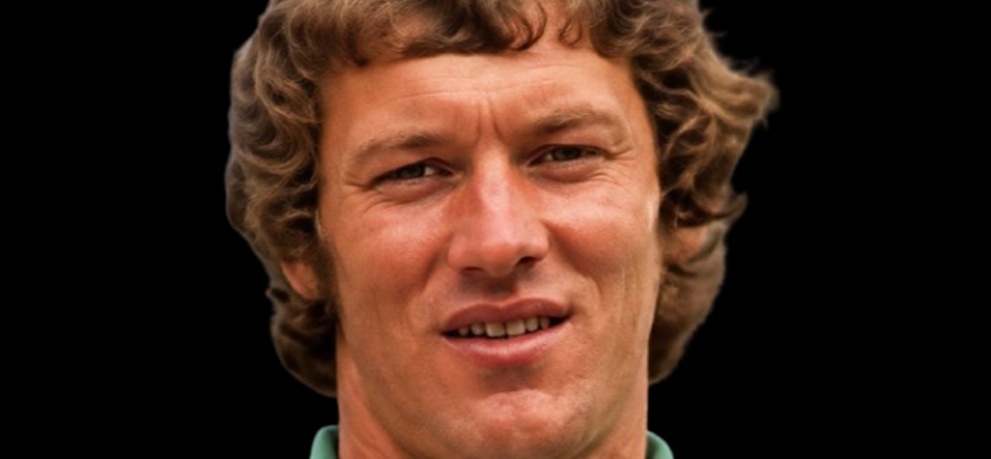
Seamus Martin McDonagh, born 6 October 1952, Rotherham, England.
PART ONE
Jim McDonagh grew up in Rotherham, a town that has sent more than its share of honest, unspectacular footballers out into the wider game, and it was fitting that Rotherham United gave him his start. McDonagh signed for the Millers in 1970, still a teenager, still learning the goalkeeping trade under the watchful eyes of coaches who valued positioning over flamboyance. Over the following six years he made more than a hundred appearances for his hometown club, and in doing so built the foundation of reliability that would define him wherever he went next. Along the way, in 1973, Manchester United took him on loan for a month — a brief taste of the very top level, gone almost as soon as it arrived, but proof enough that bigger clubs had noticed the young shot stopper from Millmoor.
Rotherham could not hold him forever. Bolton Wanderers came calling, initially on loan, and McDonagh stepped into the gloves recently vacated by Barry Siddall. It did not take long for Burnden Park to discover what they had signed. The 1977–78 season would be the making of him: Bolton stormed to the Second Division title, and McDonagh played every single one of the 42 league fixtures, conceding just 33 goals across the campaign — a club record that has never since been matched. Numbers alone rarely tell the whole story of a goalkeeper’s season, but this one did. Consistency, more than any single wonder save, had carried Bolton up, and McDonagh’s ever-present run between the sticks was the platform on which the whole promotion had been built.
Promotion brought Bolton into the First Division, and McDonagh, rather than shrinking from the step up, thrived on it. He remained ever-present for two further seasons in the top flight, a remarkable stretch of durability that few goalkeepers of any era could claim, and his form did not go unnoticed. Everton, needing a replacement for George Wood, paid £250,000 for his signature in the summer of 1980 — a substantial fee for a goalkeeper at that time, and one that reflected the esteem in which he was held. Bolton, meanwhile, had been relegated that same season, so the timing of his departure carried a certain bittersweet logic: McDonagh leaving a sinking ship just as it hit the bottom, only to find dry land at Goodison Park.
Yet Everton would prove to be a way-station rather than a destination. Howard Kendall’s Everton were still shaping their identity, still searching for the goalkeeper who would eventually define an era, and within a year a teenage Neville Southall had begun pushing through the ranks. McDonagh made 40 league appearances in royal blue before the writing became impossible to ignore, and by 1981 he was back at Bolton, older but hardly diminished, ready for a second spell in Lancashire. It was during this Bolton stint, incidentally, that he won the first of his international recognitions, winning caps for the Republic of Ireland through his father Michael, who hailed from Midfield in County Mayo — a lineage that opened the door to a green shirt even though McDonagh himself had grown up entirely English, in accent and upbringing alike.
His second Bolton spell brought both triumph of a personal kind and further disappointment on the collective front. In January 1983, McDonagh did something goalkeepers almost never manage: he scored, netting in a 3–0 win over Burnley, a moment of pure novelty that Bolton supporters of a certain vintage still recall with a smile. But the season ended badly all the same, with Bolton relegated again in 1982–83, and this time there would be no way back to the top flight for McDonagh in a Wanderers shirt. He left having made 242 league appearances across his two spells at Burnden Park, a figure that places him among the club’s most durable servants of the era, whatever division they happened to be playing in.
PART TWO
Notts County offered the next chapter, and Jim McDonagh spent two seasons at Meadow Lane between 1983 and 1985. By now he had turned thirty, and the game was beginning to scatter him more widely than before. Loan spells followed in quick succession — a single appearance for Birmingham City in 1984, ten games out on loan at Gillingham, then seven more at Sunderland, all packed into 1985 as clubs sought short-term cover and McDonagh, ever reliable, obliged. That same year he crossed the Atlantic, joining the Wichita Wings in the indoor game, a route trodden by plenty of British goalkeepers of his generation chasing one last payday and a change of scenery before the legs, or in his case the reflexes, finally gave out.
He was not quite finished in England, though. Scarborough took him on in 1987, followed by a loan at Huddersfield Town, and then, in 1988, a brief and entirely goalless stint at Charlton Athletic — zero appearances, a footnote rather than a chapter, yet part of the record all the same. It was that same year, 1988, that McDonagh crossed the Irish Sea for good, taking the player/manager’s job at Galway United with the club deep in the relegation mire of the League of Ireland. He rolled up his sleeves, pulled on the gloves one more time, made 20 appearances, and somehow steered Galway clear of the drop. Gratitude, however, is not always football’s currency: his contract was unilaterally terminated by the club in May 1989, a shabby reward for saving them from the very fate he had been hired to prevent.
If the big stages were behind him now, McDonagh was not quite ready to hang up his boots altogether. Spalding United, Grantham Town, Telford United, a second stint at Grantham, and finally Arnold Town carried him from 1989 right through to 1994, non-league football offering him a gentle wind-down rather than an abrupt stop. Across the whole sprawling itinerary of his playing days — Rotherham to Manchester United to Bolton to Everton to Bolton again to Notts County to Birmingham to Gillingham to Sunderland to Wichita to Scarborough to Huddersfield to Charlton to Galway to Spalding to Grantham to Telford to Grantham again to Arnold — he racked up 507 games in total, a number that speaks less to glamour than to graft, to a goalkeeper who simply kept turning up wherever he was needed.
McDonagh´s Ireland career, meanwhile, had run its own separate course. He won his first cap in 1981 and his last in 1985, accumulating 25 caps in the green shirt, and few of those matches carried more romance than the 3–2 victory over France in Dublin in 1981, when Ireland got the better of a side built around Michel Platini. It was the kind of result that gave the Boys in Green real belief, and McDonagh, guarding the goal that night, played his part in a famous evening.
Retirement from playing was never really retirement at all — merely a change of role. McDonagh moved seamlessly into coaching, and the list of clubs that have called on his expertise since reads like a tour of English football’s middle and lower reaches: Coventry City, Mansfield Town, Nottingham Forest, Millwall, Rotherham United, Leicester City, Aston Villa, Plymouth Argyle, Hull City. Wherever Martin O’Neill went, more often than not, McDonagh followed, the two men having built a working relationship across those clubs that eventually carried them both into the international arena.
On 6 December 2011, O’Neill appointed him Sunderland’s first-team goalkeeping coach, and when O’Neill took charge of the Republic of Ireland in November 2013, McDonagh went with him, replacing Alan Kelly after Kelly’s eight years in the role. The pairing lasted until 21 November 2018, when O’Neill and his entire backroom staff parted company with the FAI, but McDonagh’s coaching odyssey was still not done: in January 2019 he followed O’Neill once more, this time to Nottingham Forest, taking up the post of head goalkeeping coach.