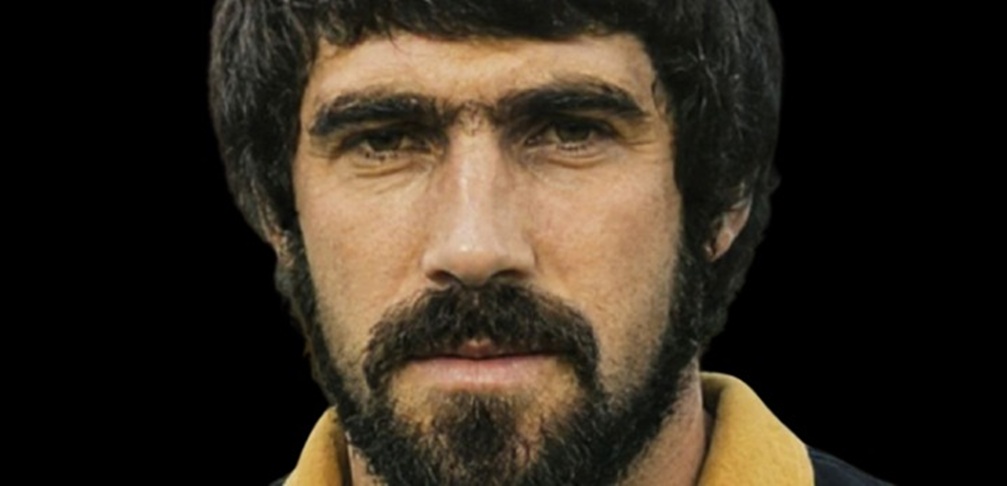
George Andrews, born 23 April 1942, Dudley, England.
PART ONE
George Andrews represented Dudley Schools and Worcestershire and District Boys, before earning trials with the England Schoolboys set-up. He left school at fifteen and took work locally, and it was through playing for a factory side, Vono Sports, that he first fell in with Fred Whittall, a figure who would keep cropping up at his shoulder for years afterwards, first as a mentor and later as something closer to a footballing shadow. Scouted by Luton Town at seventeen, Andrews signed as an apprentice in the late 1950s under the management of Syd Owen and turned professional in 1960, though the move south proved a false start; unable to force his way past the Hatters’ senior forwards and increasingly gripped by homesickness for the Black Country, he left Kenilworth Road in 1961 without a single first-team appearance to show for it.
Rather than sulk over the setback, Andrews simply dropped back down to non-league level, first with Dudley Town and then with Lower Gornal Athletic, where Fred Whittall was waiting for him once again. It was at Gornal that Andrews rediscovered his scoring touch away from the pressures of the professional game, and it was there too that Cardiff City manager Jimmy Scoular came calling in October 1965, ready to take him back into the Football League for an estimated fee of £2,100. The move to Ninian Park very nearly did not happen at all, since Andrews walked out of the initial contract talks in disgust at being offered no more in wages than he was already earning at the factory, and it was only Whittall’s persuasion that got him back through Scoular’s door to strike the deal that finally took him into the Football League proper.
Andrews made his senior debut for the Bluebirds on 16 October 1965, a 2–1 defeat against Portsmouth at Ninian Park, and followed it a week later with his first goal in senior football, scored, somewhat ironically, in a second successive 2–1 loss, this time against Bolton Wanderers at Burnden Park. Defeats they may have been, but the early goal set the tone for what followed, and Andrews finished that first professional season with twenty goals in all competitions, a return that marked him out immediately as a forward worth watching. He struck up an instant understanding with a raw sixteen-year-old strike partner by the name of John Toshack, feeding the future Wales international the pass that brought Toshack his first senior goal, and later formed another effective partnership with George Johnston, while Terry Harkin, a forward who would go on to follow Andrews from club to club over the years that came after, also lined up alongside him in South Wales.
It was under the guidance of the great John Charles, by then winding down his own remarkable career on the coaching staff at Ninian Park, that Andrews sharpened the heading ability that would become his trademark for the rest of his time in the game; Charles taught him to count to four at corners before launching his leap, timing his jump rather than simply reacting to the flight of the ball, and the discipline stuck with him for the following decade and beyond. Cardiff struggled collectively during Andrews’ time there, memorably shipping nine without reply at Preston in a mauling that left Scoular fuming in the away dressing room, though Andrews later joked that he had at least touched the ball more times than anyone else on the pitch that afternoon. There was heartbreak too in the League Cup, where Cardiff fell 4–2 to West Ham United in the semi-final second leg despite Andrews scoring both of his side’s goals, a personal high watched from close range but framed by a collective low.
Andrews scored six goals in the opening twelve matches of the 1966–67 season before the arrival of new signing Bobby Brown squeezed him out of Scoular’s first-choice attack, and in February 1967 he was allowed to leave for Southport in exchange for £6,000, a fee that stood as a club record for the Sandgrounders at the time. Southport manager Billy Bingham, who had crossed paths with Andrews briefly at Luton back in 1960, brought him in as a direct replacement for the departed Jim Fryatt, who had moved on to Torquay United, and the new signing wasted no time in repaying the faith shown in him, scoring on his Haig Avenue debut in a 3–0 win over Barnsley on 4 March 1967.
He settled quickly into Bingham’s side, and, fittingly, it was Andrews who supplied the only goal of the game on the final day of that 1966–67 season, a 1–0 victory over Southend United that confirmed Southport’s promotion into the Third Division. Over the two seasons that followed, Andrews and Terry Harkin, reunited once more after their spell together at Cardiff, forged a partnership sharp enough to produce forty goals between them, each seeming to know instinctively where the other would drift into space.
There was a near miss in the FA Cup, where a mouth-watering home tie against Everton was lost by the narrowest of margins, and there was, more remarkably still, a brush with one of the biggest names ever to grace an English dugout. Bill Shankly, by then established as the dominant force at Liverpool, made known his interest in Andrews and offered Southport £39,000 for his signature; the Lancashire club, however, held out for a valuation nearer £50,000, and rather than meet their price Shankly walked away from the deal and turned his attentions elsewhere, eventually signing a young Kevin Keegan from Scunthorpe United instead. It stands as one of the great what-ifs of Andrews’ time in the lower divisions, and Southport’s stubbornness over the fee did the club few favours in the long run, since their finances continued to deteriorate regardless, and in November 1969 they were forced to sell Andrews on to Shrewsbury Town for a cut-price £10,000, a fee so modest that incoming Shrewsbury manager Harry Gregg could scarcely believe his good fortune.
PART TWO
George Andrews’ start at Shrewsbury Town mirrored the one he had enjoyed at Southport, finding the back of the net on his debut in a 1-1 draw against Leyton Orient at Gay Meadow on 22 November1969 before adding a brace in a 3–2 victory over Walsall at Fellows Park a fortnight later. He was similarly productive against Walsall on a separate occasion too, scoring twice more in a 4–1 win, and, remarkably, found himself lining up alongside Terry Harkin for a third time once the Irishman also arrived at Gay Meadow. It was, though, a different partnership that came to define his Shrewsbury years, this one struck up with Alf Wood, a player converted from centre-back into a razor-sharp forward; across the 1971–72 campaign the pair contributed sixty goals between them, twenty of them coming from Andrews’ own boot.
Andrews´ relationship with Salop boss Harry Gregg, a former goalkeeper with Doncaster Rovers, Manchester United and Stoke City, was generally warm but occasionally combustible. On one occasion Gregg hauled him in to complain about his hair and facial hair, worrying aloud that it might set a bad example to the younger players in the squad. On another occasion, Gregg’s fondness for punishing stamina work in the gym left Andrews with a strained back and a blunt message for his manager that he was a footballer rather than a weightlifter.
When a barren run of six games without a goal left Andrews uneasy, he went to Gregg and asked to be dropped, only for his manager to refuse point blank, a decision vindicated almost immediately when Andrews scored twice in his very next outing. It was, oddly enough, a Walsall reserve fixture at Gay Meadow that set in motion Andrews’ next move, since it was there, midway through a half he had gone along simply to watch, that he was summoned to Gregg’s office and introduced to a stranger who turned out to be John Smith, the new manager of Walsall, already primed to offer him terms on the spot.
That conversation led, in January 1973, to a swap deal that took Andrews to none other than Walsall along with a cash adjustment of £6,000, with winger Geoff Morris moving in the opposite direction. He made an immediate impact in claret and white, scoring on his very first appearance for the club, before adding another goal in a narrow defeat at Wrexham the following week. Manager John Smith lost his job before the end of that first season, with Jimmy McEwan taking temporary charge, and the summer of 1973 brought Ronnie Allen into the hot seat at Fellows Park. Andrews, a boyhood West Bromwich Albion supporter who had long admired Allen from the terraces at the Hawthorns, found their working relationship far frostier than he had expected, and injury together with a loss of form limited him to only a handful of appearances early in the 1973–74 season.
He was recalled to the side that November and immediately made himself indispensable, scoring the only goal of the game in an FA Cup win over Swansea Town and retaining his place for the rest of the campaign. Allen’s departure that December, engineered by chairman Ken Wheldon with Doug Fraser installed as his replacement, was a moment Andrews welcomed without much disguise. Allen had brought in the young Alan Buckley from Nottingham Forest during the previous summer, and although Buckley’s early form had briefly kept Andrews out of the side, the two strikers went on to form a genuine understanding, complementing one another’s game in a manner that would soon pay handsome dividends.
The 1974–75 season stands as the finest of George Andrews’ time at Walsall, and arguably of his entire time in the professional game. He was an ever-present through the campaign, and his consistency was rewarded at its end when he was voted the club’s Player of the Season with fifty-nine per cent of the vote. It was, above all, the FA Cup that brought Walsall and Andrews to national attention that winter. Drawn against mighty Manchester United in the third round, Walsall held Tommy Docherty’s side to a goalless draw at Old Trafford on 4 January 1975 before welcoming them back to Fellows Park three days later for the replay.
In front of 18,000 supporters, Bernie Wright fired the home side into an early lead in the twenty-first minute, only for Gerry Daly to level from the penalty spot for United shortly before half-time. Neither side could find a winner in normal time, and the tie went into extra time still locked at 1–1. There, with the match seemingly slipping away from them, Walsall rallied: Alan Buckley restored their lead deep into the additional period, Sammy McIlroy hauled United level again within minutes, and then, as the clock ran down towards the end of extra time, Buckley converted a late penalty to complete a stunning 3–2 victory over one of the biggest names in the country.
Walsall’s cup run did not end there. On 25 January, in front of 20,000 spectators at Fellows Park, it was George Andrews himself who scored the only goal of the game as Walsall knocked out the previous season’s beaten finalists, Newcastle United, in the fourth round, a goal that turned Andrews overnight into the man every journalist wanted to speak to. The run finally came to an end in the fifth round on 15 February, when Walsall travelled to St Andrew’s and went down 2–1 to Birmingham City side who scored through Bob Hatton and Kenny Burns.
The 1976–77 season proved a harder one for Walsall as results slipped, costing Doug Fraser his job that spring, and new manager Dave Mackay soon informed Andrews, by then thirty-four, that the season in progress would be his last at the club. Andrews continued to give everything regardless, scoring a brace in Walsall’s final away fixture of the season at Peterborough United and finding the net again on the last day of the campaign against Bury, bringing to a close a Fellows Park spell in which he had played 159 league games and netted 38 goals.
Released by Walsall in 1977, Andrews refused to accept that his scoring instincts had deserted him, and he continued playing into his forties for a string of clubs including Worcester City, Telford United, Dudley Town, Oldswinford, Solihull Borough and, as player-manager, Tipton Town, before finally hanging up his boots from charity football at the age of fifty. His working life after football took him in an altogether different direction, and at forty-one he joined the Parks and Gardens department of Dudley Metropolitan Borough Council, tending the borough’s green spaces for the following twenty-four years until his retirement in April 2007.