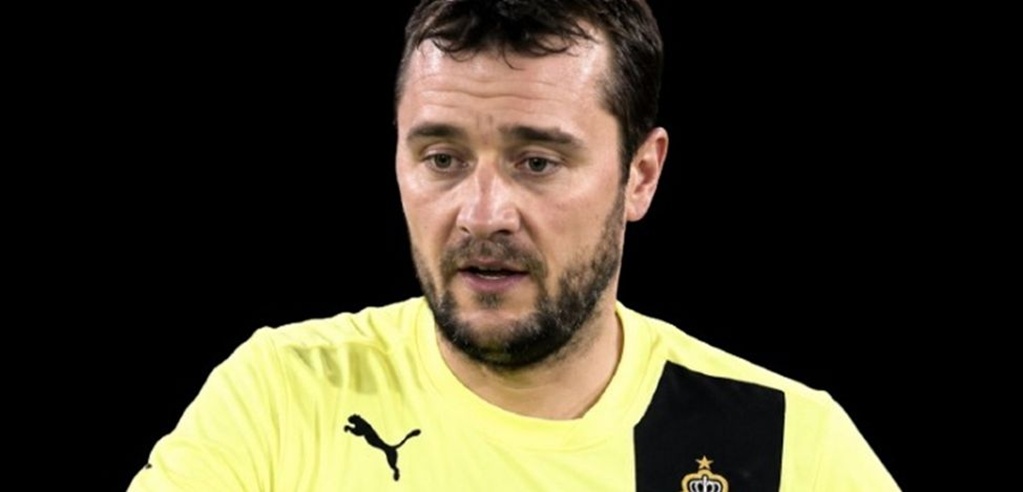
Jonathan Blondel, born 3 April 1984, Ypres, Belgium.
PART ONE
Jonathan Blondel was first discovered by Excelsior Mouscron in 1995 at the age of eleven. The national federation noticed him early, and between 1999 and 2001 Blondel pulled on the shirt of Belgium’s Under-16s twelve times and the Under-17s three times, scoring once, before moving up to the Under-19s, whom he would captain, so that by the time he was seventeen he was a name in the right notebooks, even if he had yet to play a minute of top-flight football.
His debut eventually arrived on 7 September 2001, when the midfield player came off the bench in a league match at Charleroi which Mouscron narrowly lost 1–0. He kept his place in the squad, made 18 league appearances and found himself in the Belgian Cup final at the Heysel Stadium in Brussels on 9 May 2002, where Mouscronfaced Club Brugge in front of a crowd that included around 11,000 of their own supporters. Brugge were the favourites and, in the end, the winners by 3–1, but it was Blondel who had dragged Mouscron level for a while with the equaliser. Mouscron at least left with something to show for the season, since the runners-up spot in the cup and their league position had won them a place in the UEFA Cup for 2002–03, and Blondel, by now captain of the Under-19s, was a youth with a trophy-sized story and a telephone that would not stop ringing.
The calls were from England, and one of them came from Manchester United, whose offer he turned down. Tottenham Hotspur got their man instead, with the Belgian midfielder signing for the north London club in the summer of 2002, and he arrived as a third midfield signing of the summer with a reputation as one of the brightest young players in Belgium. Almost at once the rush of events picked up pace, because on 21 August 2002 he made his full international debut, coming off the bench in a friendly against Poland that finished 1–1, and ten days later, on 31 August, he made his Premier League debut as a substitute in a 2–1 win over Southampton at the age of 18 years and 150 days, a figure that put him among the youngest players ever to appear for Spurs in the competition.
By late October 2002 it was reported that he was considering asking for a loan move back to Belgium, and Mouscron duly enquired about taking him back on those terms, but Spurs were not minded to agree and the enquiry went no further. He would explain years later that Mouscron already had money worries when he left, which goes some way to explaining why a player who might have stayed put went off to London instead. The wait finally brought a second Premier League outing on 1 November 2003, another substitute’s appearance, this time in a 1–0 home defeat by Bolton Wanderers, a match settled by Kevin Nolan’s goal in the 73rd minute, and Blondel, who came on late, very nearly snatched an equaliser that would have given the afternoon a happier ending for him. It did not drop, however, and it would turn out to be his last game in the Premier League, two appearances and no goals in a stay of a year and a half.
There was nothing left to prove in London and nothing more to be gained by waiting, so on 28 January 2004 he came home, joining Club Brugge, the very club that had beaten him at the Heysel two years earlier, on a four-and-a-half-year contract. The same spring he scored in the Belgian Cup semi-final second leg against, of all clubs, Mouscron, thumping in a volley in the 54th minute of a 1–0 win at the Jan Breydel Stadium that took Brugge through 3–2 on aggregate, and he did not celebrate wildly, which was only polite. On 17 May 2004 Brugge beat Beveren 4–2 in the final in Brussels, and the first piece of silverware of his playing days belongs to that afternoon, a Belgian Cup winner’s medal that was a long way from the loser’s one he had picked up at the same ground two years before.
PART TWO
The 2004-05 campaign was Jonathan Blondel´s best season in Bruges. It opened with the Belgian Super Cup, played on 22 December 2004 at Anderlecht’s ground since the Brussels club were league champions, and Brugge, as cup holders, won it 2–0, which meant the second trophy was in the cabinet before the winter was out. The league was a more drawn-out affair. Anderlecht and Brugge were first and second after five matches, Brugge were top soon after and, remarkably, stayed there until the end, while the Brussels club failed to find any consistency under Hugo Broos, who was fired after a 0–0 draw at Gent, and then recovered under Franky Vercauteren after an opening 1–0 defeat at Oostende.
The gap had narrowed to six points after 32 matches, so the game between the two clubs on the 33rd matchday was decisive, and a 2–2 draw was enough for the West Flemings, whose title owed a lot to their steadiness against the smaller sides and finished with 79 points to Anderlecht’s 76. Behind them there was a scrap for the last European place, with Standard and Genk level on points and wins at the end, which forced a two-legged test match that Standard won 3–1 at home before losing 3–0 away, and so it was Genk who took the UEFA Cup spot while Brugge qualified for the Champions League’s third qualifying round. There was one sour note for the champions, because on 28 May 2005 they lost the Belgian Cup final 2–1 to Germinal Beerschot, but the League title was safely theirs, and Blondel, still only twenty-one, was a champion of Belgium.
On 30 July 2005 Brugge met Beerschot in the Super Cup at the Jan Breydel Stadium and drew 1–1 before winning 4–2 on penalties, which made it two Super Cups in his first two seasons as a Brugge player. By the end of September 2005, however, Blondel became the twelfth Brugge player to join a growing injury list, and the list would only get longer in the years to come. He played on, and played well when fit, and on 26 May 2007 his name went onto another Belgian Cup winners’ list when Brugge beat Standard Liège 1–0 in the final at the King Baudouin Stadium, Manasseh Ishiaku scoring the only goal of the game, which made it a second cup medal to go with the one from 2004.
After that the highlights came more sparsely but were no less welcome for it. On 30 July 2009, in a Europa League qualifier at home to FC Lahti, Brugge were in danger of going out until Blondel scored twice, the second of them late on, to win the game 3–2 and keep the tie alive ahead of the return in Finland, and it was the sort of night that explained why supporters had stuck with him through the physio’s room visits. Belgium had not forgotten him either. After his three appearances in 2002 and 2004, the second and third caps came in friendlies against Germany and Turkey in 2004, he had been out of the national set-up for almost six years when he won his fourth and final cap in 2010, as a substitute in a friendly with Croatia.
Blondel´s last official match for Brugge arrived on 8 August 2013, in the 2013–14 Europa League, and on 13 January 2015, at the relatively young age of 30, Blondel announced he was retiring from professional football. The club went on to win the Belgian Cup in the spring of 2015, and although he had not played a part in it his name was on the squad list for a winners’ medal, the fourth domestic trophy to go alongside the title, the cups of 2004 and 2007 and the two Super Cups. The record that remains shows 18 league appearances for Mouscron, two for Tottenham, 189 league games for Brugge and four full caps for Belgium.