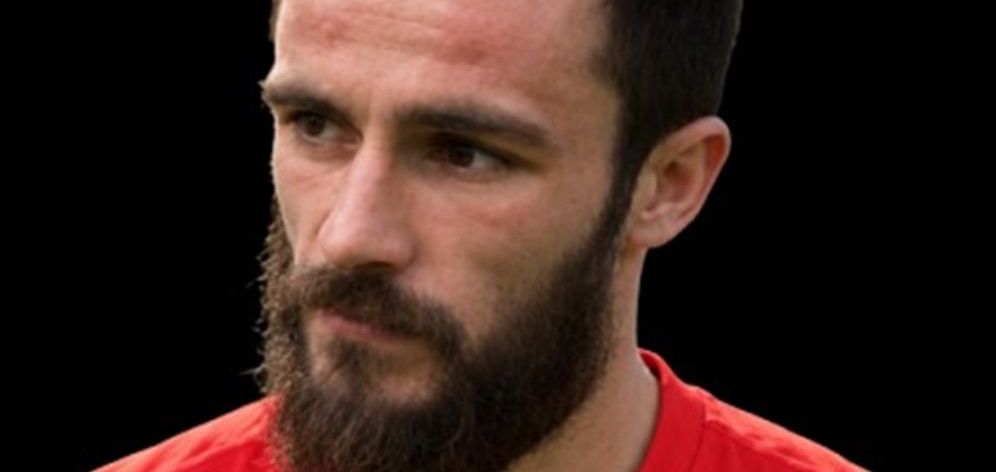
Christopher Dagnall, born 15 April 1986, Liverpool, England.
PART ONE
Chris Dagnall´s first taste of the senior game came against Peterborough United at Prenton Park on 13 September 2003, when he was seventeen years old and Ray Mathias, the Tranmere Rovers manager, put his name in the matchday squad. Ten league appearances and one League Cup outing followed that season, and on 6 October, in a fixture with Luton Town at Kenilworth Road, he scored his first senior goal by equalising in a game Tranmere eventually lost by three goals to one. Rovers ended the campaign in eighth place, narrowly missing the play-offs, with the forward from the youth side already knowing his way round the first-team dressing room.
On 10 August 2004, he netted his first Prenton Park goal in a 2–1 win over Hartlepool United and then promptly got himself sent off for jumping into the crowd to celebrate it. Nobody at Tranmere held it against him for long, because the goals kept coming and he ended the campaign with six hits. Tranmere eventually finished third in the table, only to lose to Hartlepool in the play-offs, going out on penalties after winning the second leg 2–0 to level the tie at 2–2. The next campaign began with several appearances and his FA Cup debut, a 2–1 defeat away to Bradford City, a club he would come to know rather well. Then, on 13 January 2006, he went on loan to Rochdale in League Two, a move that began as a temporary arrangement and turned into the making of him. He stayed at Spotland for the rest of the season, scored three goals in 21 appearances, and on 15 April stole a point at Rushden & Diamonds with a last-minute equaliser in a 1–1 draw.
Rochdale liked what they saw, and in July 2006 they made the deal permanent for an initial fee of £25,000. Steve Parkin, the manager, needed a replacement for Grant Holt, the club’s top scorer, who had just left for Nottingham Forest in a £300,000 move, and he saw in Dagnall a player who could carry some of that load without pretending to be a copy of the man who had gone. The second debut, at home to Walsall, ended in a 1–0 loss in which Dagnall came on late and could not change the result, but he soon found his feet. Braces against Boston United, Wrexham and Peterborough followed, and then on 21 April 2007 came his first hat-trick, in a 5–0 win at Spotland against Macclesfield Town. He finished the season with 17 league goals, which left him joint fourth in the League Two scoring list, and a player who had been a Tranmere reserve-team prospect a year earlier was suddenly one of the most dangerous finishers in the division.
Eight games into the following season he picked up an injury that kept him out from September 2007 until March 2008, a long and frustrating lay-off for a man who lived on rhythm and confidence, and the manner of his comeback showed what kind of player he was. In his first game back he scored the opening goal in a fine 4–1 win against Rotherham United, as if he had never been away. In May he scored in three consecutive games, one of them a home draw with Shrewsbury and the other two the legs of the play-off semi-final against Darlington, which Rochdale lost first and won a week later before taking the tie 5–4 on penalties. Wembley was the reward but the final was a cruel blow because Stockport County won 3–2 and Rochdale were left to wonder what might have been. Dagnall finished with nine league goals from only 17 games and he walked off the pitch having been part of the club’s biggest day for a generation without getting the ending it deserved.
Dagnall´s first goal of the 2008–09 season arrived in a 3–1 home win against Barnet, and on 21 October 2008 he scored his third senior hat-trick in a 6–1 win over Chester at Spotland, a night when everything he hit seemed to find its way in. The season had its darker moments too, and on 3 March 2009 he was shown the second red card of his playing days in a 2–1 defeat at Barnet, which is the sort of thing that happens to strikers who throw themselves into every challenge. He finished with 10 goals, and Rochdale reached another play-off semi-final, only for Gillingham to knock them out.
That could have been the end of the story at Spotland, but the 2009–10 campaign turned out to be the best of all. Dagnall scored six goals in the first ten league games, including a brace against Torquay United on 12 September 2009, and on 27 March 2010 he added another hat-trick in a 4–1 win over Grimsby Town. Then, on 17 April, Rochdale defeated Northampton Town 1–0 courtesy of a goal from Chris O’Grady in the 23rd minute of the clash and secured promotion for the first time in 41 years. Dagnall himself ended with 20 goals, the highest total he had ever managed in a single season, and he left the Dale as a hero.
PART TWO
On 2 June 2010, Chris Dugnall joined Scunthorpe United on a free transfer, signing an initial three-year deal, and he made his debut on 7 August in a 2–1 win at Reading’s Madejski Stadium, which was as good a start as a player stepping up two divisions could ask for. His first Scunthorpe goals came in the League Cup second round, where he scored twice in a 4–2 win over Sheffield Wednesday on 24 August, and two weeks later he did it again in the league, with two more in a 4–0 away win at Sheffield United’s Bramall Lane.
Three further goals that season, against Preston, Burnley and Nottingham Forest, all came in wins, which tells you he was scoring when it mattered, but the team around him could not hold its place and Scunthorpe finished bottom of the Championship and went down. He stayed with them in League One and picked up where he had left off, scoring in a 2–0 League Cup win away at Accrington Stanley on 9 August 2011 and then against Oldham Athletic a week later. In the next round Premier League Newcastle United came to Glanford Park, and Dagnall scored against them in a game Scunthorpe lost 2–1 after extra time, which was a fair account of what he could do against better opposition. In October he scored in back-to-back games within four days, in a 2–2 draw with Huddersfield and a 4–2 win over his old club Tranmere, and the form was there for anyone to see. His last game for Scunthorpe was a 2–1 away win at Hartlepool on 2 January 2012.
Four days later, on 6 January, Dugnall signed for Championship club Barnsley for an undisclosed fee on a two-and-a-half-year contract, and the manager who brought him in was Keith Hill, who had worked with him at Rochdale and knew exactly what he was getting. Hill did not hide his enthusiasm, saying that Dagnall was definitely value for money and the type of player who fitted what the club was trying to achieve. The debut came eight days later, a 2–1 away win at Leicester City, and he made nine appearances before the club sent him out on loan to League Two side Bradford City on 16 March, a decision that suited everyone.
He made his debut the next day against Aldershot Town and on 24 March he reached a landmark, playing his 300th senior appearance in a 2–2 draw with Gillingham at Valley Parade. Three days after that, on 27 March, he scored his first goal for Bradford in a home game against Crawley Town and was named man of the match, which is the kind of start a loan player dreams about. Back at Barnsley the goals took longer. His first for the club came on 12 August 2012, when he scored twice in a League Cup tie against Rochdale, the club where he had made his name, and on 12 January 2013 he got his first league goals for Barnsley, both of them in a 2–0 win over Leeds United. He was a useful presence rather than a regular, and the next chapter began when Coventry City signed him on an emergency loan on 28 November 2013.
The Coventry spell was short but sharp. He made his debut two days later away to Milton Keynes Dons and equalised as the Sky Blues came from behind to win 3–1, and when the loan ran out at the turn of the year he went back to a Barnsley side that no longer had a place for him. On 10 January 2014 the club released him from his contract, along with defender Scott Wiseman, and six days later Leyton Orient signed him on an 18-month deal. Most players in that position would have taken a few weeks to settle, but Dagnall made his debut on 18 January at Crewe Alexandra and came on at half-time as a substitute for Robbie Simpson, and he scored twice in a 2–1 win that took Orient to the top of League One.
It was one of the most remarkable debuts one could imagine. Six goals that season helped Orient into the play-offs, and the semi-final against Peterborough United turned on a night at Brisbane Road on 13 May, when, again as a substitute, he scored in a 2–1 win that gave Orient a 3–2 aggregate victory after the first leg at London Road had finished 1–1. Dean Cox had put Orient in front on the hour, Dagnall scored the goal that put the tie beyond Peterborough, and a local newspaper noted that it was the hundredth goal of his playing career.
Twelve days later, on 25 May 2014, came Wembley again, and this time the opponents were Rotherham United. Dagnall entered the pitch in the 76th minute of the encounter in place of Kevin Lisbie, with Orient leading 2–0 at half-time and then pegged back by two goals from Alex Revell either side of the hour, and the game went into extra time. He had a glorious chance late in the extra period when a Rotherham mistake put him through, only for Kari Árnason to make a saving tackle at the last moment, and so to penalties. The O´s scored through Lloyd James, John Lundstram and Nathan Clarke, but Mathieu Baudry’s kick was saved, and when the fifth Orient penalty fell to Dagnall, United goalkeeper Adam Collin stopped that too and the Millers won the shoot-out 4–3.
PART THREE
The 2014-15 campaign brought different troubles. On 2 September 2014, Chris Dugnall scored twice in a 3–2 win over Peterborough in the first round of the Football League Trophy, which was a decent way to start, but on 29 November he was sent off in a 3–1 defeat at Bradford, his former loan club, receiving a straight red card for a foul on Billy Knott, and by then Orient were in a bad way. He finished as the team’s top scorer with 11 goals, a respectable return for a side that won little, but the season ended in relegation to League Two, and a player who had been at the top of League One barely a year earlier was now looking for a new home.
On 10 June 2015, Dagnall left Orient to join Indian Super League side Kerala Blasters , replacing Iain Hume, who had signed a new contract with Atlético de Kolkata. It was an unusual move for an English lower-league striker, but Dagnall had never played the percentages. He made his debut on 6 October at the Jawaharlal Nehru Stadium, where Kerala began the season with a 3–1 win over NorthEast United and he was replaced at half-time by his compatriot Sanchez Watt, and a week later he scored his first goal for the club, an 83rd-minute consolation in a 2–1 defeat at Atlético de Kolkata. Then, on 15 November, came the moment that put his name in the record books. He scored twice in a 4–1 win at NorthEast United, and his first came after just 29 seconds, the quickest goal in the league’s history, beating the previous record of 48 seconds held by Mohammed Rafi against FC Pune City, who, as it happens, had been set up for that goal by Dagnall himself in the earlier match.
By Christmas he was heading back to Britain. On 23 December 2015 he joined Scottish Championship club Hibernian on a short-term deal until the end of the 2015–16 season, and he made his debut on 9 January in a 2-0 Scottish Cup fourth round victory over Raith Rovers. Hibs went on a run that few had predicted, and in the final that May they managed to edge out Rangers by a 3–2 margin to win the Scottish Cup for the first time in 114 years, with Dagnall an unused substitute on the day.
On 5 July 2016, he joined League Two club Crewe Alexandra on a two-year deal, and he made his debut in the season opener at Stevenage. His first Crewe goal came in a 3–3 draw with Hartlepool on 16 August, and over the course of the campaign he became the club’s top scorer, finishing with 17 goals in all competitions after a hat-trick on the final day against Barnet on 6 May 2017, which was a fine way to finish a first season and a reminder, if anyone needed one, that he could still do it at thirty-one. The following campaign was quieter but still productive, with 37 appearances and seven goals, though on 9 May 2018 Crewe supremo David Artell announced that Dagnall would not be offered a new contract.
On 19 June 2018, Dagnall agreed to a one-year contract with Bury to link up again with Ryan Lowe, the Gigg Lane manager and a former Crewe team-mate. The spell did not last the full year as the veteran striker was released by the Shakers in January 2019 and promptly re-joined Tranmere Rovers until the end of the 2018–19 season, which meant that the player who had made his debut at Prenton Park as a seventeen-year-old trainee had come back to the club that gave him his start. An age defying footballer, Dagnall later appeared for a number of clubs, including Yeovil Town, Ashton United and Stalybridge Celtic.