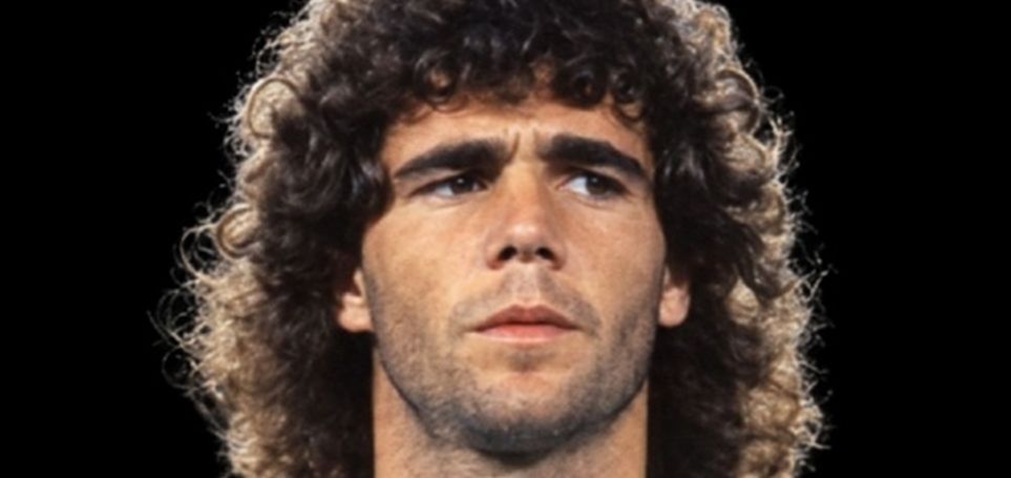
Alberto César Tarantini, 3 December 1955, Ezeiza, Argentina.
PART ONE
Alberto Tarantini emerged through the Boca Juniors youth ranks in the early years of that decade, and it did not take long for team-mates and rivals alike to settle on a nickname for him: conejo, the rabbit, a tag inspired by those protruding front teeth and the unruly thatch of hair that sat above them. Underneath the comic exterior, however, there beat the heart of a genuinely fierce competitor, and by 1973, at just seventeen years of age, he had forced his way into the Boca first team.
Progress from there was rapid, and it was matched by success at international level almost immediately. In 1975, still only nineteen, Tarantini was part of the Argentina under-23 side that travelled to the south of France and won the Toulon Tournament, lining up alongside future World Cup team-mates such as Jorge Valdano and Américo Gallego under the guidance of César Menotti, the coach who would soon reshape the fortunes of the senior national team.
It was Menotti, in fact, who handed Tarantini his opening at full international level, promoting him into the senior Argentina side once the experienced Jorge Carrascosa departed the set-up; some accounts of the era, including the book El DT del Proceso by Gasparini and Ponsico, suggest that Carrascosa’s exit was bound up with his reluctance to represent a team so closely associated with the ruling military dictatorship. Whatever the truth of that particular episode, the upshot for Tarantini was unambiguous, and at the age of twenty-two he found himself the youngest player in Menotti’s group.
Back at club level, meanwhile, Boca Juniors were sweeping to silverware, and 1976 brought both the Nacional and Metropolitano championships to La Bombonera, with the young left-back an established fixture in the side by that point. Better still was to follow a year later, when Boca reached the final of the Copa Libertadores against the Brazilian champions Cruzeiro, and what unfolded across three enthralling matches has since passed into club folklore.
Boca won the first leg 1–0 at home through a Veglio strike, only for Cruzeiro to level the tie with a Nelinho goal at the Mineirão, and so the destiny of South America’s premier club prize came down to a winner-takes-all play-off at the Estadio Centenario in Montevideo on 14 September 1977. Ninety minutes and then extra time passed without a goal, and the shoot-out that followed was won 5–4 by Boca, the decisive save coming from the veteran goalkeeper Hugo Gatti, who guessed correctly and denied Cruzeiro’s Vanderlei with the last kick of the contest. Tarantini started all three matches, and the triumph gave Boca their first Copa Libertadores in the club’s history, a distinction that mattered enormously on a continent where the tournament carried at least as much prestige as any domestic crown.
Trouble, however, was brewing away from the pitch even as that glory was being won, because a few months before the 1978 FIFA World Cup, Tarantini became embroiled in a contractual dispute with Boca that left him, remarkably, without a club altogether. According to contemporary accounts, Boca’s hierarchy leaned on rival Argentine clubs to ensure none of them would offer him a contract, a situation that might have derailed a lesser player’s hopes of representing the host nation that summer. Instead, Tarantini simply played his way back into Menotti’s plans through sheer form on the training pitch, and when the tournament began in June 1978 he was installed as first-choice left-back for a side burdened with the weight of a nation’s expectations and, less comfortably, the political ambitions of the junta that ruled it.
Argentina’s passage to the final hinged on a second-round match against Peru in Rosario on 21 June, a fixture the hosts had to win by four clear goals to leapfrog Brazil, and win big they duly did, thrashing their opponents 6–0 in a result that has never entirely shaken off suspicions of foul play, though nothing was ever proved. Tarantini contributed directly to that emphatic scoreline, netting in the forty-third minute to put Argentina 2–0 up before further goals from Mario Kempes, Leopoldo Luque and René Houseman completed the rout, and the performance carried Argentina through to a final against the Netherlands at the Estadio Monumental in Buenos Aires on 25 June.
There, in front of 78,000 supporters, Tarantini lined up alongside Ubaldo Fillol, Daniel Passarella and Osvaldo Ardiles as Argentina won 3–1 after extra time, with Kempes finding the back of the net twice and Bertoni adding a third goal, and Tarantini’s performances throughout the tournament were rewarded with a place in the official World Cup All-Star Team, a fitting personal postscript to a summer that had begun with him having nowhere to play at all.
PART TWO
That World Cup exposure transformed Tarantini’s standing overnight, and English clubs, newly curious about the flair of South American football following Tottenham Hotspur’s ground-breaking swoop for Ossie Ardiles and Ricky Villa, were quick to make their move. It was Birmingham City, managed by Jim Smith, who won the race, paying £295,000 to bring Tarantini to St Andrew’s partway through the 1978–79 season, and the deal made headlines well beyond the back pages given how rare it still was, in that era, for a World Cup winner to arrive in an English dressing room. Unfortunately for Birmingham, the impact he made on the field rarely matched the size of the fee or the fanfare that had greeted his signing, though there were flashes of the swagger that had illuminated Argentina’s triumph, and one afternoon in particular has lived long in the memory of those who witnessed it.
On 11 November 1978, Birmingham entertained a Manchester United side that had arrived at St Andrew’s as strong favourites, and for a quarter of an hour that reputation looked entirely justified when Joe Jordan fired the visitors into a thirteenth-minute lead. But Birmingham responded with a ferocity that stunned the away supporters, as Kevin Dillon equalised with a rasping effort past goalkeeper Paddy Roche, before Alan Buckley, a recent arrival from Third Division Walsall, put the hosts ahead and then doubled his own tally to make it 3–1 by the interval.
The second half brought no respite for United, since Don Givens, once on their own books, added a fourth before Jimmy Calderwood completed a remarkable 5–1 victory in the closing stages. It was during that same match that Tarantini left his mark in another, more controversial fashion, clattering into Brian Greenhoff with such force that the United man had to be stretchered from the field, unconscious for some twenty-five minutes before he came round in the dressing room, an incident that did little to soften the Argentine’s reputation for indiscipline on English shores.
That reputation, in truth, followed him for the remainder of a stay in the Midlands that turned out to be brief and, by most measures, unhappy; Birmingham struggled throughout the campaign and would eventually finish deep in the relegation zone, and Tarantini’s spell was further complicated by an off-field flashpoint in which he waded into the crowd to confront a heckling spectator, an episode that all but sealed his departure. He made just twenty-three league appearances for the club, scoring once, before returning to Argentina in 1979, initially with Talleres de Córdoba, where he featured thirteen times and reached the quarter-finals of the national championship, before a more substantial move arrived a year later in the shape of River Plate, one of the great institutions of Argentine football and a club far better suited to a player of his pedigree.
At River Plate, between 1980 and 1983, Tarantini rediscovered the consistency and the silverware that had characterised his early years at Boca, helping the club to the Metropolitano title in 1980 and the Nacional championship in 1981, and racking up over a hundred appearances in the famous red sash along the way. He was also retained by Menotti for the defence of Argentina’s world crown at the 1982 tournament in Spain, though the campaign proved a considerable disappointment for a side still carrying the aura of 1978; Argentina lost their opening match to Belgium, recovered with wins over Hungary and El Salvador, and then fell in the second-round group stage to both Italy and, most painfully, to Brazil.
Tarantini nevertheless emerged from the tournament with his reputation largely intact, and later that year he was voted into the Top Ten of the South America Player of the Year awards, a recognition of a body of work that, while never quite scaling the heights of 1977 and 1978 again, remained consistently of the highest standard. His international involvement concluded shortly afterwards, bringing to a close a spell with the national team that had brought sixty-one caps and one unforgettable goal against Peru.
The remainder of his playing days were spent in Europe, beginning with a single season at SC Bastia on the French island of Corsica during the 1983–84 campaign, before a longer and more productive stint at Toulouse between 1984 and 1988, where he accumulated 130 appearances and contributed eight goals, and where the club enjoyed some of its better campaigns in the French top flight, finishing fourth in Division 1 in 1986 and third the year after.
A final chapter followed at FC St. Gallen in Switzerland between 1988 and 1989, bringing the curtain down on a professional playing life that, across Argentina, England, France and Switzerland, had yielded 510 club appearances and fifteen goals. Recognition of his standing in the Argentine game continued to arrive long after he had hung up his boots, with his inclusion in the AFA’s Team of All Time, published in 2015, and a place in the IFFHS Argentina All Times Dream Team announced in 2021, both testifying, in their own quiet way, to the esteem in which he was held by those who studied the sport closely.