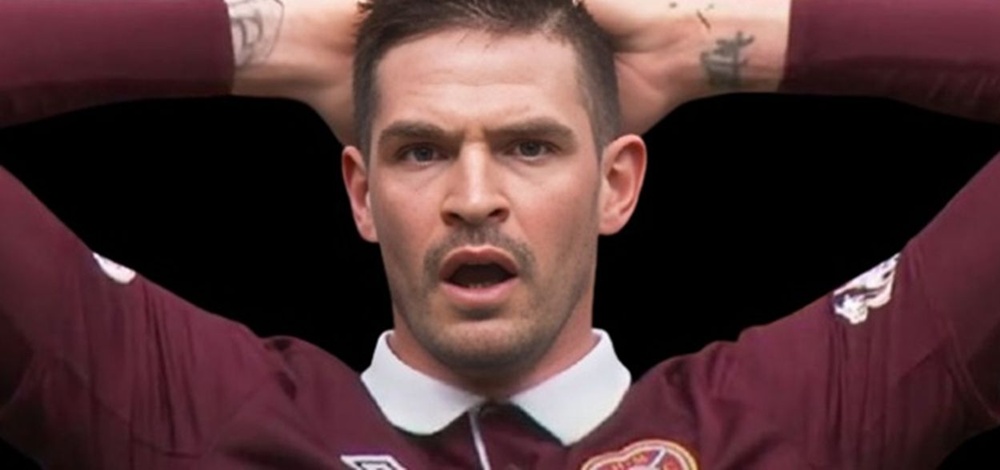
Kyle Joseph George Lafferty, born 16 September 1987, Enniskillen, County Fermanagh, Northern Ireland.
PART ONE
Growing up in Enniskillen, Kyle Lafferty’s rise began far from the grand arenas he would later grace, yet even then there was a sense of something combustible within him, a raw, unpolished drive that would both elevate and complicate his career in equal measure.
From those early beginnings, the pathway into professional football came through grit rather than glamour, and when he signed a youth apprenticeship with Burnley in 2004, it marked the first tangible step toward a life that would soon accelerate beyond anything the young striker could have imagined.
Yet stepping into the professional world is rarely seamless, and Lafferty’s first real taste of senior football arrived on 6 August 2005, when he made his debut in a 2–1 defeat away at Crewe Alexandra, coming on late as a substitute and offering only a fleeting glimpse of what might lie ahead. But fleeting moments can plant deeper roots than expected, and as a result, Lafferty’s development gathered pace through persistence and opportunity, even if his early outings were scattered and his influence still emerging rather than commanding.
In January 2006, therefore, he dropped down the divisions to join Darlington on loan, and it was here, amid the grind of lower-league football, that something clicked into place, as he scored on his debut against Notts County and added two more goals in nine appearances. That spell, brief though it was, offered a vital shift in momentum, and similarly, it provided Lafferty with the belief that he could influence games rather than simply participate in them, a subtle but crucial evolution for any young striker finding his feet.
Returning to Burnley, he began to carve out a more defined role, and his first senior goal for the Clarets arrived on 30 April 2006 in a 1–1 draw against Luton Town, a moment that hinted at the attacking instincts that would later define his best spells.
But progress was gradual rather than explosive, and although he accumulated 89 appearances and 10 goals for Burnley, there remained a sense that his true potential had yet to be fully unleashed, as if he was a striker waiting for the right stage to ignite. That stage, as it turned out, would come north of the border, and in June 2008, Rangers moved decisively to secure his services in a £3.25 million deal, a transfer that carried both expectation and scrutiny in equal measure.
Stepping into the cauldron of Ibrox is never straightforward, and Lafferty’s early days in Glasgow were marked by flashes of promise mixed with moments of inconsistency, as he adjusted to the intensity of playing for one of Scotland’s most demanding clubs. His debut came in a UEFA Champions League qualifier against FBK Kaunas, and although it was only a brief cameo, it signalled the beginning of a new chapter, one defined by higher stakes and sharper spotlights.
His first goal for Rangers arrived swiftly, coming in a Scottish Premier League clash against Heart of Midlothian, and it served as an early reminder that he possessed the finishing touch required at this level. Yet if goals offered glimpses of his quality, controversy soon followed, and in May 2009, an infamous incident involving Charlie Mulgrew against Aberdeen cast a shadow over his reputation, as Lafferty’s exaggerated reaction led to a ban for simulation and criticism from manager Walter Smith.
Adversity can either derail or define a player, and in Lafferty’s case, it seemed to sharpen his resolve, as he gradually began to deliver more consistently on the pitch, even if the scrutiny never fully faded.
Thus, by the 2009–10 season, he was playing a more decisive role, and on 25 April 2010, he scored the winner against Hibernian to clinch the league title, a moment that underlined his growing importance within the squad. What followed was a period of increasing productivity, highlighted by his first hat-trick for Rangers in a 7–2 League Cup win over Dunfermline Athletic, as his confidence surged and his finishing became more assured.
Similarly, during the 2010–11 campaign, Lafferty found himself at the heart of a title-winning side, contributing crucial goals in the run-in and delivering a hat-trick on the final day against Kilmarnock as Rangers secured a third consecutive league title. These moments, taken together, painted the picture of a striker who thrived when the stakes were highest, yet even so, his time at Rangers was rarely without turbulence, as disciplinary issues and off-field distractions occasionally threatened to undermine his progress.
In contrast, his performances on the pitch often spoke with clarity, and his first Old Firm goal against Celtic in September 2011 showcased his ability to rise to the biggest occasions, scoring in a thrilling 4–2 victory. But by 2012 circumstances beyond the pitch began to reshape his path, as financial turmoil engulfed Rangers, leading to a controversial restructuring that saw Lafferty choose not to transfer his contract to the new company.
PART TWO
On 30 July 2012, Kyle Lafferty moved abroad, joining FC Sion in Switzerland, where he linked up with former teammate Gennaro Gattuso, who was then serving as player-coach. This move, while offering a fresh start, was not without complications, as disputes over international clearance delayed his debut, highlighting once again how Lafferty’s path hardly ever followed a straight line.
Nevertheless, once on the pitch, he quickly made his mark, scoring his first goal for Sion in a 3–0 win over FC Luzern, and demonstrating that his instinct for goal remained intact despite the upheaval.
Building upon that foundation, he embarked on a new challenge in Italy, signing for Palermo in 2013, and it was here that he arguably produced one of the most effective seasons of his career. In 34 appearances, he scored 11 goals and helped Palermo secure promotion to Serie A as champions, earning the fans’ player of the season award and cementing his status as a key figure in their success.
Now, even success carried complications, and despite his contributions, tensions with club president Maurizio Zamparini led to his departure, as criticism of his lifestyle overshadowed his achievements. Consequently, Lafferty returned to England in 2014, signing for Norwich City, where expectations were high but opportunities proved more limited than anticipated.
Lafferty was handed his debut for the Canaries against Wolverhampton Wanderers and soon started at Carrow Road against Watford, yet goals were scarce, and he managed just one league strike, coming in a 3–2 win over Cardiff City. As a result, he sought opportunities elsewhere, joining Çaykur Rizespor on loan, where he found the net twice in 14 league games, offering glimpses of resurgence but not a sustained revival.
Similarly, a later loan spell with Birmingham City produced a solitary goal against Brighton & Hove Albion, a moment of sharp instinct that was ultimately overshadowed by defeat. Then, by 2017, his time with the Norfolk side had run its course, and he returned to Scotland with Heart of Midlothian, where he rediscovered a sense of purpose and rhythm.
Scoring 12 league goals and playing a pivotal role in ending Celtic’s long unbeaten run, Lafferty reminded observers of his enduring quality, even as questions about consistency lingered. As it happened, his performances earned him a second spell at Rangers in 2018, where he scored twice on his return against Motherwell in a dramatic 3–3 draw, yet this chapter proved short-lived, ending by mutual consent in 2019.
Then followed a nomadic phase, as he moved between clubs including Sarpsborg 08, Sunderland and Reggina, each spell offering moments of contribution but little permanence.
Yet football careers are seldom defined by stability alone, and in 2021, Lafferty produced one of the most remarkable bursts of form in his career after joining Kilmarnock, amassing 13 goals in as many games, including a hat-trick against Dundee United. And even though Kilmarnock were ultimately relegated, his impact was undeniable, and it served as a reminder that even in the later stages of his career, Lafferty retained the ability to dominate matches.
Subsequent moves to Anorthosis Famagusta and a return to Kilmarnock were followed by a spell with Linfield, bringing him back closer to home. Finally, in 2023, he took an unexpected step down the football pyramid, joining Johnstone Burgh, where he continued to write new chapters, including scoring a decisive penalty in the 2025 Scottish Junior Cup final.
PART THREE
Turning to the international stage, Kyle Lafferty’s career with Northern Ireland national team stands as one of his most enduring legacies, as he earned himself over 80 caps and scored 20 goals, becoming the second-highest scorer in the nation’s history behind David Healy.
Back in early 2006, at the Milk Cup, Lafferty offered the first real glimpse of his promise, scoring against Paraguay despite a 3–1 defeat, and although the result went against Northern Ireland, the young forward’s presence lingered. Furthermore, that early strike carried weight because it hinted at a player willing to shoulder responsibility, and it wasn’t long before senior recognition followed with a call-up for friendlies against Romania and Uruguay in the United States.
As a result of that rapid progression, 2007 became a year of genuine breakthrough, and Lafferty seized it by scoring his first senior international goal away to Finland, announcing himself with a finish that spoke of confidence rather than nerves. However, his role at that time was not as the main man, but as a supporting striker alongside the prolific David Healy, and together they formed a partnership that balanced youth and experience during the Euro 2008 qualification campaign.
In that same campaign, Lafferty’s first competitive goal arrived in a commanding 4–1 victory over Liechtenstein, and it was the kind of contribution that suggested he was growing into the demands of international football. Consequently, his equaliser in a 1–1 draw away to Sweden carried even greater significance, because it showed composure under pressure and the ability to deliver when the margins were tight.
Then came March 2008, and with it a night that hinted at something more explosive, as Lafferty scored twice in a 4–1 friendly win over Georgia, marking his first international brace. In addition, those goals were not just numbers on a scoresheet, but evidence of a striker beginning to find rhythm, timing his runs better, and striking with a sharper instinct that would define his later years.
Yet, for all the early flashes, it was during the long road to UEFA Euro 2016 that Lafferty truly etched his name into Northern Ireland folklore, and he did so with a sequence of performances that blended grit with decisive finishing. Notwithstanding the pressure of expectation, he scored in each of the opening three qualifying matches against Hungary, the Faroe Islands, and Greece, helping his country to an unprecedented trio of victories at the start of a campaign.
Accordingly, his brace in the 2–1 home win over Finland in March 2015 became a turning point, because it reinforced belief within the squad and among supporters that something special was brewing. Moreover, when he found the net again in a 3–1 win over the Faroe Islands in September, Northern Ireland surged to the top of Group F, and the dream of qualification edged closer to reality.
Three days later, against Hungary, Lafferty delivered one of his defining moments, scoring a stoppage-time equaliser in a 1–1 draw that preserved Northern Ireland’s position at the summit. Consequently, he ended the qualifying campaign with seven goals, finishing as the team’s top scorer and playing a central role as they secured qualification as group winners, a feat that resonated across the footballing world.
Rising to the occasion, Lafferty´s 50th cap in May 2016 was marked in fitting fashion with a goal in a 3–0 friendly win over Belarus at Windsor Park, and it felt like a milestone earned through persistence rather than privilege.
Then again, the game of football is rarely predictable, and in October 2018, controversy surfaced when Lafferty withdrew from the squad for UEFA Nations League fixtures, prompting the Irish Football Association to invoke FIFA regulations that prevented him from playing for his club immediately after.