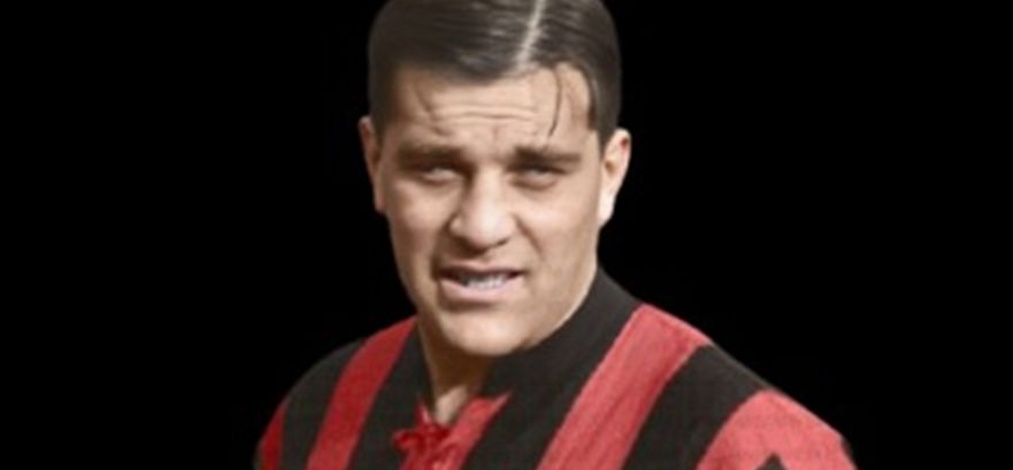
Gunnar Nordahl, born 19 October, 1921, Hornefors, Sweden.
PART ONE
Gunnar Nordahl’s introduction to organized football arrived when he joined his local outfit Hornefors in 1937, at the age of 16 years. While the level was nothing approaching the heights that he would eventually reach, the foundation being laid was as robust solid as the man himself.
He worked at a local brewery during these years, and if that sounds like an unlikely preparation for a career that would one day see him celebrated across the whole of Europe, it is worth understanding what that kind of physical labour did for a young man of already impressive natural size. He stood six feet and one inch tall and carried muscle rather than bulk, and the combination of his frame, his strength, and his emerging instinct for goal made him a presence in those amateur games that was clearly different from the players around him.
He refined his finishing through repetition and through the collective, team-oriented approach that Swedish grassroots football demanded at the time, learning to read the game through the patterns and rhythms of lower-division football rather than through individual brilliance alone, and this early schooling in the value of cohesion and teamwork would prove to be every bit as important as his physical attributes when the bigger stages eventually arrived. He remained an amateur throughout his time at Hornefors, playing without professional pressures but with a seriousness of purpose that those who knew him from those early years could already identify as something exceptional.
The next step came in 1940, when he was nineteen years old and the world outside Sweden was descending into the catastrophic violence of the Second World War. While Europe tore itself apart, Sweden maintained its neutrality, and domestic football continued with a particular intensity and importance as a source of national morale and communal identity in uncertain times. It was in this atmosphere that Nordahl made his pivotal move to Degerfors, stepping up to a higher semi-professional level in the Allsvenskan and leaving behind the purely amateur world of Hornefors for something with more edge, more competition, and more expectation. The transition was not without its challenges, but he was not the sort of man who shrank from them.
Over four seasons at Degerfors, from 1940 to 1944, he scored 56 goals in 77 appearances, and those are numbers that, even in the context of a lower tier of the game, speak with considerable eloquence about the nature of the man’s ability and ambition. In the 1942–43 season he was the Allsvenskan’s top scorer with 16 goals, a distinction that announced him to a wider Swedish football audience and began to attract the attention of clubs operating at the very highest level of the domestic game. He was still balancing football with off-field work, still grounded in the practical realities of working-class Swedish life, but the football itself was becoming ever harder to ignore for anyone who followed the game seriously.
In 1944, Gunnar Nordahl made the move that would transform him from a very fine Swedish footballer into a genuinely dominant one: he joined IFK Norrkoping, and what followed over the next five years represents one of the most sustained and statistically breath-taking periods of goalscoring the Allsvenskan has ever witnessed from a single player. Norrkoping were the club of the moment in Swedish football, a side built on physical robustness and swift, direct attacking play, and they were about to enter a period of dominance that Nordahl himself would do more than almost anyone else to create and sustain.
The numbers demand to be stated plainly, because they are extraordinary in any era and under any conditions: 93 goals in 95 league matches over the course of his time at Norrkoping, a ratio that places Nordahl in a category so rarefied that comparisons become difficult. He won the Allsvenskan title four times in consecutive years, in 1945, 1946, 1947, and 1948, and he was the league’s top scorer three times in that period, claiming the honour with 27 goals in the 1944–45 season, 25 in 1945–46, and 18 in 1947–48. Norrkoping were the finest club in Sweden, and Nordahl was their most devastating weapon, a forward who combined the aerial dominance of a natural header of the ball with the penalty-box instincts of a born poacher and the physical power of a man who had been built for contact and who welcomed it without flinching.
He played within the WM formation that was standard across European football in the post-war years, a system that placed enormous demands on centre-forwards to lead the attacking line with both presence and intelligence, to hold the ball, to bring others into play, and to finish with clinical efficiency when the chances arrived. Nordahl did all of this with a naturalness that belied the difficulty of what he was doing, and under coaches like Lajos Czeizler he developed within a system that prioritised collective defensive solidity and rapid counter-attacking movement, which suited his particular gifts perfectly. He was not a footballer who needed long periods of possession to construct an opportunity; he needed a yard of space, a ball into the danger area, and the reflexes and power to do what came instinctively to him, which was to score.
His physical presence was something that opponents described in terms that bordered on the mythological, and the nickname “The Bison” that he earned during these years was not merely affectionate but genuinely descriptive of the kind of force he represented on a football pitch. Alongside it came “The Gunner,” which spoke to the accuracy and lethality of his finishing, and together the two nicknames captured something essential about the man: he was both immovable object and unstoppable force, a striker who could batter his way through a defence or pick his spot with the precision of a man who had thought carefully about exactly where the ball needed to go before it ever arrived at his feet.
PART TWO
Then came London in the summer of 1948, and everything changed, not just for Gunnar Nordahl but for Swedish football and for the way the world understood what Sweden had been quietly producing in its domestic leagues while the rest of Europe was picking itself up from the wreckage of the war years.
The 1948 Summer Olympics were held in the British capital, and the football tournament brought together national sides from across the world in a competition that, for Sweden, became a statement of collective excellence as much as a sporting event. Nordahl arrived at those Games already the most feared striker in the Allsvenskan, a man who had been scoring goals at a rate that seemed almost unreasonable, and he proceeded to demonstrate to a global audience what the Swedish football public had known for years.
His debut in the first-round match came at White Hart Lane on 2 August, where Sweden faced Austria and dispatched them 3–0 with Nordahl scoring twice, and the message was delivered early and without ambiguity: this was a man who arrived at major tournaments and performed, who did not need settling-in time or gentle opponents to find his rhythm. But it was the quarterfinal at Selhurst Park on 5 August that produced the most remarkable individual display of his Olympic campaign, and one of the most remarkable individual displays in the history of Olympic football. South Korea, outmatched in every department, were on the receiving end of a 12–0 defeat, and Nordahl contributed four of those goals with a finishing exhibition of such precision and physicality that the scoreline told only part of the story of the gap between the two sides.
He was held scoreless in the semi-final at Wembley on 10 August, where Sweden overcame Denmark 4–2 through goals from Kjell Rosén and Henry Carlsson, but his presence in the attacking line throughout that game maintained a threat that Denmark’s defence was forced to respect and plan around even when they succeeded in keeping him off the scoresheet. Then came the final, also at Wembley, on 13 August, in front of more than 62,000 people who witnessed something historic, and Nordahl was again central to it, opening the scoring in the second half in the 48th minute as Sweden defeated Yugoslavia 3–1 to claim the gold medal. Seven goals across the tournament, a tally that tied him for top scorer of the entire competition, and a gold medal that brought Swedish football to the attention of the entire watching world.
The significance of those seven goals in London cannot be overstated when considering what came next, because they were the opening statement in a global conversation about his abilities that had, until that point, been largely a domestic Swedish one, and that conversation was now being conducted in Italian, in English, and in every other language spoken by the people who ran and watched the great clubs of European football.
AC Milan came calling in January 1949, and Nordahl became the first Swedish soccer player to join a foreign professional club, a distinction that carried with it an enormous weight of expectation and no small amount of historical significance for the relationship between Swedish and Italian football that would develop powerfully in the years that followed. The fee and terms were agreed, Nordahl signed, and almost immediately he began the process of convincing his compatriots and Norrkoping teammates Gunnar Gren and Nils Liedholm to follow him south, which they duly did later that same year.
What was formed when those three men came together in the red and black of AC Milan was something that Italian football had not seen before and has not quite seen since: the Gre-No-Li trio, a forward line of such complementary qualities, such instinctive mutual understanding, and such collective devastating effectiveness that the combination of their names became a single word in the football vocabulary of an entire nation. Gren was the technician, Liedholm the organiser and passer, and Nordahl was the scorer, the physical battering ram, the man who turned the creativity of the others into goals with a regularity and relentlessness that Serie A defences found simply overwhelming. They had played together at Norrkoping, they understood each other’s movements and preferences without needing to articulate them, and they brought that familiarity to one of the great clubs in European football and used it to redefine what Milan could achieve.
The early months in Italy brought challenges that had nothing to do with football and everything to do with the reality of establishing a life in a foreign country. The language was not his, the tactical culture of Serie A was substantially different from what Nordahl had known in Sweden, and the transition from the direct, open style of the Allsvenskan to the more structured and defensively organised approach of Italian football required genuine adaptability and intelligence from a man who might easily have been tempted to rely purely on physical dominance. He was not that kind of player and the intelligence that had made him so effective at Norrkoping served him well in the process of adjusting to new demands and new expectations.
The results, once that adjustment had been made, were almost implausible in their sustained quality. In the 1949–50 season, his first full year in Serie A, he hit 35 goals and claimed the Capocannoniere award as the league’s top scorer. The following campaign brought 34 goals and another Capocannoniere, and also brought Milan their first Scudetto in 44 years, the league championship that had eluded them for nearly half a century and that the Gre-No-Li trio had provided the decisive attacking firepower to finally secure. The city was delirious, the club was transformed, and at the centre of it all was the big Swede from Hornefors who had carried boxes at a brewery and played on rough northern pitches and worked his way through the divisions of Swedish football to become, at that moment, the most feared striker in the most technically demanding league in the world.
There was more to come. The Capocannoniere award arrived again in 1952–53 with 26 goals, in 1953–54 with 23, and in 1954–55 with 27, giving Nordahl five of them in total, a record that stands to this day and that represents an achievement of such sustained excellence across multiple seasons that it places him among the most reliable and lethal scorers in the history of the Italian game. And in 1954–55, alongside that fifth top-scorer award, came a second Scudetto for Milan, another league title, another demonstration that when Nordahl was at his best the club was at its best, that his goalscoring was not merely impressive statistically but consequential in the most meaningful possible way.
Over eight seasons at the San Siro, Nordahl scored 210 goals in 257 Serie A appearances, a tally that remains to this day the all-time record for league goals in the history of AC Milan, a record that has survived the decades and the arrivals of many great strikers who have worn the club’s colours since. Two hundred and ten goals. Two hundred and fifty-seven games. Those numbers carry their own weight and need no embellishment, but it is worth pausing to consider what they meant in the context of the era in which they were accumulated: a time of physical, demanding, defensively organised football in which goalscorers were policed closely and margins were tight and every goal required something exceptional from the man who scored it.
PART THREE
The question of Gunnar Nordahl’s relationship with the Swedish national team is one of the most complicated and, in some respects, most melancholy threads running through his story, because it involves a set of circumstances that removed him from the international arena at precisely the moment when his abilities were most completely developed and most devastatingly expressed. He earned 33 caps for Sweden between 1942 and 1948, scoring 43 goals at a rate of 1.30 per game, a ratio that places him among the most prolific international forwards of any era and any nation, and those numbers were achieved entirely in the amateur football world that he inhabited before his move to Milan.
His international debut came in that period when he was still developing his game at Degerfors and then Norrköping, and his scoring record for his country tracked the scoring record he was simultaneously building in the Allsvenskan: relentless, extraordinary, an expression of a finishing instinct that simply could not be suppressed regardless of the level or the opponent. By the time the 1948 Olympics arrived, he was the complete international forward, and the seven goals he scored in London were the fullest possible expression of what he could do on the biggest stage with the whole world watching.
But the move to AC Milan in January 1949 ended all of that, because the Swedish Football Association’s rules at the time were unambiguous on the subject of players who signed professional contracts abroad: they were ineligible for selection. It was a policy designed to preserve the amateur status that Olympic participation required, and in the particular context of Swedish football’s relationship with its best players it created a situation that deprived the national team of Nordahl, Gren, and Liedholm simultaneously, removing the entire Gre-No-Li attacking trio from international consideration at the moment when those three men were reaching the absolute peak of their collective powers. The 1950 FIFA World Cup in Brazil arrived, and Sweden competed without them, which was a loss that no honest assessment of the situation could minimise.
The remarkable thing, and the thing that speaks to the genuine quality of Swedish football in that post-Olympic generation, is that Sweden still managed to finish third in Brazil, still mounted a campaign that brought enormous credit to the domestic game and to the players who were available for selection. They edged out Italy 3–2 in a result that constituted something of an upset given the status of their opponents and that remains one of the more celebrated victories in Swedish football history, they drew 2–2 with Paraguay, and they overcame Spain 3–1 in the final round-robin before the defeats to Brazil and Uruguay placed them in the third-place position that represented their finest World Cup showing at that point. 11 goals scored across five matches without the three men who had been the most important attacking players in the country eighteen months earlier: it was an achievement that demanded genuine respect.
For Nordahl himself, the exclusion was a professional reality that he accepted without public bitterness but that must, privately, have stung with particular sharpness when he considered what a Swedish team containing himself, Gren, and Liedholm might have achieved in Brazil with the combination of Olympic gold-medal experience and the sharper edge that professional football in Serie A had given all three of them. His international numbers stopped accumulating at 33 caps and 43 goals, and the goals-per-game ratio of 1.30 remained frozen in time as a measure of what he had achieved in the years when he was available, a reminder both of the quality and of the quantity that was never allowed to be added to it.
In 1956, at the age of thirty-four, Nordahl was transferred from AC Milan to AS Roma for a fee reported at around 105 million lire, and the move represented the beginning of the final phase of his Italian story. He was no longer the force of nature who had terrorised Serie A defences in his prime Milan years, but he was still a professional footballer of significant quality and considerable experience, still a man whose name carried weight in the dressing room and whose presence on a team-sheet demanded respect from opponents. Roma were a different kind of challenge from the club he had left, a side without the resources or the immediate ambitions of Milan but with their own particular identity and their own loyal and passionate supporters.
In his first season at Roma, 1956–57, Nordahl appeared in 30 league games and scored 13 goals, which was a perfectly respectable contribution from a player in the twilight of his career and which helped Roma to a 12th-place finish that kept them comfortably away from any relegation anxiety. His experience and his reading of the game compensated for the physical decline that was inevitable given his age and the demands that a decade of professional football at the highest level had placed on his body, and he remained a valued member of the squad in ways that extended beyond the purely statistical. The following season, 1957–58, brought only four league appearances and two goals as the physical toll became impossible to ignore, but Roma improved to ninth place and the club was building towards something better than the previous season had suggested.
Across his two full seasons at Roma, Nordahl accumulated 34 Serie A outings and registered 15 league goals, with an additional four goals in cup competitions giving him 19 goals in 39 appearances across all competitions, and while those numbers could not compare to the sustained brilliance of his Milan years they were still the numbers of a man contributing meaningfully to a professional football club at an age when many players had already withdrawn from the game entirely.
In 1958, he took on a player-manager role at Roma, blending the remaining threads of his playing contribution with the early responsibilities of coaching, and it was a transitional year in every sense, a period of adjustment and anticipation that pointed towards the next phase of his life in the game. He left Italy altogether the following year, driven by homesickness after nearly a decade abroad and by the recognition that the time had come to return to the country and the family that had always been the foundation beneath the extraordinary professional edifice he had constructed in the years since that move to Milan in January 1949.
Back in Sweden in 1959, Nordahl teamed up with Karlstad in the Second Division, taking on a player-manager role which allowed him to remain connected to the game while easing himself into the purely coaching responsibilities that lay ahead. He amassed 24 appearances for Karlstad and found the back of the net on 11 occasions, numbers that tell their own modest but dignified story about a great player finding a gentle and appropriate way to close the playing chapter of a life spent on football pitches.