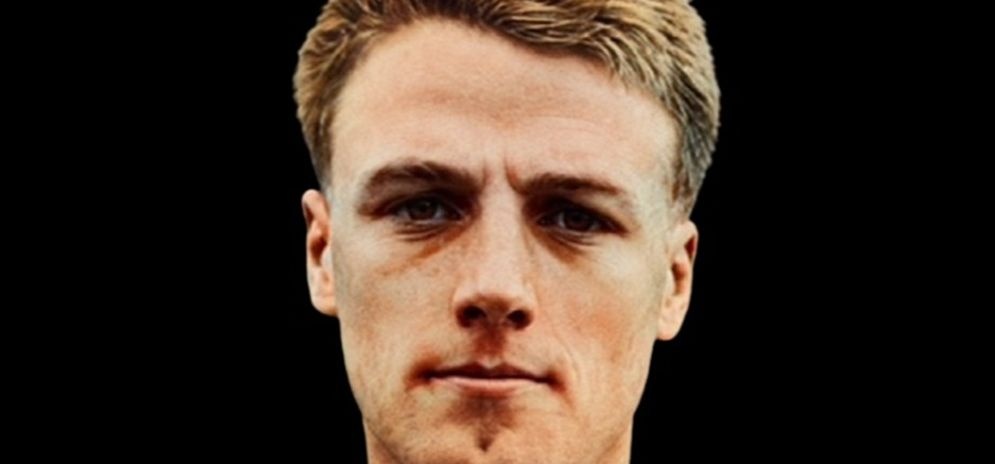
Albert Joseph Scanlon, born 10 October 1935, Manchester, England.
PART ONE
Albert Scanlon joined the Manchester United groundstaff in 1950, when he was just fifteen years old, and signed a professional contract in December 1952. By then, Matt Busby’s great experiment was already well underway — the famous decision to build from the bottom up, to trust in youth, to develop rather than simply buy, a philosophy that would produce the team the country would come to know as the Busby Babes, those brilliant, brash young men who played attacking football as if they had invented it. Scanlon was one of them.
The talented left winger played his part in back-to-back FA Youth Cup wins in 1953 and 1954, those early triumphs that announced a generation of talent to English football, and on 20 November 1954 he was handed his long-awaited senior debut by Busby in a First Division fixture against Tom Whittaker´s Arsenal at Old Trafford, stepping onto the pitch for the first time as a proper Manchester United player. He was nineteen years old and bursting with ability. The difficulty, though, was that he wasn’t the only one.
David Pegg, another enormously gifted left winger, had the number eleven shirt more or less locked down during those years, and Scanlon found himself hovering on the edges of a first team that was, by any honest measure, sensational. Manchester United won the First Division title in 1955-56 and again in 1956-57, and Scanlon was part of the squad both times, even if his appearances were too few to earn him a winner’s medal on either occasion. He was occasionally deployed on the right wing in place of Johnny Berry, but those were cameo roles, supporting-cast appearances in a show being headlined by others. He was still young, still learning, still waiting for the moment when the stage would be properly his.
That moment arrived on 5 February 1958, in Belgrade, though nobody who was there could have imagined the circumstances that would bring it about. Manchester United were away to Red Star Belgrade in the second leg of their European Cup quarter-final, and Scanlon started on the left wing in what turned out to be a 3-3 draw — a result that put the Old Trafford outfit through on aggregate to the semi-finals and sent the travelling supporters into raptures. For five of the players who started that evening, it would be the last match they ever played for the club. For several others, it would be the last match they ever played at all.
The following day, 6 February 1958, the team boarded British European Airways Flight 609 at Munich-Riem Airport for the flight home to Manchester. The runway was slushy and the weather was terrible, and on the third attempt to take off, the aircraft failed to clear the perimeter fence at the end of the runway. It tore through a house, clipped a tree, and broke apart. Twenty-three of the forty-four people on board were killed, including eight United players — Roger Byrne, Geoff Bent, Eddie Colman, Mark Jones, David Pegg, Tommy Taylor, Billy Whelan, and the irreplaceable Duncan Edwards, who died in hospital fifteen days later. For those who lived through those days in Manchester, who heard the news crackling over the wireless or read the stop-press columns in the evening papers, there was a grief that seemed to have no bottom.
Scanlon survived, but only barely. He had been left for dead initially, as rescue workers searched for those who looked more likely to survive. He had suffered a fractured skull, a broken leg, and kidney damage, and he did not play again that season. The club, meanwhile, was held together by the sheer willpower of assistant manager Jimmy Murphy, who had been absent from Belgrade because he was managing Wales in a World Cup qualifier and who now faced the near-impossible task of rebuilding a team from the rubble of that runway.
PART TWO
Albert Scanlon came back, and when the 1958-59 season began, he was in the team. Not just in the team: he played in every single game that season, all forty-three of them, and he scored sixteen goals, which for a winger in that era was a genuinely outstanding return. Bobby Charlton was United’s top scorer that season with twenty-nine league goals, while Scanlon was also impressive with his sixteen. The rebuilt United side, carrying within it the weight of everything that had happened, finished second in the First Division, just two points behind champions Wolverhampton Wanderers. In the circumstances, it was a feat that defied easy description — a team drawing on reserves of character that went beyond anything normally demanded of footballers.
Scanlon, running at full-backs down that left flank, was a significant reason why United were as good as they were that season. He was quick and direct and difficult to pin down, and those sixteen goals — headers, tap-ins, the occasional thunderbolt struck on the run — were not lucky goals or scrappy ones but the goals of a player at the peak of his powers. Furthermore, there was something deeply moving about the sight of a young man who had been pulled from the wreckage of a crashed aircraft less than a year earlier now terrorising First Division defences with such evident relish. Scanlon was, in every meaningful sense, back.
The 1959-60 campaign was harder. The lingering physical effects of Munich were beginning to make themselves felt, and by that season, the effects from his injuries contributed to a decline in Scanlon’s form and consistency, resulting in thirty-one league appearances. He was still a valued member of the squad, still a handful for any defender who faced him, but the absolute peak of that post-Munich season was not quite matched, and in November 1960, he was sold to Newcastle United for £18,000. He felt he had been betrayed by the club, in particular by new chairman Louis Edwards and by Matt Busby. It was a painful end to his time at Old Trafford — 127 appearances, 35 goals, two FA Youth Cup medals, and a story that deserved a grander farewell.
His time on Tyneside was not a success, and in February 1962 he moved down the divisions to Lincoln City. He was on the move again just over a year later, signing for Mansfield Town in April 1963 just in time to share in their promotion to the Third Division — a modest celebration compared to the European nights of his youth, but a celebration all the same. Mansfield came close to a second successive promotion two years later, finishing third in Division Three, but they fell away the following season and Scanlon eventually dropped out of league football altogether, joining Belper Town in 1966 before retiring not long afterwards.
After football, he returned to Manchester and got on with life in the straightforward way of men of his generation. He worked as a security guard at a Colgate-Palmolive factory near Old Trafford, and as a docker in Salford — hard, honest work, far removed from the roar of the crowds and the glare of the floodlights. There was something characteristically unglamorous about it, and also something characteristically dignified. He had been a Busby Babe, had survived Munich, had scored sixteen goals in a season that should never have happened — and now he was clocking in for his shift like everybody else.
Scanlon remained, however, a Manchester United man to his bones. On 13 May 2007, he stood on the Old Trafford pitch alongside his old teammate Bill Foulkes and presented the Premier League trophy to the club — a moment that connected fifty years of history in a single image. Then in May 2008, United flew him to Moscow on a private jet, along with Bobby Charlton and Harry Gregg, to watch the Champions League final against Chelsea. United won that night on penalties, and the Munich survivors were there to see it. Whatever else had happened in the years between, that night in the Luzhniki Stadium must have felt like something being completed.