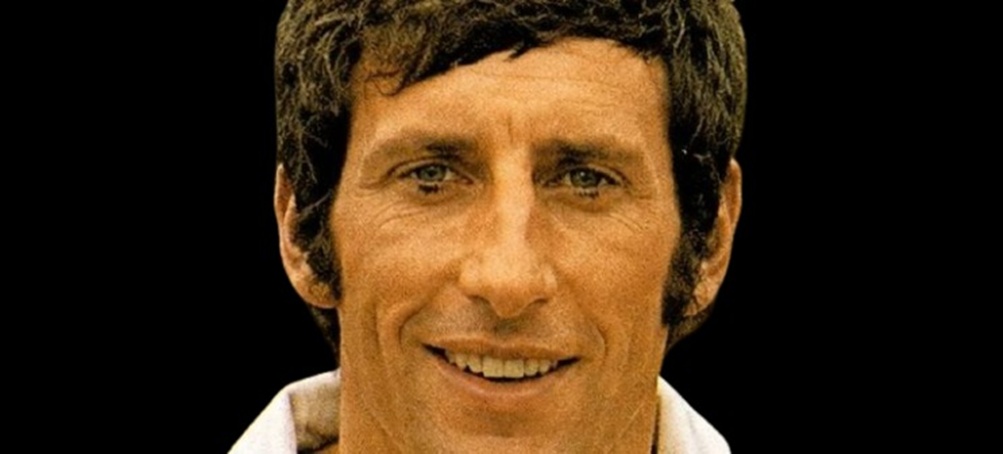
Edward Glyn James, born 17 December 1941 Llangollen, Wales.
PART ONE
Glyn James signed professional terms with Blackpool in 1959 after coming through the youth ranks, a young centre half from North Wales who had caught the eye of the coaching staff at Bloomfield Road and persuaded them that he was worth the gamble of a contract. The early months were patient ones — he was learning, watching, absorbing — but on 28 September 1960, the moment arrived. Blackpool were at home in the League Cup against Leeds United, the match ended goalless, and Glyn James had played his first senior game of football as a professional, marking the beginning of something that would last until 1975.
That debut season, 1960–61, brought him just four appearances, and it would have been easy, particularly for a young man still finding his feet, to feel discouraged by the modest involvement. But James was not built for discouragement, and by around 1962 he had worked his way into the side as a genuine first-team regular, holding down a starting place at centre half as Blackpool moved between the First and Second Divisions. The team of those early years was a mixed bag of seasoned professionals and emerging talents, and among the latter was a hyperactive, combative young midfielder by the name of Alan Ball Jr., who would go on to captain England to World Cup glory in 1966 but who served his football apprenticeship at Bloomfield Road between 1961 and 1966. Alongside players of that calibre, James was quietly building a reputation for defensive reliability that money cannot buy — the sort of solid, unspectacular excellence that does not attract headlines but wins football matches.
His first goal for the club came in the 1965–66 season and, for a centre half of his type, it was not simply a statistic but a statement — evidence that this was not a player who simply parked himself in front of the goalkeeper and hoped for the best, but one who could affect a game from one end of the pitch to the other. However, the broader picture of those years was not uniformly bright, and the following season, 1966–67, brought one of the crueller experiences that football dishes out: relegation from the First Division. James was one of the men who had to square his shoulders, accept the verdict of the league table, and commit to the hard work of rebuilding.
He did exactly that. Through the latter years of the 1960s he remained an indispensable presence as Blackpool gritted their teeth in the Second Division and plotted their way back, and when the reward finally came at the end of the 1969–70 season, it arrived in the most emphatic fashion imaginable. On 13 April 1970, Blackpool travelled to Deepdale to face local rivals Preston North End and dismantled them 3–0, a result that confirmed promotion back to the First Division in front of a crowd that understood perfectly well what the occasion meant. James was there, as he always was, organising and defending and competing with the absolute conviction of a man who understood what this club meant to the town and to himself.
The 1970–71 season brought yet another relegation, pulling Blackpool out of the First Division once more, but it also brought access to the Anglo-Italian Cup, a competition that would produce one of the most astonishing afternoons in the club’s entire history and deliver James a moment that nobody who witnessed it was likely to forget. On 10 June 1972, Bloomfield Road hosted Lanerossi Vicenza, and what unfolded over ninety minutes was not so much a football match as a demolition.
The scoring began after only 82 seconds, when Tommy Hutchison slipped a clean pass through the middle of the Italian defence and Micky Burns, reacting faster than Alan Ainscow who had been unable to control the ball, swept Blackpool into the lead from ten yards. Almost immediately from the restart Blackpool doubled their advantage, Hutchison finding an unmarked Ainscow who drove the ball past the helpless Vicenza goalkeeper as if the Italians had not grasped what was happening around them, and the crowd inside Bloomfield Road began to sense that this was going to be a very different kind of afternoon. The third goal arrived on 15 minutes when Bill Bentley’s cross was met by a neat header from Alan Suddick, who needed only a yard of space and found it easily, and then on 31 minutes Hutchison drove in a corner that was swept on — and Glyn James, the club’s captain and defensive rock, was alert and decisive enough to prod the ball home and make it four. Half-time came with Lanerossi reeling at 4–0, their composure as crumbled as their defensive shape, and the second half began in a manner that suggested the torture was nowhere near finished.
Four minutes after the restart an own goal made it five, and then Burns, already one goal to the good, embarked on the kind of spell that forwards dream about. On 58 minutes he received a pass from Suddick and struck it home from 25 yards with such certainty that it looked almost effortless, and barely two minutes later, with the Vicenza defence unable to clear an Ainscow shot, Burns pounced on the rebound and fired it in to complete a hat-trick and make the scoreline an implausible 7–0. By this point the Lanerossi goalkeeper, apparently making a private calculation about how much more of this he was prepared to absorb, walked off the field and was replaced by his deputy — but the substitute had been on the pitch for only five minutes before Mick Hill, a player on extended trial at the club, volleyed home a Hutchison centre to make it eight. Hill added a ninth with a header from another Hutchison cross, and then on 71 minutes Burns stretched out a foot to push in a drive from substitute Steve Harrison and the scoreboard read ten.
James wore the captains armband through the remaining years of his time at Bloomfield Road, leading the side through the Second Division campaigns with the same committed professionalism he had always brought to the job His appearances became less frequent in the 1974–75 campaign, the body making demands that the will could no longer entirely override, and in 1975 he retired at the age of 33 following injury. The numbers tell you something about what he gave: 399 league appearances, 22 goals,15 seasons at one club, and not a single day of his professional life spent anywhere else. He played for Blackpool and only for Blackpool, from 1959 to 1975, which in an era of transfer fees and personal ambition and clubs competing for the best defenders in the country is a remarkable thing to be able to say.
PART TWO
In1966, Glyn James was selected for the Wales national team and sent, along with his teammates, on a tour of South America — and on 14 May, in the Maracanã Stadium in Rio de Janeiro, one of the most intimidating sporting arenas on the face of the earth, he made his international debut against Brazil. Wales lost 3–1, which was far from disgraceful against a Brazilian side of that era, and James played his part in a defence that was going up against some of the most talented footballers the world had ever produced.
Four days later, on 18 May, he was back on the pitch in São Paulo for a second match against Brazil, and Wales went down 1–0, though the margin tells only part of the story of the effort required to keep it that close. Then came Santiago on 22 May and a 2–0 defeat to Chile, completing a three-match tour that would have been physically and mentally punishing for anyone, let alone a young centre half who was essentially learning international football on the job at altitude and in heat that bore no resemblance to what he experienced on the Fylde Coast in autumn. Furthermore, the education these matches provided was invaluable, and James returned to Blackpool a more complete player for having tested himself against opposition of that quality.
His nine caps were spread across the years from 1966 to 1971, and they included two UEFA European Championship qualifying matches in 1967 — a 0–0 draw with Northern Ireland in Belfast on 12 April and a 2–3 home defeat to Scotland on 22 November, both in Group 8 — as Wales pushed hard for advancement but ultimately came up short. The British Home Championship matches of 1971 brought three further appearances: a goalless draw with Scotland on 15 May, the same result against England on 19 May in a game that suggested Wales were far from embarrassed at that level, and then a 0–1 loss to Northern Ireland on 22 May that was disappointing but hardly catastrophic. His final cap came on 21 April 1971 in a UEFA European Championship qualifier at Cardiff, where Czechoslovakia won 3–1, and that, as it turned out, was the end of his international involvement.
Life after football took James in directions that might seem far removed from the pressures of competitive sport, but which in their own way continued the story of a man rooted in a place and proud of what that rootedness meant. He initially ran a post office in the Blackpool area and then, showing the kind of practical determination that had served him well in a defensive career, established a laundry and dry cleaning business. The business secured a contract to clean the matchday shirts of Blackpool Football Club — which meant that even in retirement, even behind a counter rather than a goalline, James was contributing to the club’s daily operations in his own quiet fashion.
He later sold the business and stepped back from working life entirely, but he never stepped back from Bloomfield Road. He continued to attend matches, continued to follow the club’s fortunes with the particular mixture of passion and pain that long-serving players tend to feel about the institutions to which they devoted their best years, and when Blackpool’s ownership became a source of genuine distress among supporters in the years after his time, James was not the sort of man to stay silent about it. He attended fan marches, he voiced his concerns publicly and he said, with the directness you might expect from a man who spent fifteen years making hard decisions under pressure: “It sickens me what’s happening at Blackpool FC.” He remembered what the club had been when he played for it — well-run, respected, connected to its community — and the gap between that memory and the reality he saw before him was too wide to accept without protest.
In August 2006, James was among the inaugural inductees when Bloomfield Road officially opened its Hall of Fame. He was selected for the 1960s category by fan vote, recognition from the people who had watched him week after week of a contribution that statistics alone cannot adequately capture. The induction placed him alongside the club’s most celebrated figures and gave formal shape to something that supporters had understood for decades: that this Welsh centre half from Llangollen, who had given his entire professional life to a Lancashire seaside club and who still turned up to matches and still cared about the result long after his knees had given in, was one of them in a way that no signing fee or transfer deal could manufacture.