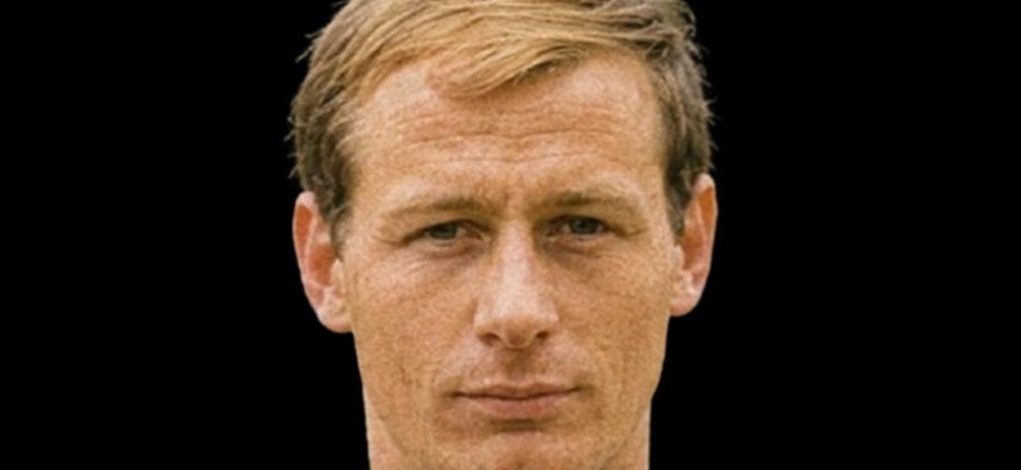
Derek Draper, born 11 May 1943, Swansea, Wales.
PART ONE
Derek Draper came up through the ranks at Swansea Town, signing professionally in 1962 and making his Football League debut in the 1962–63 season. The Vetch Field was a tough education — a compact, angular ground wedged between terraced streets in the heart of the city, where the crowd sat close enough to make themselves heard on every touch — but Draper was not easily rattled. He was a versatile forward, clever rather than thunderous, with a low centre of gravity, quick feet and an almost intuitive understanding of how to use his body to create space in packed penalty areas. Even at twenty, there was an intelligence to his play that set him apart from the typical lower-division striker of the era.
The 1963–64 campaign brought with it the kind of adventure that most footballers of that generation never got close to. Swansea reached the FA Cup semi-finals, and along the way Draper was a prominent figure in a 4–0 demolition of Sheffield United that announced the club’s intentions to the rest of the country. To beat a First Division side by four goals in the FA Cup was not a small thing, and the Swansea supporters who made that journey knew they were watching something special. They were knocked out before Wembley, as lower-division sides almost always are, but the run had shown Draper what the game could be at its most exhilarating — the giant-killing, the noise, the sense that the draw had handed you something precious and it was your job not to waste it.
He remained at Swansea until April 1966, when Derby County paid £5,000 to take him to the Baseball Ground. It was a reasonable fee for the time, and on paper it looked like the move that would define his next chapter. In practice, it did not work out that way. Draper made just eight league appearances for the Rams and never really established himself in Brian Clough’s plans — though Clough was still two years away from arriving at Derby, and the club was not yet the force it would become. Nonetheless, it was a frustrating spell and he moved on, joining Bradford Park Avenue for what proved to be a more productive, if still transitional, period of his life.
The real story, though, begins in January 1969. Chester manager Ken Roberts paid £5,000 — the same fee which Derby had paid three years earlier — to bring Draper to Sealand Road, and it turned out to be one of the most astute pieces of business in the club’s history. On 18 January 1969, Draper pulled on a Chester shirt for the first time in a 3–1 victory against Notts County, and from that afternoon onwards he was theirs. He would not leave for eight years, and when he did, he left as a club legend.
Chester at that time were a Fourth Division outfit with a modest history but a loyal and tight-knit support. Founded in August 1885 and initially competing in The Combination, the club had gradually worked its way through the regional leagues — winning the Combination title in 1908–09, joining the Lancashire Combination in 1910, earning promotion from Division Two the following season, and eventually entering the Cheshire County League in 1919, where they were champions three times, in 1921–22, 1925–26 and 1926–27. Elected to the Football League in 1931, they had spent the decades since then living mostly in the Third and Fourth Divisions, solid without being spectacular, provincial without being parochial. They were not a glamour club. But they were a good football club, and they knew how to look after their own.
PART TWO
Draper settled quickly at Chester, though it was not until 1974–75 — his sixth season at the club — that the story reached its extraordinary peak. By then he was thirty-one years old, an age at which many forwards begin to feel the game ebbing away from them, but Draper had never relied on pace and never would. His gifts were different: the sharp elbows-in-tight technique of the street footballer, the knack of flicking headers into exactly the space his strike partners were anticipating, the intelligence to move before the ball arrived rather than after. He and John “Jesse” James had developed, over those years together, the kind of near-telepathic understanding that takes time to build and looks effortless once it is fully formed.
The League Cup that season was, to put it plainly, extraordinary. Chester — a Fourth Division side, playing in front of average home gates below five thousand — went on a run that left the football world rubbing its eyes. In the first round, on 21 August 1974, Draper scored both goals in a 2–1 home win over Walsall. A second-round victory over Second Division Blackpool followed, and then Preston North End were seen off in the third round. But the fourth round brought Leeds United to Sealand Road, and here the story takes on a quality that even now seems almost too good to be true.
Leeds United in November 1974 were the champions of England. The Peacocks had won the First Division title the previous season, finishing five points clear of Liverpool and losing only four matches all year. They were also, in those days, a genuinely formidable and ruthless outfit and the idea of a Fourth Division club seeing them off looked, on paper, somewhere between unlikely and impossible. Chester players thought otherwise, though. On 13 November, in front of 19,000 supporters who had packed Sealand Road far beyond its usual capacity, James scored twice and Trevor Storton added a third to give the hosts a shock 3-0 triumph over Leeds.
Draper’s role in that win was not found on the scoresheet but it was fundamental to everything Chester did that evening. The flicked headers, the clever running off the ball, the willingness to drop deep and link play — he was the architect of much of what the strike partnership produced, and James in particular owed Draper a considerable debt for the supply of chances that came his way. Then, n the quarter-final, Chester drew 0–0 at Newcastle United on 4 December before James settled the replay at Sealand Road on 18 December, scoring in the seventy-fifth minute in front of another 19,000 crowd. The Cheshire club were in the semi-finals of the Football League Cup.
The semi-final was against Aston Villa, who were then in the Second Division under Ron Saunders but progressing at considerable pace. The first leg at Sealand Road on 15 January 1975 drew Chester’s biggest crowd of the season, and the match ended 2–2, with Terry Owen and Ian Moore scoring for the home side. The aggregate was level going into the second leg at Villa Park on 22 January, where 47,632 people watched Villa win 3–2, with Keith Leonard scoring twice. Chester lost on aggregate 5–4, and the dream was over.
There was still the matter of the league, however. Chester finished fourth in Division Four and were promoted for the first time since joining the Football League in 1931. The League Cup run and the promotion had arrived in the same season. For those who were there, it remains the finest year in the club’s history — and Draper, who scored nine goals in league matches that season, including a hat-trick in a 4–0 win over Rochdale at Sealand Road, was at the heart of it.
He continued playing for Chester for another two years after that golden season, accumulating appearances at the methodical rate of a man who understood his craft and was in no hurry to abandon it. His final game came on 11 April 1977, a 1–1 draw with Portsmouth at Sealand Road — a low-key ending, as final games so often are, but appropriate in its way. Draper would not have wanted a ceremony. When he retired, the numbers were plain: 322 Football League appearances for Chester, 54 goals. Both figures place him in the top ten on the club’s all-time lists, an honour he shared with only a handful of others in the club’s history. Additionally, he had earned one cap for Wales Under-23s, recognition from his country that came alongside the club recognition he had always received in abundance from the terraces at Sealand Road.
In the years that followed, Draper remained a Chester man through and through. He worked in the commercial department at the ground, then as a postman and a milkman in the Chester area — trades that suited a man of his temperament, out early, moving among people, unpretentious — and he stayed involved in local football for many years. He became an active and deeply respected member of the Chester Former Players’ Association. He was inducted into the club’s Hall of Fame, an honour that surprised nobody who had seen him play.