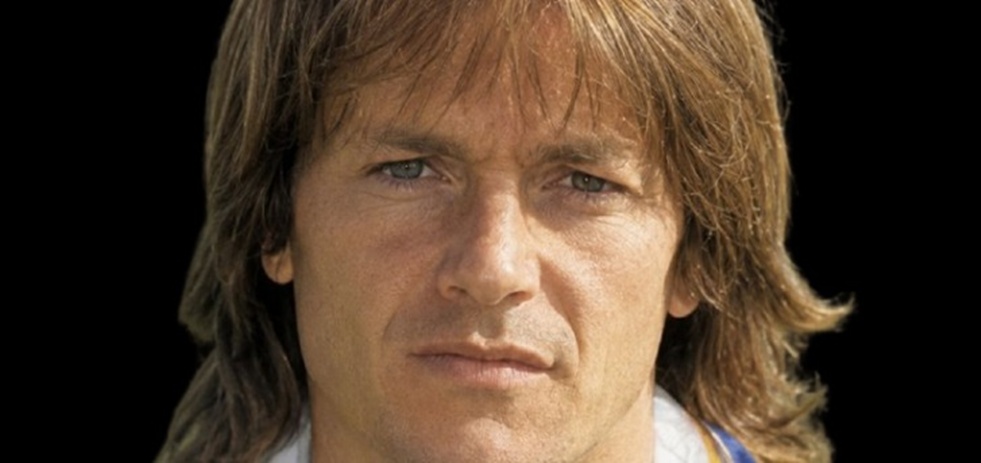
Daniel Bravo, born 9 February 1963, Toulouse, France.
PART ONE
Daniel Bravo signed his first professional forms with OGC Nice in the summer of 1980, at the age of seventeen. The precociously talented footballer made his senior debut against FC Metz in the French D1, thrown into a league that did not much care how young you were once the whistle went, and he adapted well enough to become a regular fixture in Nice’s midfield across the 1980–81 and 1981–82 seasons. There was no fairytale start to speak of, no early cup run or unlikely title challenge, just the steady business of a youth learning to compete week after week against grown men who had no interest in taking it easy on him because of his age.
Nice were not a team on the rise during those years, however, and at the end of the 1981–82 campaign the club slipped into D2, a blow that might have derailed a lesser prospect but instead gave Bravo the platform to show what he could do with more of the ball at his feet and less pressure bearing down on every touch. In the 1982–83 season, he found a scoring touch that had not been obvious before, hitting eleven goals from midfield and proving that his game had more to it than tidy distribution; suddenly a player who had been valued chiefly for his passing and his positional sense was arriving in the box at the right moments too, timing his runs to steal in behind opposing midfields that had grown used to thinking of him as a facilitator rather than a threat. Those goals, allied to the calm way he ran games from deep, were enough to persuade AS Monaco to sign him, and in 1983 he swapped the red and black of Nice for the red and white of the principality club, a move up in stature if not, strictly speaking, in geography, given how close the two clubs sat along the same stretch of coastline.
Monaco in the mid-1980s were a side stacked with craft, playing some of the most watchable football in the country even as the bigger battalions of Bordeaux and Paris Saint-Germain hogged more of the newspaper column inches, and it was against that backdrop of quiet, principality-based excellence that Bravo did some of the best sustained football of his playing days, and Bravo spent four years there, from 1983 to 1987, appearing in 122 matches and scoring 22 goals, a return that would have been considered excellent for most midfielders of his era but which he treated almost as a sideline to the defensive discipline and tactical intelligence that were becoming his real trademarks.
Bravo was there for the heartbreak of the 1984 Coupe de France final, when Monaco lost 2–0 against FC Metz at the Parc des Princes in front of over forty-five thousand spectators, a result that stung all the more given the manner in which Monaco had fought through the earlier rounds. He was there too, twelve months later, for the redemption of it, when Monaco overcame Paris Saint-Germain by a 1–0 score in the 1985 final courtesy of a Bernard Genghini goal, a trophy that gave Bravo his first senior honour as a professional and one that must have carried an extra edge given it came against the very club he would join four years down the line.
Along the way he also won the Coupe des Alpes with the club in 1983, a smaller prize but one that mattered to a young player still building his reputation and still learning what it took to win things rather than simply compete in them. Monaco in this period were among the strongest sides in the country, finishing runners-up in the league in 1983–84 and champions themselves a few years later, and Bravo, playing week in and week out alongside gifted teammates, grew into exactly the kind of central midfielder that bigger clubs notice: reliable, technically assured, and never afraid to put his foot in when the situation demanded it, a player coaches trusted to do the unglamorous work that let the more decorative talents around him shine.
Rather than push on to one of the continent’s true giants, though, Bravo chose in 1987 to go back to where it had all started, re-joining Nice for a second stint that would run until 1989, a homecoming that surprised nobody who understood how fond the club had always been of him and how fond, in turn, he had remained of it. He was not the same player who had left the club four years earlier, and it showed in the way he began to contribute more directly to the scoresheet, offering an offensive spark from midfield that Nice had missed during his years away, arriving in the box with a confidence that owed a good deal to the seasoning he had picked up at Monaco.
The high point of that second spell came on 17 September 1988, when Bravo scored a hat-trick as Nice beat RC Lens 3–0 in Ligue 1, three goals in an afternoon that confirmed just how far his all-round game had come since his first appearance against Metz back in 1980, and which stood, for years afterwards, as one of the more talked-about individual performances of his time in blue and black. Nice never troubled the top of the table during either of Bravo’s spells there in the 1980s, and no major trophy came his way at that stage of his time with the club, but his versatility and his eye for goal from central midfield made him one of the more important figures in a Nice side that was otherwise treading water in the middle reaches of the table, and by the time he left for Paris in 1989, he had already given the club two separate periods of consistent, dependable service that supporters of a certain age still speak of warmly, long before anyone could have guessed there would be a third instalment still to come, a decade or so further down the line, once his playing days were winding towards their close.
PART TWO
Paris Saint-Germain signed Daniel Bravo from Nice at the beginning of the 1989-90 campaign and it was here, over the course of seven seasons, that he built the body of work for which he is most fondly remembered. He arrived as a central midfielder whose defensive solidity and clean passing had already been well proven at two other clubs, and he settled quickly into a Parisian side that was starting to assert itself as a genuine force in French football after years spent in the shadow of Marseille and Bordeaux.
Across his time in the capital he made 217 appearances and registered 23 goals in Ligue 1 alone, and even though he was never the most eye-catching player on the pitch, Paris Saint-Germain’s coaching staff came to depend on the balance which he gave a midfield that had no shortage of flair elsewhere in the shape of more celebrated names. His first piece of silverware in the capital came in the 1992–93 season, when PSG won the Coupe de France, a competition in which Bravo accumulated 23 appearances across his time at the club. The following year brought the club’s first Ligue 1 title of the modern era, PSG topping the table in 1993–94 with a defensive record built in no small part on the platform Bravo and his midfield partners provided, breaking up opposition attacks before they ever reached a back four that could then play with real confidence.
If 1993–94 was the season that announced Paris Saint-Germain as champions again, then the 1994–95 campaign was the one that confirmed it was no fluke, with Bravo helping the club to a domestic double of the Coupe de France and the Coupe de la Ligue, the latter secured with a final victory over Lyon in which his typically disciplined performance played its part, doing the sort of unseen defensive work that never troubles a highlights reel but wins matches all the same. A year later still, in 1995–96, Paris Saint-Germain went one better on the European stage, edging out Rapid Wien by a 1–0 margin in the final of the UEFA Cup Winners’ Cup at the King Baudouin Stadium in Brussels, a result which delivered the club’s first major continental trophy and lifted the Red-and-Blues, for one night at least, onto the same footing as Europe’s more established powers.
Bravo featured in eight matches across that European run, including the campaign that carried Paris Saint-Germain all the way to the final, offering the same reliability in continental competition that he had long since made his calling card domestically. By the time he eventually left the club in 1996, he did so as one of the more decorated and trusted figures of that Paris Saint-Germain era, a player who had gone from Coupe de France winner to European champion without ever being the man the crowd chanted for, and who probably would not have wanted it any other way.
At the age of thirty-three, with a European trophy and three domestic honours in his pocket from Paris, Bravo took the unusual step of testing himself abroad, moving to Parma in Serie A in the summer of 1996 as one of the club’s marquee signings that year alongside defender Lilian Thuram, a pairing that gave the Italian side’s midfield and defence a distinctly French flavour heading into the new season. It would prove to be his only spell outside France, and results were mixed: he played 24 times in Serie A, starting 17 of those matches and totalling 1,344 minutes without finding the net, a modest personal return but one that came within a Parma side that finished second in Serie A that season, the best league placing in the club’s history to that point and proof that his defensive contribution, even without goals attached to it, was helping the team where it mattered the most.
He also turned out twice in the UEFA Cup group stage and once in the Coppa Italia during his time there, though Parma’s European and domestic cup campaigns both ended earlier than the league form suggested they might, exiting the UEFA Cup at the first hurdle and going out of the Coppa Italia in the second round, results that must have felt like missed opportunities for a squad with such evident quality running through it. Bravo’s spell in Italy lasted until October 1997, during which time he settled into a Parma midfield that also featured the likes of Dino Baggio and Massimo Crippa, adding a further layer of tactical know-how to a squad that was quietly becoming one of the most competitive in the country.
PART THREE
Midway through the 1997–98 season, Bravo returned to France, joining Olympique Lyonnais in November 1997, at a moment when the Kids were still some years away from the dominance that would later define the club under different ownership. And although his time there was brief, it was productive: fourteen appearances brought him four goals in 1,259 minutes, a creative contribution that helped the side finish sixth in Ligue 1 that campaign, comfortably the sort of mid-table finish a club of Lyon’s ambitions was hoping to build upon.
It was not an entirely trouble-free spell, with two yellow cards and a red mixed in among the goals, evidence that the competitive edge which had served him so well across nearly two decades in the game had not dulled with age, but by the time he departed at the season’s end, Bravo had done enough to help stabilise a Lyon midfield that was navigating a period of transition, and he left with the club’s engine room in noticeably better shape than he had found it, a short stay but a useful one all the same.
From Lyon, Bravo moved on to Olympique de Marseille for the 1998–99 season and made a respectable twenty appearances as the Stade Vélodrome side finished in fourth place in the Ligue 1 standings. In Europe, though, Marseille went on a run that took them all the way to the final of the UEFA Cup, with Bravo featuring in seven matches across the campaign, helping to steer a squad that had been shorn of five suspended players following an ugly tunnel incident in the semi-final against Bologna, only for the dream to end in Moscow on 12 May 1999, when Parma, the very club he had so recently represented himself, defeated the Phocaeans 3–0 at the Luzhniki Stadium in front of sixty-one thousand spectators. Bravo came on as a second-half substitute in that final, wearing the number 27 shirt, watching from close range as his former club denied his current one a trophy that had briefly seemed within reach, a strange and slightly cruel footnote to a spell in the south that had otherwise given him one more taste of Europe’s biggest stages before his playing days wound down.
There was to be one last chapter, and fittingly it took him back to where the whole story had begun. In 1999, Bravo returned to Nice for a third and final spell, this time in Ligue 2, the division the club had slipped back into and the same division in which a much younger version of himself had once scored eleven goals to help earn his move to Monaco. He made nineteen appearances in that 1999–2000 season and scored once, and although his role by then was closer to that of an experienced hand steadying a young side than a first-choice midfielder driving the team forward, it mattered: Nice finished third that year and earned promotion back to Ligue 1, a fitting send-off for a player who had first pulled on the shirt as a teenager nearly two decades earlier.
Bravo announced his retirement on 1 July 2000, bringing to a close eighteen professional seasons and well over 550 appearances for club sides, a body of work that had taken him from the third division reserves of Nice to a European final with PSG and back again, via Monaco, Parma, Lyon and Marseille, without ever really straying far from the country where he had grown up, Italy aside, and without ever losing the defensive discipline and quiet reliability that had first caught Léon Rossi’s eye on a training pitch outside Toulouse all those years before.
PART FOUR
International recognition had arrived for Daniel Bravo earlier than most of his club honours, and in dramatic fashion at that. On 23 February 1982, still only nineteen years old and with barely two full seasons of senior football behind him at Nice, the midfield playmaker was named among the substitutes for France’s friendly against Italy at the Parc des Princes, a fixture that always carried a little extra weight given the fierce rivalry between the two footballing neighbours.
The Frenchmen led 1–0 through an earlier Michel Platini goal when Bravo was sent on in the sixty-sixth minute in place of Didier Six, and within twenty minutes of coming onto the pitch he had found the back of the net, latching onto a clever pass from Dominique Rocheteau to make it 2–0 and seal a victory that carried extra significance beyond the score line itself: it was the first time that France had defeated the Italians in more than sixty years, a run of frustration stretching back generations that Bravo, of all people, had a hand in ending on his very first taste of senior international football. It was, by any measure, about as good a debut as a teenager could hope for, the sort of night that gets replayed in a player’s mind for decades afterwards, and it announced Bravo to the French football public as a player capable of making an impact at the very highest level, even if regular starts for France would prove harder to come by than that opening night suggested.
Over the following two years Bravo picked up further caps in a series of friendlies under coach Michel Hidalgo, starting in a heavy 4–0 defeat to Poland at the end of August 1982, a chastening evening that nonetheless kept him in and around the squad, then featuring in a 3–1 loss to Denmark in September 1983 and a goalless draw with Yugoslavia that November, results that came and went without lifting France’s fortunes a great deal but which kept Bravo’s name on the teamsheet as Hidalgo continued to shape the group that would attempt to win a home tournament the following summer.
By the time UEFA Euro 1984 arrived, hosted on French soil and carrying the weight of a nation’s expectation after years of near-misses at major tournaments, he had accumulated eight caps and the one goal from his debut, enough to earn him a place in Hidalgo’s twenty-man squad for the tournament, even though he remained very much a squad player rather than an automatic starter behind the likes of Platini and Alain Giresse, two men who between them were forming one of the most celebrated midfield axes in the tournament’s history.
His sole involvement on the pitch during that triumphant summer came in the decisive Group 1 match against Yugoslavia at Stade Geoffroy-Guichard in Saint-Étienne on 19 June, when he replaced Jean-Marc Ferreri on seventy-seven minutes with France trailing 2–1 and the tournament suddenly hanging in the balance for the hosts. He watched from the pitch as France rallied to win 3–2 with late goals from Bruno Bellone and Patrick Battiston, a result that topped the group and sent the hosts through to the semi-finals amid scenes of considerable relief around the stadium. Bravo did not feature again in the tournament, remaining an unused substitute as France beat Portugal in an epic semi-final that has since become one of the most fondly remembered matches in the competition’s history, and then Spain 2–0 in the final on 27 July to lift the European Championship for the first time, but his name is on that winning squad list all the same.
After Euro 1984, Bravo’s involvement with the national team thinned out considerably, and he did not make either the 1986 World Cup squad or the Euro 1988 squad, a tournament from which France failed to qualify altogether, a lean spell for a national side that had grown used to success under Hidalgo and now had to rebuild without several of the players who had carried them to glory in 1984. His next caps came four years later, during qualification for the 1990 World Cup under Henri Michel, by which time he was established as a senior figure at club level even if the international recall came only sporadically, a reminder that consistent club form does not always translate into a settled place in the national side once a generation of gifted competitors has grown up around a player.
He started France’s 1–0 home win over Norway at the Stade de Gerland in Lyon on 28 September 1988, a match settled by a Jean-Pierre Papin penalty, and followed it with a full ninety minutes in a tense 1–1 draw away to Cyprus in Limassol the following month, holding the midfield together in conditions that were rarely straightforward for a French side more used to home comforts. A month after that, on 19 November 1988, he came on as a substitute during a 3–2 defeat away to Yugoslavia in Belgrade, a difficult night in a difficult qualifying group, and his final cap arrived almost a year later still, on 11 October 1989, when he was introduced at half-time as France beat Scotland 3–0 at the Stade de la Beaujoire in Nantes, a result that helped push the team closer to qualification for the finals in Italy the following summer.
In total Bravo won thirteen caps for France, scoring the one goal on his debut against Italy in 1982, a modest tally for a player of his ability but one that nonetheless included a European Championship winner’s medal and a piece of history against the Italians that few players ever get to claim, and it says something about the depth of talent in French midfields through the 1980s that a player as capable as Bravo could go from a scoring debut and a Euro-winning squad to little more than a squad number within the space of a few short years, competing for places against a generation of central and attacking midfielders that remains, even now, among the most talked-about in the country’s footballing history.
Retirement from playing in the summer of 2000 did not mean stepping away from the game altogether, and within a year Bravo had found a new role in front of the cameras rather than in front of goal. He began work as a consultant for Infosport+ in 2001, offering analysis drawn from two decades spent reading midfield battles from the inside, before moving across to the TPS group, where he appeared on channels including TPS Foot and TPS Star, commenting on matches and breaking down tactics for viewers who had grown up watching him do the same things on the pitch rather than talk about them from a studio. That grounding in broadcasting served him well when, in 2007, he joined Canal+ as a consultant and commentator, a role in which he became closely associated with coverage of Serie A, a competition he of course knew from the inside thanks to his spell at Parma a decade earlier, and one where his understanding of Italian tactical culture gave his analysis a texture that few of his fellow pundits could match.
Bravo stayed with Canal+ until his contract ended in July 2016, nearly a decade spent offering the kind of tactical insight that only a player who had actually done the job could provide, patiently explaining the sort of positional detail that had defined his own playing style to audiences who might otherwise have missed it entirely. The following month, in August 2016, he moved to beIN Sports as a lead consultant, taking on responsibility for Ligue 1 coverage and frequently working alongside commentator Christophe Josse.
It is not, in the end, the kind of playing record that produces statues outside stadiums or documentaries retracing every step of a rise to fame, and Bravo himself never seemed to want it to be. What it does produce, laid out end to end the way it has been here, is the record of a footballer who did the difficult things well for eighteen years without ever once appearing to make a fuss about it: a European champion at twenty-one, a French champion in his early thirties, a European trophy winner in the same PSG shirt that had once seemed an unlikely destination for a boy from Cugnaux, and a familiar, reassuring voice in French living rooms for the best part of two decades after he finally hung up his boots. Few players manage to serve four decades of French football, first with their feet and then with their words, quite as steadily as Daniel Bravo did.