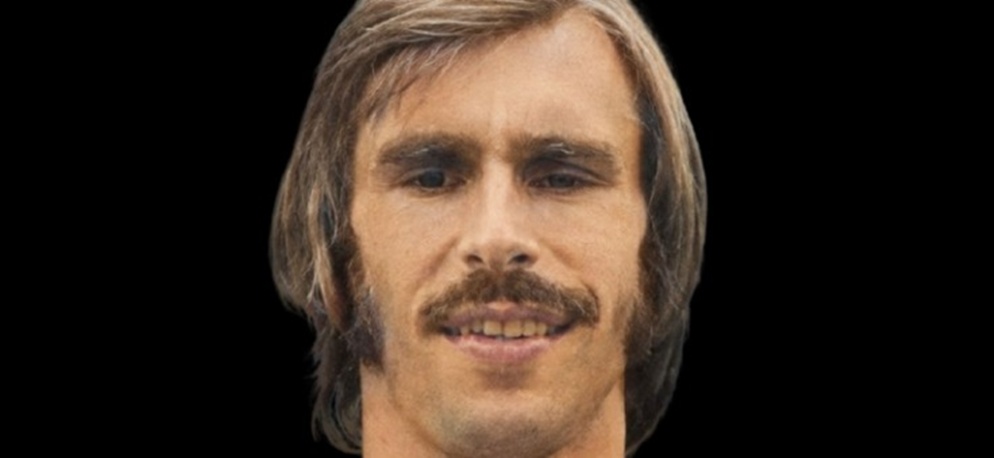
Paul Victor Heffer, born 21 December 1947, London.
PART ONE
Paul Heffer entered West Ham United’s youth setup in the mid-1960s, aged sixteen. He arrived, initially, as a centre-forward, a big, raw-boned kid earning £7 a week for ninety minutes of daily training and a good deal more besides in ground-staff duties: mowing pitches, cleaning boots, laying out kit, the unglamorous apprenticeship every young professional of that era had to serve before anyone cared what he could do with a football. Under youth team manager John Lyall, with Ken Brown and John Bond — both first-team defenders easing themselves into coaching — offering additional guidance, Heffer spent 1964 to 1966 building the physical and technical foundations that would define him. He stood six foot five, an unusual height for the game even now, let alone then, and Lyall’s staff worked hard to turn that frame into an asset: heading, tackling, positional sense, all drilled into a body built for exactly that purpose.
It was during the 1965–66 FA Youth Cup, however, that Heffer’s actual position within the team changed for good. Lyall, needing someone to nullify a pair of outstanding young centre-forwards, pulled him back from attack into defence, first to shadow Arsenal’s John Radford and then Chelsea’s Peter Osgood, two players who would go on to have considerable First Division careers of their own. Heffer performed superbly in both fixtures — his own description of the displays was that they were very well executed against quality opposition — and from that moment West Ham had no doubts whatsoever about where his future lay. He had gone, in his own words, from one end of the pitch to the other, and the switch stuck.
Success in the Youth Cup, alongside a promising young midfielder named Trevor Brooking, earned Heffer a step up at eighteen to West Ham’s third string, known inside the club as the ‘met team’, where he found himself up against grown men from army and police sides rather than boys his own age. It toughened him considerably, and by the late 1960s consistent form in the youth and intermediate ranks had opened the door to reserve-team football, the final rung on the ladder before the first team proper.
That door swung open on 18 March 1967, when Heffer made his senior debut in a First Division fixture away at Nottingham Forest, a match West Ham lost 1–0. He was not yet twenty, thrust straight into a defence that had to compete week in and week out with some of the best forward lines English football could offer, and though the result went against him that afternoon, the outing marked him as a genuine first-team option rather than merely academy fodder. What followed, across the remainder of that 1966–67 season, was a run of nine appearances in a settled if unspectacular spell: victories over Aston Villa home and away, a 3–2 win against Burnley, defeats to Sheffield United, Manchester United, Newcastle and West Bromwich mixed in among them.
Opportunities, though, would remain scarce thereafter, and the reason was not hard to find: West Ham’s defence already contained Bobby Moore, captain of England’s World Cup-winning side and one of the finest defenders the English game has produced, alongside the experienced Jack Hurst. Breaking into that company on any regular basis was never a realistic proposition for a young centre-back still finding his feet, however talented. Heffer’s appearances thinned out accordingly — one in the 1967–68 season, one in the FA Cup during 1968–69, a single substitute outing in 1969–70, three appearances split between one start and two substitute roles in 1970–71, and finally two substitute appearances, one in the league and one in the FA Cup, during 1971–72. Add it together and his complete senior record at West Ham reads seventeen appearances, twelve of them starts and five off the bench, without a single goal to his name — modest figures, certainly, but figures earned in direct competition with two of England’s greatest ever defenders for a shirt.
Even so, those fringe years were not wasted ones. Sharing a dressing room with Moore left an impression on Heffer that never really faded; the calm authority the captain carried both on the pitch and off it became something of a template for how a professional ought to conduct himself. Heffer trained alongside Moore, Martin Peters and Geoff Hurst during a period when West Ham were still glowing from their FA Cup triumph of 1964 and their European Cup Winners’ Cup success the following year, and while he never featured in the Inter-Cities Fairs Cup campaign that ran alongside his emerging first-team involvement, simply being part of that environment day after day shaped him profoundly. Ken Brown and John Bond, by now further along in their own transition from players to coaches, continued to pass on tactical discipline in the same afternoon sessions that had once turned him from a centre-forward into a centre-back, reinforcing lessons that would resurface, decades later, in his own coaching.
Fate, unfortunately, intervened before Heffer could establish himself any more firmly. A serious knee injury struck around 1969–70, when he was twenty-two, and required two separate operations to address. He continued to feature sporadically afterwards, as those final substitute appearances in 1970–71 and 1971–72 demonstrate, but the knee never fully cooperated, and by 1972 his time as a professional footballer at West Ham was over. The club marked the end of his playing days with a testimonial match on 4 April 1973, in which a West Ham side beat an Israeli opposition 3–2 — a fitting, if quiet, send-off for a player whose senior minutes had always been rationed by the presence of genuine greats ahead of him. He was not quite finished with playing altogether, though, turning out afterwards on a semi-professional basis for Cambridge City, a step down in level but one that let him carry on playing the game a little longer before hanging up his boots for good.
PART TWO
Retirement from playing cleared the way for a second act. Paul Heffer moved into non-league management during the 1980s, taking charge at Southend Manor and later added the chairman’s role there too, before Simon Dibley succeeded him in that position in 1990. It was unglamorous work, the sort that rarely makes headlines, but it kept him inside the game and, crucially, kept him learning about it from a different angle: budgets, boardrooms, the running of a club rather than merely the coaching of players within one.
By 1985, though, West Ham had drawn him back to Upton Park, and this time for good. He joined the club’s academy set-up — the Academy of Football, as it became known — initially focused on youth development, and what started as a modest coaching role would eventually stretch across an almost unbroken 38 years of service by the time anyone thought to count. He held positions including youth coach and, eventually, assistant academy director, working alongside academy director Tony Carr through many of those years and shaping the club’s approach to bringing young players through from schoolboy level into the professional game.
His methods leaned heavily on what he himself had experienced as a teenager under Lyall, Brown and Bond. Having learned defensive positioning, heading and man-marking through direct instruction from senior professionals, Heffer passed those same principles on to generations of young centre-backs, stressing adaptability and physical presence just as he himself had once needed both against Radford and Osgood. Through the 1990s and into the 2000s he played a significant part in shaping the academy’s training curriculum, introducing high-tempo warm-up routines built around pair-based volleys and headers that sharpened peripheral vision and communication, alongside triangular passing drills designed to mirror the demands of senior possession football. Fitness work was woven throughout rather than bolted on separately, all of it built around a coaching philosophy West Ham liked to call developing a “soccer brain” — smarter players making faster decisions under genuine pressure, rather than merely fitter ones.
The names that passed through Heffer’s hands over those decades read like a roll call of the modern English game. Rio Ferdinand, who made his first-team debut in 1996, absorbed the defensive teachings that had once been drilled into Heffer himself, his composure and reading of the game bearing more than a passing resemblance to the lessons handed down. Frank Lampard progressed through the same system in the early 2000s, developing the vision that would later define his midfield play at the very highest level, while Joe Cole’s flair was refined through drills that emphasised space exploitation and quick turns, exactly the kind of technical polish the academy prided itself on instilling. Elliott Ward, another graduate who came through in the early 2000s, later credited Heffer as the first coach he ever had at the club, a small but telling tribute to the influence Heffer carried with players who would never remember a world before his presence around the training ground.
As assistant academy director, Heffer took particular pride in West Ham’s FA Youth Cup campaigns, overseeing the coaching support for successive U18 sides across multiple seasons. By the 2022–23 campaign, with Kevin Keen now head coach of the age group, Heffer — by then 75 years old and marking 38 years in the academy — spoke with real enthusiasm about a squad enjoying an unbeaten run in the U18 Premier League South, calling them a fantastic group of players and noting how much the club looked forward to the Youth Cup every year, even acknowledging candidly that West Ham’s results in the competition over the previous decade had fallen short of what everyone at the club wanted.
That U18 side went on an extraordinary run through the tournament, beating Sheffield United, Burnley, Stoke City, Ipswich Town and Southampton in turn before dismantling Arsenal 5–1 in the final at the Emirates Stadium — West Ham’s first Youth Cup triumph in 24 years, and a league-and-cup double to boot. George Earthy and Callum Marshall both scored in that final, and both would go on to earn senior opportunities not long afterwards, precisely the kind of pathway from academy pitch to first-team involvement that Heffer had spent nearly four decades trying to build.
He finally stepped away from formal coaching duties in May 2024, at the age of 76, bringing to a close roughly 40 years in various academy roles that had begun, in truth, all the way back in 1964 when he first walked through the door as a sixteen-year-old apprentice centre-forward. He cited his advancing years, sensibly enough, along with a wish to spend more time with his wife, as the reasons behind the decision. All told, his association with West Ham United spanned some 60 years in one capacity or another — five as a player battling for a place behind Bobby Moore, and well over fifty more spent giving back to the club that had shaped him, first through a brief spell running an amateur side at Southend Manor and then, far more enduringly, through nearly four decades on the training pitches at Chadwell Heath and beyond.