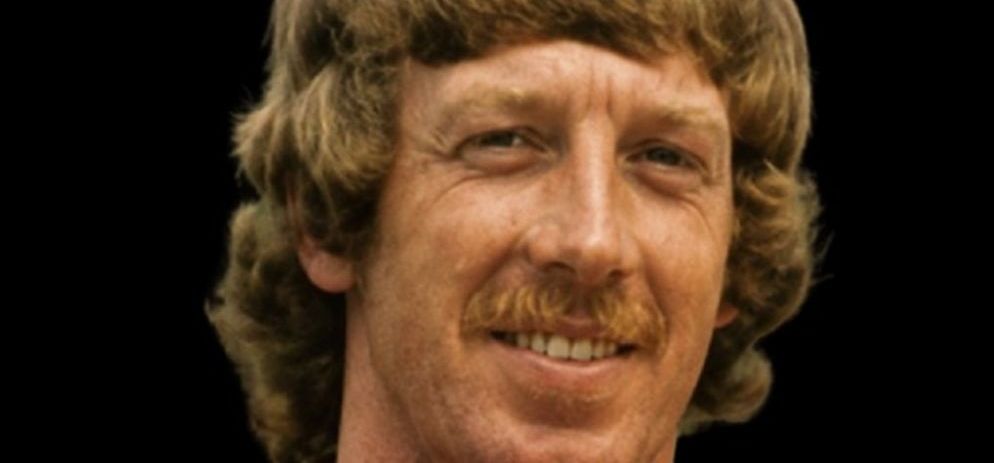
Maitland Alexander Inglis Pollock, born 31 October 1952, Dumfries, Scotland.
PART ONE
Lochmaben sits eight miles north of Dumfries, a small market town more readily associated with its castle ruins and its loch than with producing footballers of note. It was here that Maitland Pollock grew up, and it was here, playing for Dumfries and Galloway Schools, that he first caught the eye. Scottish schools football in the late 1960s was a fiercely competitive business, watched closely by scouts from both sides of the border, and Pollock’s performances on the wing were sharp enough to be noticed. Among the boys that he lined up against in representative fixtures was a young John Robertson, a name that would later mean rather more to Nottingham Forest than Pollock’s own.
In 1968 Pollock was picked for Scotland’s schoolboy side, and he travelled south to White Hart Lane to face England in one of the fixtures that mattered most on the youth calendar. Scotland won 1-0 that day, a result that would have sent the travelling party home in good spirits, but it was the company Pollock kept rather than the scoreline that proved significant. Alongside him in that Scotland team was Graham Souness, a Edinburgh boy already marked out for bigger things, and although the pair’s paths would diverge sharply in the years that followed, the shared experience of a schoolboy cap placed Pollock, however briefly, in the same bracket as a future European Cup winner. Scouts do not forget performances like that, and it was on the back of his form for Scotland’s schoolboys that Nottingham Forest’s assistant manager Bill Anderson, working alongside the club’s long-serving centre-half Bob McKinlay, moved to bring the teenager to the City Ground.
Pollock signed as an apprentice with Nottingham Forest in October 1970, seventeen years old and a long way from Lochmaben. Forest were a Second Division club at the time, their forward line built around Neil Martin, a proven goalscorer who had arrived from Coventry City that same year and would go on to score 85 times in 155 appearances during his years at the City Ground. It was, in other words, a squad with little room for a raw teenage winger, and even though Pollock spent three years on the books, training alongside the club’s emerging talents and its more seasoned professionals, the step up to the first team never came. He left in July 1973 without a single senior appearance to his name, a common enough fate for young players of that era, but a sobering one nonetheless for a boy who had once shared a pitch with Souness.
Nottingham Forest’s loss was not, on the face of it, Walsall’s gain, but it was somewhere for Pollock to go and prove himself, and that is precisely what a young professional needs more than anything else. He arrived at Fellows Park on a free transfer ahead of the 1973–74 campaign, joining a Third Division side that would go on to finish a respectable fifteenth. His time there, however, was brief and thin on opportunity: two league appearances, one start and one outing from the bench, and no goals to show for either. Competition for places was stiff, and by March 1974 Walsall had released him. It was a hard lesson in just how narrow the margins are between staying in the professional game and slipping out of it altogether.
Released by Walsall and still only twenty, Pollock dropped into non-league football with Burton Albion, then playing in the Midland Counties League, and stayed with the Brewers through the remainder of 1973–74 and into the following season. It was a considerable comedown for a player who had trained under a Football League club’s assistant manager only a few years before, and the non-league game of the mid-1970s offered little in the way of comfort: fewer resources, irregular fixtures, and none of the structure Pollock had grown used to at Nottingham Forest and Walsall. Detailed records from his time at Burton are scarce, a reflection of how loosely non-league statistics were kept in that period, but the spell mattered for a simpler reason. It kept Pollock playing, kept him sharp, and kept the door to the Football League from closing entirely.
That door reopened in the summer of 1975, when Luton Town brought Pollock back into the professional ranks ahead of their 1975–76 Second Division campaign. The Hatters had been relegated from the top flight the previous season after finishing bottom of the table, and the club was in the process of rebuilding, though Pollock found first-team chances hard to come by. He made six league appearances as a flanker that season, without troubling the scoresheet, and no further outings followed before his departure in 1976. It was, on paper, another frustrating stop on a fitful path through the lower reaches of the Football League. But it was also a stepping stone, because it was at Kenilworth Road that Pollock finally found a club willing to build around him rather than simply fit him in around the edges.
PART TWO
Portsmouth, relegated from the Second Division after finishing bottom in 1975–76, needed players who could offer something different in the Third Division, and in the summer of 1976 they turned to Pollock. It proved to be the making of him. Freed from the reserve-team treadmill that had characterised his time at Nottingham Forest, Walsall and Luton Town, Pollock finally had a manager willing to trust him week in and week out, and he repaid that faith handsomely. In the 1976–77 campaign he was virtually ever-present, playing 40 league matches and scoring six goals, his pace and his delivery from wide areas becoming a genuine weapon for a Portsmouth side scrapping to stay up. They finished twentieth, one place above the drop, and Pollock’s consistency through a difficult campaign had played no small part in keeping them there.
The following season told a different story. Portsmouth’s form fell away badly, injuries and squad upheaval limiting Pollock to fourteen league appearances, though he still found the net four times, including once in the League Cup. The team’s collapse was total: a twenty-fourth-place finish and relegation to the Fourth Division, a grim reversal for a club that had looked, only a year earlier, to be steadying itself. For Pollock personally, though, his two years at Fratton Park stood as the high point of his time in the professional game — 54 league appearances and 10 goals, 68 games and 11 goals in all competitions, figures that speak plainly enough of a winger who, for once, was given the run of games that he had always needed.
After Portsmouth, Pollock turned for home. On 5 August 1978 he signed for Queen of the South, the club of his native Dumfries, and there was something fitting about a Lochmaben boy pulling on the colours of Palmerston Park after eight years of dressing rooms in the English Midlands and on the south coast. Queen of the South were then playing in the Scottish Second Division, a club in the middle of its own period of rebuilding, and he slotted into a dressing room that included English goalkeeper Allan Ball — a shot-stopper who would go on to make more than 700 outings for the side, a record that stands to this day — along with defender Iain McChesney and forwards Jocky Dempster and Crawford Boyd. Back in Scotland, Pollock made 23 league appearances in the 1978–79 campaign, scoring once, with further outings in the League Cup and the Scottish Cup.
It was to be his last season as a professional footballer. He was twenty-six, an age at which many wingers are only just entering their most productive years, but Pollock’s time in the senior game came to an end in 1979, and with it closed a spell that had carried him from Nottingham to Dumfries by way of Walsall, Burton, Luton and Portsmouth. Across all those clubs, he totalled more than 85 senior appearances and upwards of 11 goals — modest figures on the surface, perhaps, but ones earned the hard way, through release forms and free transfers and long bus journeys between clubs that never quite gave him what Fratton Park eventually did.
Pollock’s exit from the professional game was a quiet one. He went home to Lochmaben, back to the town he had left as a teenager, and in time he found a new outlet for the same restless energy that had once carried him up and down English and Scottish touchlines: golf. Pollock became a volunteer coach at Lochmaben Golf Club, dedicating himself to encouraging local youngsters into the sport and to growing the club’s junior membership at a time when financial pressures and the drift of young people away from small towns for work or study made that a genuinely difficult task. With the support of his wife and a small band of fellow volunteers, he set about building something in retirement that mattered every bit as much to him, in its own quieter way, as anything that he had achieved as a player.
The work did not go unnoticed. In 2015 Maitland Pollock shared the Scottish Golf Volunteer of the Year award with Evan Sutherland of Reay Golf Club, recognition for years spent giving up his time for youngsters who might never have picked up a club otherwise. He had also been a finalist for the RBS Volunteer of the Year award the previous season, and he remains, to this day, an accredited PGA volunteer coach, his certification valid until February 2027. In a 2016 interview reflecting on his life, Pollock spoke of the years spent away from Lochmaben during his professional playing days, of how much the town had changed in the time since, and of the satisfaction he continued to draw from his work at the golf club.