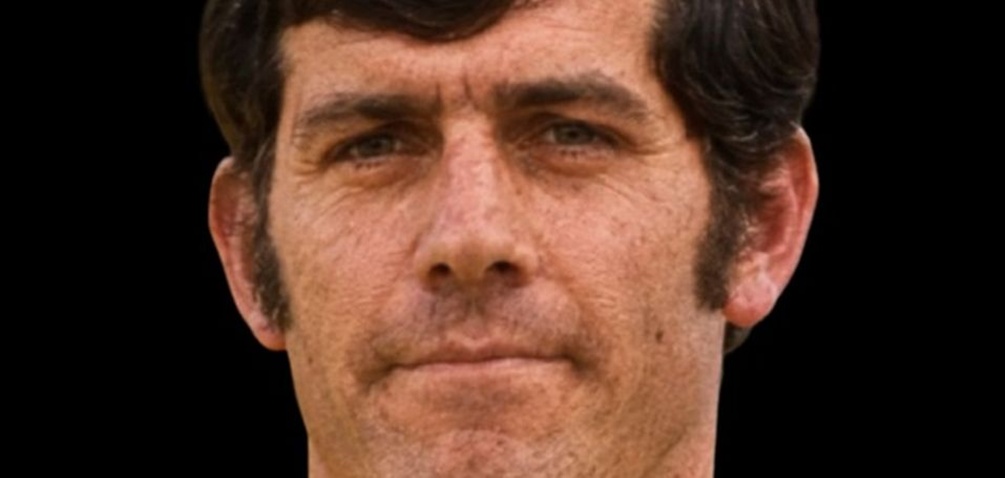
John Harvey Benson, 23 December 1942, Arbroath, Scotland.
PART ONE
Born in Arbroath but brought up in Manchester, John Benson joined Les McDowall´s Manchester City in 1958 and the young and promising full back was given his debut for the Citizens against West Bromwich Albion in 1962. Manchester City, however, was not to be the making of him, and at the beginning of the 1964-65 campaign he moved on to Torquay United for a transfer fee of £6,000, a sum that constituted a club record for the Devon side at the time and reflected the esteem in which he was held despite his limited senior experience at Maine Road. It was a substantial gamble for a Fourth Division outfit to take on a player who had not yet proved himself at the top level, but it was one that paid off almost immediately, since Benson slotted into the Torquay team and rarely looked back over the six years that followed.
Plainmoor might have seemed an unlikely place for a young professional to flourish, but it suited Benson perfectly, and he quickly established himself as an automatic choice in a side that, under Frank O’Farrell’s management from 1965 onward, was quietly building towards something significant. Sure enough, the 1965–66 season delivered promotion, with Torquay finishing third in Division Four, and Benson was a fixture throughout the campaign, his consistency at the back a quiet but essential part of the club’s success; while others around him came and went, he remained a constant, the kind of reliable, unfussy performer that any promotion-chasing side needs if its better days are to be built on solid foundations rather than fleeting individual brilliance.
Over the course of his six years on the Devon coast he made 240 league appearances and scored seven goals, numbers that speak plainly of durability rather than spectacle, and by the time he eventually left Plainmoor he had become one of the most experienced professionals on Torquay’s books, a defender trusted by successive managers to marshal a backline through the unglamorous grind of Fourth and Third Division football, week in and week out, in all weathers and against all manner of opposition, without ever once losing his place through injury or loss of form for any extended stretch.
That experience did not go unnoticed, and in October 1970 Bournemouth & Boscombe Athletic paid £12,000 to bring him to Dean Court, where he was reunited with John Bond, the man who had by then taken charge on the south coast and who would go on to shape the whole of the remainder of Benson’s involvement in the game far more than any other individual, whether as manager, as colleague, or simply as the friend whose fortunes seemed forever entwined with his own. Bond made him captain almost immediately, a mark of the trust the young manager placed in a player he clearly regarded as a natural leader as well as a reliable defender, and Benson repaid that faith with several years of consistent service as Bournemouth pushed for promotion from the lower divisions.
His time at Dean Court was interrupted only briefly, in March 1973, when he was loaned out to Exeter City for four games, a short spell at St James Park that did little more than keep him match-fit during a quiet period at Bournemouth, and before the year was out he had moved on again, this time to Norwich City in December 1973, where he made 37 league appearances and scored a single goal during a spell in East Anglia that, while unremarkable in itself, would later prove significant in ways nobody could then have predicted, since it was at Carrow Road that his long association with the club, and with figures who would repeatedly reappear throughout the rest of his working life, first began in earnest.
PART TWO
John Benson returned to Bournemouth in January 1975, though this time in a very different capacity, taking over as player-manager and stepping for the first time into the position that would come to define the second half of his working life in football. He made a further 57 league appearances in his new dual role, but the results that mattered most to supporters proved harder to come by than the personal milestones, and his first season in charge ended in relegation, a bruising start that nonetheless did not cost him his job.
Bournemouth improved the following year, finishing sixth, and for a while it looked as though Benson might yet lead the Cherries back towards the higher reaches of the Football League; however, that sixth-place finish turned out to be the high-water mark of his time in the Dean Court hot seat, since the two campaigns that followed brought disappointing finishes of thirteenth and then seventeenth, and as the 1978–79 season threatened to follow the same discouraging pattern, the club’s patience finally ran out and he was replaced by the experienced Alec Stock.
Rather than walk away from the game altogether, Benson instead returned to Norwich City in January 1979, this time not as a player but as youth-team coach and scout, working once again under John Bond, who had since taken charge at Carrow Road, and it was in this backroom capacity that the two men rebuilt the working relationship first forged years earlier on the pitch at Bournemouth. That relationship deepened further in October 1980, when Benson was offered the manager’s job at Norwich, an opportunity that arose because the East Anglian club had expected their assistant manager, Ken Brown, to be offered a similar post at Manchester City.
But instead Benson turned the Norwich job down, choosing loyalty to Bond and following him north to Maine Road as his assistant, a decision that in turn opened the door for Norwich to appoint Ken Brown as their new manager, who duly accepted. It was a curious, interlocking sequence of events, the kind that tends to define the lower rungs of the football management ladder, where one man’s decision reshapes the prospects of several others in a single stroke, and it took Benson back, for the second time, to the club where his time as a player had begun nearly two decades earlier.
Benson´s stay at Manchester City as Bond’s assistant lasted until 9 February 1983, when Bond was dismissed and Benson was promoted, somewhat abruptly, to take temporary charge of the first team at the club where his own senior football had begun more than two decades earlier. It was, in truth, a difficult inheritance rather than an opportunity to relish, since he arrived in the hot seat with the side already fighting to preserve its top-flight status and with precious little time to stamp any real authority on a struggling squad.
By the end of that season City had been relegated, the fatal blow delivered by a home defeat to Luton Town that has since become notorious in English football folklore for the sight of Luton’s manager, David Pleat, dancing jubilantly across the Maine Road pitch as full time confirmed his side’s survival at City’s expense; it was a moment replayed on television screens for years afterwards, and one that, however unfairly, tends to overshadow the wider context of the difficult, short-notice job Benson had been asked to do.
He was duly replaced by Billy McNeill at the end of the campaign, but rather than drift away from the professional game altogether he simply followed the familiar pattern once more, re-joining Bond, this time as a coach at Burnley, and when Bond was dismissed there too, Benson again stepped up to take the manager’s job, in August 1984, continuing what by now had become an almost ritual sequence of following his old friend from club to club and picking up the reins whenever Bond himself moved on or was moved on. His spell in charge at Turf Moor was to prove short-lived, however, and he was sacked in May 1985 after Burnley suffered relegation, a second successive experience of seeing a club go down on his watch and one that, for a time, seemed to push him away from English club management altogether and towards a very different chapter of his working life.
In the years that followed, Benson took coaching positions overseas, first in Dubai and then with Al Naser in Kuwait, gaining an unusual breadth of experience for an English-based coach of his generation and working in football cultures far removed from the muddy Fourth Division pitches where he had made his own name as a player; it was, by most measures, an adventurous and unexpected turn for a man in his forties whose whole footballing life until that point had been spent within a fairly narrow stretch of the English game. He returned to more familiar territory in 1990, when he was appointed Chief Scout at Barnsley, a role he held for four years and one that suited a man who, whatever his occasional discomfort with the pressures of front-line management, had a genuine eye for spotting ability in players others might overlook, honed no doubt by his own years as an unheralded but dependable professional at Torquay and Bournemouth.
PART THREE
In April 1994, John Benson came back once more to Norwich City, this time assisting manager John Deehan with administrative duties while also taking responsibility for coaching the club’s goalkeepers, a role that drew on the meticulous, unglamorous attention to detail that had characterised so much of his working life, and it was in this quieter, more specialised capacity that he spent the middle years of the decade away from the harsher spotlight of first-team management. Deehan resigned from his post in April 1995 and was succeeded by Martin O’Neill, while Deehan himself moved on to take charge of Wigan Athletic; Benson, ever loyal to the men he had worked alongside, followed him there too, becoming his assistant at Springfield Park in November 1995 and beginning an association with the Lancashire club that would, in various guises, occupy him for much of the following decade and ultimately define the closing, most public phase of his time in the game.
When Deehan left Wigan Athletic in the summer of 1998 to take up a coaching role at Sheffield United, Benson was the obvious candidate to succeed him, and he was duly offered the manager’s job at Wigan; yet, citing concerns over his health, he turned it down, a decision that led the club to appoint Ray Mathias instead while Benson remained on hand in an advisory role behind the scenes. Wigan’s promotion push under Mathias fell short of expectations, and with pressure mounting from a fanbase eager for progress, Mathias was sacked, leaving the club to turn once more to the man who had already declined the job a year earlier. This time Benson accepted, and on 1 June 1999 he was formally appointed as Wigan Athletic’s manager, taking charge just as the club prepared to move into its new home at the JJB Stadium.
What followed was, by some distance, the most eye-catching passage of Benson´s time in management, and all the more remarkable for having come to someone who had twice turned the job down before finally, reluctantly, accepting it. Wigan went undefeated for twenty-six league matches as the Latics settled into their new surroundings, a run that finally came to an end with a narrow 1-0 defeat against Andy Ritchie´s Oldham Athletic side at JJB Stadium on 7 January 2000.
Along the way Benson collected two Manager of the Month awards in recognition of a team performing well above expectations for a club of Wigan’s modest resources at the time; for a manager who had never sought the limelight and who, by his own admission in later interviews, saw himself as a good number two rather than a natural figurehead, it was an unlikely vindication, and one that few outside the club had seen coming. The team’s form dipped as the season wore on, as is so often the case once an unbeaten run of that length finally breaks and the pressure of expectation begins to weigh on players who had grown used to winning, but Wigan nevertheless secured a place in the play-offs and progressed all the way to the final at Wembley, where they were due to face Gillingham for a place in the higher division.
In a twist entirely in keeping with the pattern of reluctant duty that had characterised so much of his time in the dugout, Benson announced his intention to step down as manager only days before the final itself, a decision that might easily have destabilised the squad at the worst possible moment, yet he chose to see the job through to its conclusion regardless, leading his team out at Wembley despite his impending departure and refusing to let his own circumstances overshadow what remained, for the players and supporters alike, the biggest match most of them would ever play in or watch.
The match ended in cruel fashion for Wigan, who had been 2–1 ahead with only seven minutes of extra time remaining before Gillingham fought back to win 3–2, denying Benson the fairytale send-off that his unbeaten run earlier in the season had once seemed to promise, and sending him out of the Wigan manager’s chair not with the trophy he and his players had come so agonisingly close to lifting, but with the sort of near-miss that lingers longest in a football club’s collective memory. Bruce Rioch eventually arrived as Wigan’s new manager in the summer of 2000, and Benson, rather than leaving the club altogether, moved into the role of general manager, continuing the pattern of adapting his position to whatever was required of him. When Rioch was replaced by Steve Bruce in April 2001, Benson’s job changed again, this time to youth development officer, and when Bruce himself departed only a month later, the arrival of Paul Jewell as the new man in charge brought Benson yet another change of title, that of Director of Football.
He held that post until 10 December 2001, when he resigned to rejoin Steve Bruce, this time as assistant manager, following Bruce’s move from Crystal Palace to Birmingham City in circumstances that were, by most accounts, distinctly acrimonious. At Birmingham he later stepped up to become general manager, a post he held until 2 June 2006, when he returned once more to Wigan Athletic, this time in a role explicitly designed to bridge the gap between the playing and administrative sides of the club, before finally leaving Wigan for good in the summer of 2010 to join Sunderland.
His time on Wearside proved brief, and desperately so; having only recently taken up his post at Sunderland, Benson died on 30 October 2010 in Macclesfield, not far from the Stockport streets where he had grown up as a boy, at the age of sixty-seven. It was a quiet end, in a sense, to a working life that had rarely followed a straight or predictable path, one shaped again and again by loyalty to a handful of familiar faces, John Bond above all, but also Deehan and Bruce, men who trusted him repeatedly with jobs he did not always seek out for himself, and who valued a quality that ran through the whole of his time in the game: a willingness to take on responsibility not for the sake of ambition, but simply because someone needed to, and he happened to be the man standing nearest the door.