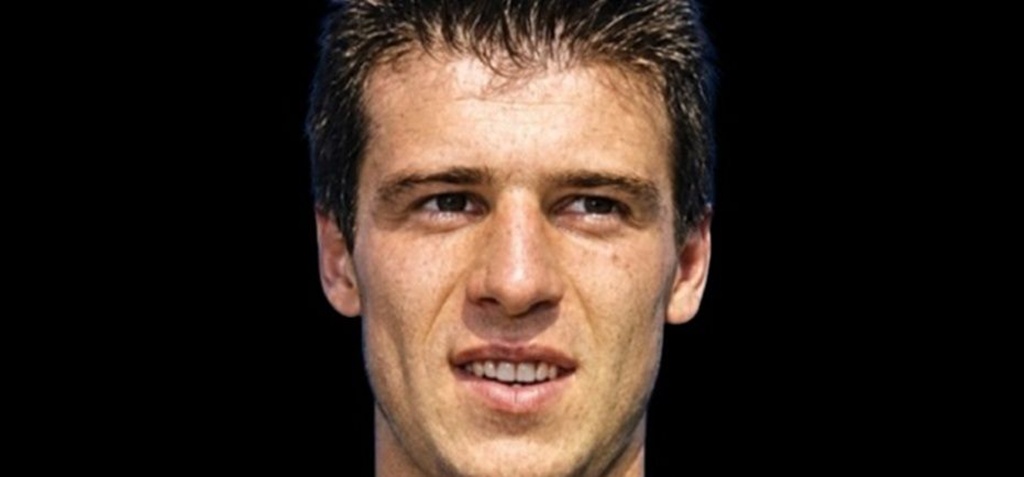
Nicola Berti, born 14 April 1967, Salsomaggiore Terme, Italy.
PART ONE
Nicola Berti was only sixteen when he was introduced to senior football during the 1982–83 season, making one Serie C1 appearance for Parma and also playing in the Serie C Coppa Italia, where he found the back of the net twice. His league involvement remained limited as Parma won their Serie C1 section and gained promotion in 1983–84 under Marino Perani, not Arrigo Sacchi as is sometimes stated, but the season still placed the young midfielder inside a successful dressing room and allowed him to learn from experienced professionals before he had properly grown into his own body.
Parma’s return to Serie B in 1984–85 changed matters sharply, because Berti was no longer merely a promising boy training with older players and waiting for a chance, and he made 27 league appearances during a difficult campaign in which the club finished bottom and went straight back down. He did not score in the league, but his pace, stamina and willingness to take responsibility had already drawn attention from higher up, and relegation therefore became a turning point rather than a setback, because Fiorentina recognised that an eighteen-year-old capable of handling a full Serie B season could be developed into a serious Serie A player.
The move to Florence in the summer of 1985 brought Berti into one of Italian football’s most demanding surroundings, because Fiorentina had passionate support, high expectations and a squad containing established men, but Aldo Agroppi gave the newcomer his opportunity and Berti responded with 28 league appearances and three goals during 1985–86. He was raw and sometimes over-eager, charging after the ball when a calmer midfielder might have held his position, although that impatience was tied to the very quality which made him dangerous, for he could recover possession and move 40 yards before the opposition had reorganised.
Fiorentina finished fourth, qualifying for the UEFA Cup, and Berti’s first Serie A campaign included goals against both Inter and Juventus, opponents who offered a much sterner examination than anything he had met in the lower divisions. Those performances established him quickly, but they also revealed that he was not simply a defensive worker, because when space opened ahead of him he attacked it directly, and his height, speed and ability to strike the ball gave Fiorentina an extra man around the penalty area. There were more polished midfielders in Italy, and there were certainly tidier ones, but few young players could turn a tackle into an attack with such speed.
Berti played 27 league matches and scored four times in 1986–87, when Fiorentina slipped to tenth, and he also received his first taste of European club football as the side entered the UEFA Cup, although the campaign ended almost immediately against Boavista. Results were less satisfying than they had been during his opening year in Florence, but his own standing continued to rise, and his performances brought him into Italy’s Under-21 side under Cesare Maldini. He took part in the 1986 European Under-21 Championship, in which Italy reached the final against Spain after overcoming England in the semi-finals, but the two-legged decider finished level at 2–2 on aggregate before Spain won the penalty shoot-out in Valladolid.
Berti was learning several different versions of the game at once, with club football asking him to carry more attacking responsibility while international football demanded tactical control, discipline and patience, and those lessons gradually made him less likely to chase every movement and more capable of choosing when to press. Even so, nobody wanted to remove the restless part of his game, because that was what separated him from ordinary holding players and allowed him to change the pace of a contest with one burst. His third and final Fiorentina season brought 25 Serie A appearances and one goal as the club finished eighth in 1987–88, and by then Berti had completed 80 league matches for the Viola, scoring eight times. The total was substantial for a player who had arrived at eighteen, but more important was the way he had changed during those three years, because the energetic newcomer had become a complete box-to-box midfielder who could tackle, carry the ball, pass over distance and appear in scoring positions.
PART TWO
Nicola Berti continued to play for the Italy Under-21 team and he took part in the 1988 European Championship, where the Italians went out to France in the quarter-finals, but the senior side was now within reach and the leading clubs were watching closely. Inter moved first and paid Fiorentina about £3.6 million during the summer of 1988, placing Nicola Berti inside a side Giovanni Trapattoni was shaping for a major assault on the championship. The fee brought pressure, but it also provided the right stage, because Inter needed a midfielder who could run between the lines, support the attack and share the physical work beside Lothar Matthäus, and Berti had spent three years preparing for exactly that task.
Inter’s 1988–89 side contained Walter Zenga in goal, Giuseppe Bergomi and Andreas Brehme in defence, Matthäus and Berti in midfield, and Aldo Serena with Ramón Díaz in attack, and Trapattoni brought those parts together with a balance few opponents could match. Berti made 32 league appearances and scored seven goals, the highest Serie A total of his playing life, while Inter won 26 of their 34 matches, drew six, lost only twice and collected 58 points under the old two-points-for-a-win system.
Napoli finished second on 47, so the margin was eleven points, and Inter’s total established a record for an 18-club Serie A season, but even those imposing numbers do not fully explain their control, because they could defend deeply, attack at speed and overpower teams through midfield without becoming predictable. Berti fitted beautifully because he did not need the ball for long periods in order to influence play, and while Matthäus directed matters with greater authority, the Italian supplied forward running, pressing and surprise. His league work was supplemented by a remarkable UEFA Cup goal against Bayern Munich in front of a 70,000 crowd at the Olympiastadion in Munich on November 23, 1988, when he won the ball deep inside his own half, surged almost the full length of the pitch and lifted his finish beyond Raimond Aumann to complete a 2–0 victory, although Inter were eliminated after losing the return 3–1 at San Siro.
The championship was secured in May 1989, but Berti’s season had also opened the door to the senior Italian side, and Azeglio Vicini gave him his debut against Norway in Pescara on October 19, 1988, when Italy won 2–1. His third appearance brought his first international goal on December 22, a late header which completed a 2–0 friendly victory over Scotland in Perugia after Giuseppe Giannini had scored the opener, and the speed of his rise showed how strongly Vicini valued his energy.
Italy already possessed several clever midfielders, but Berti offered something different, because he could be asked to track an opponent, press high, attack the far post or carry the ball through the centre, and his physical reach made him useful in both penalty areas. He was not always the first name chosen, and his positional enthusiasm occasionally caused problems, but the national manager understood that tournament football could become tight and cautious, and a midfielder willing to break formation with a hard forward run might create an opening which patient passing could not. By the time Inter faced Sampdoria in the Supercoppa Italiana at San Siro on November 29, 1989, Berti was both an Italian international and a national champion, and a 2–0 victory gave him another medal.
PART THREE
Inter could not retain the Scudetto in 1989–90, finishing third as Napoli took the title, but Berti remained a strong contributor with 29 league appearances and five goals, and his attention increasingly turned towards the World Cup which Italy would stage that summer. Vicini selected him in the squad and gave him the number ten shirt, though the number did not mean he would be used as a traditional playmaker, and he made his tournament debut as a substitute in the opening 1–0 victory over Austria in Rome on June 9.
He started the next group match against the United States, which Italy won 1–0 through Giannini, then returned as a substitute during the 2–0 quarter-final victory over Czechoslovakia, but he was not used in the round-of-16 success against Uruguay or the semi-final against Argentina. That semi-final ended 1–1 before Argentina won 4–3 on penalties in Naples, leaving Italy to meet England in the third-place match at Bari on July 7, and Berti played the full 90 minutes as Roberto Baggio and Salvatore Schillaci scored in a 2–1 victory. He thought he had added another goal from Baggio’s late cross, but it was wrongly ruled out for offside, and Italy completed the competition unbeaten despite finishing third.
The 1990–91 season brought Inter’s first European trophy for 26 years and gave Berti a central place in one of the club’s most important nights, although the UEFA Cup campaign demanded patience as well as power. Inter knocked out Rapid Vienna, Aston Villa, Partizan Belgrade, Atalanta and Sporting Lisbon to reach an all-Italian final against Roma, with the first leg played at San Siro on 8 May, 1991. Matthäus converted a penalty-kick on the hour mark, but a single-goal advantage would have left the tie dangerously open and Berti settled the ground just a mere eight minutes later, moving into the area and finishing from close range after an effort from Jürgen Klinsmann’s had been blocked.
Inter won the match 2–0, then protected that lead despite losing the second leg 1–0 at the Stadio Olimpico on May 22, and Berti had scored the goal which eventually separated the teams on aggregate. He also made 30 league appearances and scored four times as Inter finished third, six points behind Sampdoria, but Europe offered the reward the domestic season had denied them, and Berti ended his third year in Milan as a champion of Italy, a Supercoppa winner and a UEFA Cup winner.
Change followed because Trapattoni left for Juventus in 1991 and Corrado Orrico took charge, but Inter never settled during 1991–92, and Luis Suárez replaced Orrico midway through a season which ended with the club eighth and outside the European places. Berti played 30 league games but scored only once, and although his willingness did not disappear, the side lacked the shape and certainty which had made its earlier football so forceful. Internationally, Italy were also entering a difficult period, because failure to qualify for the 1992 European Championship brought the end of Vicini’s time and placed Arrigo Sacchi in charge, the manager whose Milan side had changed European football through pressing, movement and strict organisation.
Sacchi demanded repeated work on positioning and timing, and Berti’s natural urge to chase the game had to be controlled within a detailed system, but his athletic qualities suited the new manager’s wish to squeeze opponents and recover possession quickly. There was tension in that relationship between personal instinct and collective order, yet Berti was adaptable enough to survive it, and the lessons learned as a young player in Florence again became useful as Italy began the long qualification programme for the 1994 World Cup.
PART FOUR
Inter improved greatly under Osvaldo Bagnoli in 1992–93, finishing second behind Fabio Capello’s Milan, and Berti contributed four goals in 32 league appearances as the team mounted a serious challenge without quite possessing the champions’ depth or consistency. The gap eventually stood at four points, but Inter had returned to the UEFA Cup and appeared capable of building upon the recovery, only for 1993–94 to become one of the strangest seasons in the club’s history.
Domestic form collapsed, Bagnoli was dismissed and Giampiero Marini took over, while Berti was restricted to nine Serie A appearances by injury, although he still scored twice. Inter finished thirteenth, only one point above the relegation places, and a side which looked uncertain and vulnerable in Italy somehow became hard, purposeful and extremely difficult to remove from Europe. Berti returned to exert a strong influence in the UEFA Cup, scoring important goals during the run, and Inter reached the final against Austria Salzburg after overcoming Rapid Bucharest, Apollon Limassol, Norwich City, Borussia Dortmund and Cagliari. It was not flowing football and nobody at Inter pretended otherwise, but when their league season threatened to fall apart, Europe gave them a separate contest in which resilience mattered more than style.
The first leg of the 1994 UEFA Cup final was played at Vienna’s Ernst-Happel-Stadion on April 26, and Berti supplied the decisive moment late in the first half, collecting Dennis Bergkamp’s pass on the right side of the penalty area and driving a low shot across goalkeeper Otto Konrad for a 1–0 victory. Inter defended that advantage at San Siro on May 11, when Wim Jonk scored the only goal of the return, and Berti therefore became one of the unusual few to score in two different UEFA Cup finals.
That achievement mattered even more because injuries had broken up his domestic season and because Inter had spent months fighting near the bottom, yet in Europe he had again produced when the match carried its greatest weight. Supporters voted him their player of the year, awarding him the Pirata d’Oro, and the honour reflected more than the final goal, because he represented the spirit which had kept the side alive when confidence was low. Inter’s league position made no sense beside a European trophy, but football seasons do not always follow a tidy pattern, and Berti’s ability to treat each match as a fresh physical contest allowed him to remain useful amid the disorder.
Barely a month later Berti was in the United States for his second World Cup, and unlike four years earlier he was now a regular starter in Sacchi’s team. Italy’s competition began badly with a 1–0 defeat by the Republic of Ireland in New York on June 18, but they recovered to beat Norway 1–0 despite losing goalkeeper Gianluca Pagliuca to a red card, then drew 1–1 with Mexico and squeezed into the knockout stage. Berti played in all three group matches and remained in the side against Nigeria in Boston, where Italy trailed until Roberto Baggio equalised in the 88th minute and then scored a penalty in extra time to secure a 2–1 victory.
The quarter-final against Spain on July 9 produced Berti’s most telling contribution of the tournament, because with the score at 1–1 and only minutes remaining he won possession in midfield and immediately sent a long pass towards Giuseppe Signori, whose clever lay-off released Baggio to round Andoni Zubizarreta and score. It was a move which captured Berti at his best: regain the ball, look forward at once and attack before the opponent can recover.
Italy defeated Bulgaria 2–1 in the semi-final through two more Baggio goals, although Berti was replaced during the second half, and that carried Sacchi’s side into the final against Brazil at the Rose Bowl in Pasadena on July 17. The heat was severe, both teams were cautious and injuries had weakened Italy, with Baggio and Franco Baresi playing despite fitness doubts, while Berti worked across midfield and occasionally from wider positions as Sacchi tried to contain Brazil without surrendering every attacking outlet.
The game finished 0–0 after extra time, becoming the first World Cup final settled by penalties, and misses by Baresi, Daniele Massaro and Baggio left Brazil victorious by 3–2 in the shoot-out. Berti had played in all seven Italian matches, starting six, and he returned home with a runners-up medal rather than the trophy, but his role could not be reduced to running and tackling, because his intervention against Spain had begun the move which sent Italy into the last four. Six years after his senior debut, he had become a trusted tournament player capable of serving Sacchi’s rigid plan even when asked to operate outside his most natural central position.
PART FIVE
Inter’s domestic recovery in 1994–95 was modest rather than complete, as the side finished sixth under Ottavio Bianchi, but Berti returned to regular league football with 30 appearances and five goals, his best scoring total since 1989–90. Italy duty continued during qualification for the 1996 European Championship, although competition for places was growing and physical problems were becoming harder to escape, and his final senior appearance came against Germany in Zurich on June 21, 1995, in a match Italy lost 2–0.
He finished with 39 caps and three goals, having represented his country between 1988 and 1995 and appeared at two World Cups, with third place in 1990 and second in 1994. Those numbers were earned during an age when Italy had exceptional midfield depth, and Berti survived changes of manager because his game could be adjusted to several demands, whether Vicini wanted greater freedom or Sacchi required fixed movements within a pressing structure. He was never the smoothest Italian midfielder of that period, but smoothness was not his purpose, and his best work came when a match needed to be disturbed by a runner willing to break its established rhythm.
The physical strain began to take a heavier toll from 1995–96, when Berti was limited to ten Serie A appearances and Inter finished seventh despite considerable investment, and although he returned for 23 league games and one goal in 1996–97, the team again fell short domestically, ending the season third. Europe offered another chance and Inter advanced to the UEFA Cup final against Schalke 04, but Marc Wilmots gave the German side a 1–0 first-leg victory in Gelsenkirchen on May 7, 1997, and Iván Zamorano levelled the aggregate score at San Siro two weeks later.
Nothing further was added through extra time, so penalties decided the trophy, and Schalke won the shoot-out 4–1 after Zamorano and Aron Winter failed with Inter’s first two kicks. For Berti, defeat carried a particular sting because the UEFA Cup had supplied his finest nights, and there would be no third final goal to repair the damage. Yet he had again helped Inter travel deep into the competition, and even as injuries removed some of his earlier speed, his experience, positional sense and readiness to press still gave the side value.
Berti remained with Inter for the opening half of 1997–98, making four Serie A appearances, but the arrival of new players and the continued effect of injuries left him on the edge of Luigi Simoni’s side, and after almost ten years in Milan it became clear that his time there was ending. He left in January 1998, having made 229 league appearances and scored 29 goals for Inter, while his total in all competitions stood above 300 matches.
Inter went on to win the UEFA Cup by defeating Lazio 3–0 at Parc des Princes in Paris that May, and Berti is commonly credited among the winners because he had been registered with the club during that season, although he had departed months before the final and played no part in the decisive night. That distinction matters, because his two UEFA Cup victories on the field in 1991 and 1994 had included goals in both finals, while the 1998 success belonged primarily to the players who completed the competition. There was no grand farewell at San Siro, only the practical ending which often comes when an older player needs matches and a club is moving in another direction.
PART SIX
In the middle of the 1997-98 campaign, Nicola Berti joined Premier League outfit Tottenham Hotspur on a free transfer, entering an English side struggling near the bottom of the table under Christian Gross. The surroundings were very different from Serie A, the matches moved at greater speed and the midfield contests allowed less time, but Berti’s direct running and willingness to compete suited a relegation fight better than those who regarded him only as an ageing Italian name might have expected.
His first league goal came at Blackburn Rovers on February 7, when he struck in the 37th minute as Tottenham won 3–0, and he scored again at Crystal Palace on April 18, opening the scoring in a 3–1 victory before Chris Armstrong and Jürgen Klinsmann added the others. A third goal completed his league total for the season, while his work in the remarkable 6–2 victory at Wimbledon on May 2 included winning the possession from which Klinsmann put Spurs ahead early in the second half. Tottenham finished fourteenth and survived, and Berti had contributed three goals in 17 Premier League appearances after arriving midway through a tense campaign.
His popularity at White Hart Lane grew quickly, helped by a chant which asked supporters to sing his name, and there was something appealing about the sight of a player who had appeared in a World Cup final throwing himself into an English relegation scrap without acting as though the work were beneath him. Yet the second season did not develop as happily, because Gross was dismissed after a poor opening and George Graham arrived in October 1998 with different priorities, while Berti made only four league appearances and struggled to hold a regular place.
Tottenham would eventually win the League Cup in March 1999, beating Leicester City 1–0 at Wembley through Allan Nielsen’s late goal, but Berti had already gone and played no part in the triumph. His Tottenham league record closed at 21 appearances and three goals, a small total beside his years at Inter but not a meaningless one, because all three goals came during the 1997–98 fight for safety and his contribution helped steady a side which had looked in genuine danger when he arrived.
The next move took him to Deportivo Alavés around the turn of 1999, and he made eight appearances and scored once in La Liga during the second half of 1998–99. Alavés were still trying to establish themselves after promotion and Berti’s opportunities were limited, while recurring fitness problems made it harder for him to reproduce the repeated forward runs which had once defined him, but he helped supply experience to a side that preserved its top-flight place. The stay in Spain was brief, and his final professional destination was Northern Spirit in Australia’s National Soccer League during 1999–2000. After making eight league appearances without scoring, Berti retired from playing the game in 2001, at the age of 34.