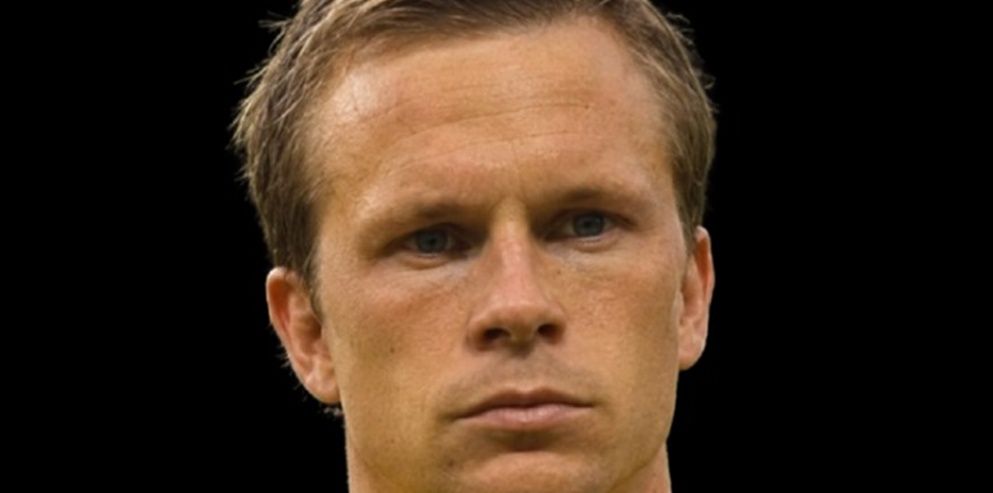
Tobias Jan Håkan Linderoth, born 21 April 1979, Marseille, France.
PART ONE
Some footballers are born into the game, and Tobias Linderoth was born into it more literally than most, arriving in Marseille on 21 April 1979 while his father Anders was playing for Olympique de Marseille. Anders went on to become a respected international and, later, a coach well thought of in Sweden, so Tobias grew up with a ready-made template for how to behave around a dressing room. He started out at Mjällby AIK’s youth set-up and learned the basics there, but the first line in his senior record is a modest one, seven games and no goals for IFK Hässleholm in 1995, and nobody watching a teenager in the lower reaches of Swedish football could have guessed that he would end up with 76 caps for his country.
The step up came in 1996, when IF Elfsborg took him on, and over the next three seasons he played 57 league games for the Borås club and scored four goals, a decent return for a lad whose job was to stop the other side playing rather than to do the playing himself. Sweden’s youth coaches had already noticed him, since he had turned out for the under-17s, the under-19s and, from 1998, the under-21s, and the scouts who followed those teams around Europe were not far behind. Norway’s Stabæk were the ones who moved, signing him in 1998, and he spent three years in the Tippeligaen, playing 68 league games and scoring nine times, which was a better strike rate than he would manage anywhere else. It was in Norway, too, that he broke into the Sweden senior side, and he was a regular by the time the national team qualified for the 2002 World Cup.
That qualification mattered, because it put him in the shop window at exactly the right moment. Everton had been watching, and on 31 January 2002 they paid Stabæk £2.5 million for him, which made him a Walter Smith signing, though only just, since Smith was sacked on 13 March of the same year with the club hovering a point above the relegation places. Linderoth made his debut as a substitute against Ipswich Town at Goodison on 2 February, and hopes were high, because Everton had been crying out for a proper midfield anchor since the days of Peter Reid and here, apparently, was a Swedish international with the engine and the discipline to fill the role. Smith had said as much when the deal was done, pointing to the 17 caps the midfielder already held and to the way he had performed for a Sweden side who were playing well.
The hope did not last. Linderoth shared one attribute with his father and it was the unhelpful one, a fierce susceptibility to injury, and it kept him out for most of his first eighteen months on Merseyside, long enough for David Moyes to arrive, settle in and start building a side without him. His full debut did not come until 10 February 2003, at home to Arsenal, which tells its own story about how long he had spent in the treatment room. He did score once for Everton, a League Cup goal against Charlton Athletic, and that was it, because his league return at Goodison was a blank, and anyone who had been counting on goals from the position was always going to be disappointed.
The 2003-04 season was the one that gave him his proper chance, and it was a dreadful one to be handed it in. Everton spent the campaign scrapping at the wrong end of the Premiership, finished one place above the drop zone with 39 points, and survived mainly because the three clubs beneath them were worse than anything the division had seen for years. Linderoth showed glimpses of composure and good positioning in the middle of the park, yet there was no adventure about his play and no sense that he might ever take a game by the scruff of the neck, so that for the most part he was hugely ineffective. He was, in short, a sound footballer in the wrong team at the wrong time, and the fans who had been promised a tough enforcer got a tidy, injury-prone passer instead.
Moyes made his mind up that summer. With a year left on the Swede’s contract, a £1 million offer arrived from FC Copenhagen, and the manager decided it was too good to turn down, using the money towards the signing of Tim Cahill, which proved to be about the best piece of business Everton did in that decade, so every cloud did have a silver lining, even if Linderoth himself was the cloud. His time at Everton ended with 40 league appearances in three seasons, no league goals, and a reputation as a player who never quite stayed fit long enough to be judged.
PART TWO
Denmark was where Tobias Linderoth´s body and his game finally came together. The suave playmaker joined Copenhagen in the summer of 2004 and played in the first team for three seasons, 82 league games and four goals, and he was handed the captain’s armband for a side that won the Danish title in 2005-06 and again in 2006-07, as well as the Royal League in 2004-05 and 2005-06. They also reached the group stage of the Champions League, which put him on a bigger stage than he had known at Goodison, and he was voted Swedish midfielder of the year in both 2006 and 2007, a clear sign that he was back to something like his best. Fit and trusted, Linderoth became the player Everton had thought they were buying, the one who won the ball, kept it simple and covered the ground for everyone else.
His Sweden form had never really dipped, even when his club form did, and the international record is probably the best case for his talent. He played in the 2002 World Cup, where Sweden came through a difficult group before going out to Senegal in the last 16, and in that tournament he ran around 15 kilometres in a game that lasted 96 minutes, which was nothing unusual for a man who treated the midfield as his own back garden. He went to Euro 2004, where Sweden lost a quarter-final to the Netherlands on penalties, then to the 2006 World Cup, where a 2-0 defeat by Germany in the last 16 ended their run. He was an assistant captain by then, which says a good deal about the way the dressing room saw him, and he added the second of his two international goals on 26 May 2008, the only goal of a 1-0 win over Slovenia in a friendly before Euro 2008. He played in that tournament as well, though Sweden did not get beyond the group stage.
By that point Linderoth had moved on from Copenhagen. On 12 June 2007 he agreed to a three-year deal with Galatasaray, who gave him the number 6 shirt, and in his first season in Istanbul the club won the Turkish league, with a Super Cup to follow in 2008. It should have been a happy final act, and in the sense of the medals it was, but the injuries came back with him, and he managed only 13 league games in the three seasons he was nominally on the books.
The end, when it came, was sudden. On 6 September 2008 Sweden were playing Albania in a qualifier for the 2010 World Cup in South Africa, and Linderoth had to come off injured in the sixth minute of the encounter, which turned out to be his last appearance for his country, 76 caps after he had started. Galatasaray released him early on 22 January 2010, a few months before his contract was due to run out, and on 12 November that year he announced that he was done as a player, although at 31 he was hardly old.
Tobias Linderoth did not stray far from football, and the family trade pulled him back. Linderoth worked with the youth teams at IF Elfsborg, the club where he had started out, and by most accounts he spent about a decade around that academy, before moving into management on 18 November 2020, when Skövde AIK appointed him. He stayed there until 2023, then took charge of Varbergs BoIS in 2024 and moved to Norrby IF at the start of 2025, a path that has taken him through the lower reaches of Swedish football in much the same way as his father went before him.