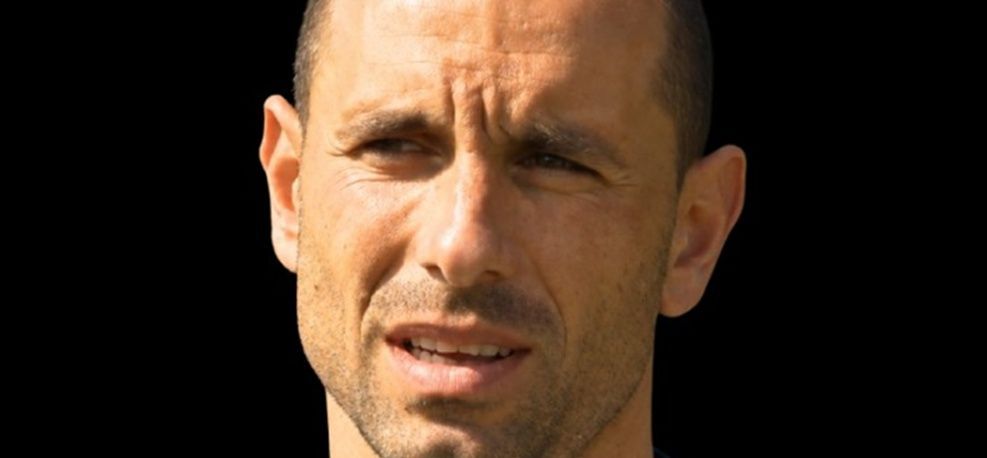
Martin Petyov Petrov, born 15 January 1979, Vratsa, Bulgaria.
PART ONE
Martin Petrov stated his footballing life at local club Botev Vratsa where he broke into the side during the 1995-96 campaign. After making 18 league appearances for the club, CSKA Sofia signed him in 1996 and the winger spent two seasons with the Armymen before Swiss side Servette bought him for 1.2 million German marks. Switzerland suited him, and Servette gave him what he needed most, a place in the team week after week while he learned how to play at a quicker tempo than he had known at home.
He scored regularly from the left flank, cutting in on his stronger foot and shooting early, and by the time he had been there a little while his name was being passed around by people who watched Bulgarian football for a living. It was during those Geneva years that the national side came calling, and the call, when it came in June 1999, could hardly have been more daunting, for Bulgaria were hosting England in a Euro 2000 qualifier in Sofia and Petrov was told to get ready to come off the bench. He ran out in the second half beside his idol Hristo Stoichkov, which is the sort of thing a youth from Vratsa might have dreamed about, but the dream turned sour almost at once, because he picked up a booking, then a second one, and was sent off inside a quarter of an hour of his arrival with the match finishing in a 1–1 draw.
Wolfsburg were the next to come knocking, and in the summer of 2001 he left Servette for the Bundesliga, where he quickly showed that the German game, with its pace and its physical edge, was not going to frighten him. His first competitive match for the club came on 14 July 2001 in the Intertoto Cup, an entertaining 4–3 home victory over Dinamo Minsk in which he scored a goal and set one up, and that is about as good an introduction as a new signing can hope for, so the supporters took to him straight away.
A fortnight later he made his Bundesliga debut on the opening day of the 2001-02 campaign, but the result went against Wolfsburg, who lost 2–1 away to Bayer Leverkusen on 28 July, and that was a reminder that the league would not be so generous. He settled all the same, finishing his first season with 32 league appearances, six goals and 11 assists, and those assists tell you as much about him as the goals do, because Petrov had the knack of beating his man on the outside, getting to the by-line and putting the ball where a striker could not miss it. He was explosive over the first ten yards, and full-backs who had been told to show him down the line found that he could go either way and still be past them before they had finished turning.
The next three campaigns at Wolfsburg were solid rather than spectacular, but 2004 was the year that really put Petrov on the front pages. In June he was the best of the Bulgarians at the European Championship in Portugal, a tournament that went badly for his country as a whole but not for him, because he played well in all three games and scored Bulgaria’s only goal at the finals, a penalty against Italy in a 2–1 defeat in a match that the Italians had to work very hard to win.
A few months later, on 30 October 2004, he went one better than anybody at Wolfsburg had any right to expect and netted all four goals in a high-scoring 4–3 triumph over Mainz, which is the sort of afternoon a wingman might wait his whole life for and one that the club’s supporters still bring up when his name is mentioned. The Mainz game set up the rest of the 2004-05 season, in which he notched up 30 outings, finished as the club’s top scorer with 12 goals and added 14 assists, and those numbers were so good that the bigger clubs could not keep pretending they had not noticed. By the end of his four years in Germany he had registered 28 goals in 116 Bundesliga appearances, and it was time to move on.
PART TWO
In the summer of 2005 Atlético Madrid paid €10 million to take Martin Petrov from Wolfsburg, and Antonio Muñoz, the club’s sporting director, said at the time that they were investing a lot of money in a player who had always maintained that he wanted to play at the Calderón. He made 49 league appearances for Atlético in two seasons and scored three goals, which was not the sort of return anybody had in mind when the cheque was written, but he did create scoring opportunities and he did give the side a different option on the left.
On 2 September 2006 Bulgaria opened their Euro 2008 qualifying campaign away to Romania in Constanta and found themselves 2–0 down by the 53rd minute, with the home crowd enjoying themselves and the visitors looking beaten, but Petrov scored in the 82nd minute and again in the 83rd, and two goals in two minutes dragged a lost game back to 2–2 in what the Romanian press called a nightmare result and the Bulgarian press called a miracle. Four days later, on 6 September, he scored again in a 3–0 win over Slovenia in Sofia, and on 7 October, in the same stadium, he put Bulgaria in front against the Netherlands with a low shot from a tight angle in the 12th minute, although Robin van Persie levelled in the 62nd minute and the game ended one-all.
Those three games, with four goals in the opening matches of the group, were the main reason he was named Bulgarian Footballer of the Year for 2006, an award he took ahead of Dimitar Berbatov and Stiliyan Petrov, which is not bad company to beat. The luck turned a week after the Dutch game, however, because on 14 October 2006 he suffered an anterior cruciate ligament injury against Recreativo de Huelva, the sort of knee damage that keeps a player out for more than six months and sometimes takes the edge off his pace for good.
Petrov got back on the pitch on 28 April 2007, playing 56 minutes of a 0–0 draw against Real Betis, and a week later, on 6 May, he scored Atlético’s only goal in a 2–1 defeat at Espanyol, so the touch was still there even if the legs needed time. But Atlético had moved on in his absence, and the summer was full of talk about his future. Then, on 26 July, Sven-Göran Eriksson’s Manchester City eventually signed him for £4.7 million, which was a good deal less than Atlético had paid two years earlier and made him look something of a bargain.
His first Premier League match was on 11 August 2007, when he started in Manchester City’s 2–0 triumph at West Ham’s Upton Park, and the new signing was soon doing what he had always done, scoring his first goal for the club against Fulham on 22 September 2007. Petrov followed it with a goal in a 3–1 win over Newcastle United and another in a 2–1 victory against Reading, and he made six assists besides, though the campaign was not all sweetness, since Rob Styles sent him off for kicking Leon Osman in a home loss to Everton and the straight red card cost him three games. He bounced back with a goal against Portsmouth, and his first season in England ended with 34 league outings and five goals according to the record books, so on the whole he had done more than enough to prove that his knee was sound and his appetite for the Premiership undimmed.
The trouble for Petrov was that Manchester City were changing faster than he could keep up with, because the club’s new owners wanted stars, and the signings of Carlos Tevez and Emmanuel Adebayor under Mark Hughes meant that a flanker who was good but not a headline name found himself in and out of the team, often without being told why. He was linked with moves away from the City of Manchester Stadium, and when he did get a game he usually did well, finding the back of the net in the first two matches that he started and earning a place ahead of Shaun Wright-Phillips for a home encounter with Fulham, where he scored again but aggravated the knee injury that had troubled him for a long time.
PART THREE
Roberto Mancini eventually replaced Mark Hughes as Manchester City manager midway through the 2009-10 campaign and Martin Petrov started both of the first two league games under him, scoring in the 2–0 trioumph against Stoke City on 26 December, but the knee gave out again, and on 18 April 2010 he announced that his season was over and that he would miss the last four Premier League matches. On 8 June 2010, Manchester City confirmed that his contract had run out and that he would leave, along with Benjani Mwaruwari, Karl Moore and Sylvinho, and he walked out with 59 league appearances and nine goals to his name.
He did not have to wait long for a new club, for Bolton Wanderers announced on 22 June 2010 that he had agreed terms and the free transfer was completed when the window opened on 1 July. Bolton gave him what City had stopped giving him, which was regular football, and he gave them the width and the end product that their attack needed. Before his first Bolton goal there was an international break, on 7 September 2010, when he earned a Euro 2012 qualifier cap in a 1–0 home defeat against Montenegro in Sofia, a game that did not go the way that Bulgaria had hoped.
Then on 26 September 2010 he scored his first goal for his new club against Manchester United. A corner from Petrov supplied Zat Knight for the opening goal and, after Luis Nani had equalised, the Bulgarian put Bolton ahead again with a shot that took a deflection on its way past Edwin van der Sar. Michael Owen’s headed equaliser left the match at 2–2, but Petrov had contributed directly to both Bolton goals against opponents who expected to challenge for the title, making the afternoon a useful demonstration of what he still offered when he was given the ball in positions from which he could hurt a defence. Petrov finished his first league campaign with Bolton on three goals, and although the season brought its share of difficult afternoons, the move had restored regular involvement and allowed him to play an identifiable part in the team’s attacking work.
His second campaign at Bolton brought six goals, four in the league, one in the League Cup and one in the FA Cup, but the team went down, and relegation from the Premier League in 2012 was a bitter end to a season in which he had played 35 matches, five more than the 30 he needed to trigger a clause in his contract that extended it for another year. Nothing, however, was going to keep him in the north-west for much longer, and on 14 January 2013 he signed for the Spanish club Espanyol for the rest of the 2012-13 season. It did not work out, because he struggled to break into the first team, and when the season was over he left.
After 15 years abroad it was time to go home, and in October 2013 he re-joined CSKA Sofia, the club that had given him his start in the first place. On 31 October 2013 he made his return debut for the club as a second-half substitute in a 1–0 home win over Beroe in an A Group match, and on 16 November he played for the first time as a starter in a 0–0 draw with Levski Sofia in a Bulgarian Cup game, His first goal came on 25 November in a 3–1 away win over Neftochimic Burgas, and the supporters had every reason to think that the old magic had not entirely gone. He played his last game as a professional on 17 May 2014, a 1–1 draw against Lokomotiv Plovdiv on the ultimate day of the 2013-14 A Group season, his final tally standing at 436 club appearances and 87 hits.